Archive for the ‘TRIZ’ Category
Map The Territory Before Improving It
 August 26th, 2026
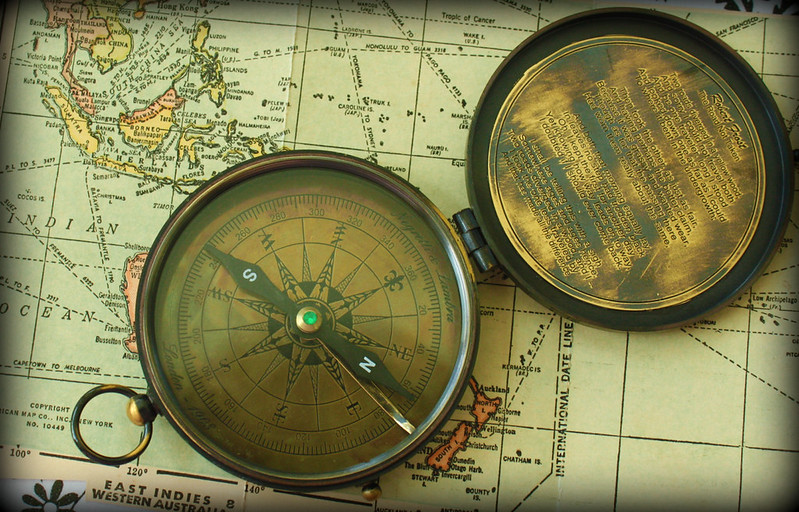 I had the best teachers. They taught me to assess the situation as it is before trying to improve it. Early in my career, my leaders did not understand the importance of spending the time to define the current state. Hurry up and fix it! Why are you spending time analyzing the existing product? Why do you want to create a functional analysis of the product we want to obsolete? Why do you want to understand why customers purchased our legacy products?
By assessing the system/products as they are, I learned how to identify the elements to reuse, to improve, and to reinvent. This has been a great way to focus the resources on the most important elements and increase the intensity the allocated resources. When you don’t spend time on the 50% of the system that can be reused, you double the resource intensity over a complete redesign.
So, I ask you – how do you decide what can be reused, what must be improved, and what must be reinvented?
Regardless of the system’s size or scope of the project, assessing the current state is the right first step. For example, there is great interest in improving the business model. First question (that no one can answer) – What is our business model? There are tools to define business models visually to show the partners, competitors, customers, data flow, money flow, product flow. The tools show who does what to whom and how, who helps whom and how, and what’s missing. One of the tools I like is Wardley Maps. While Simon (Wardley) doesn’t talk much about mapping business models, I’ve misused his maps for business model mapping.
A rule for business models: If you can’t describe your business model visually on one page, you don’t know what your business model is and you can’t improve it.
And assessing the current state is effective at the leaf-level (the lowest level). Mapping the system functionally (functional decomposition with Axiomatic Design) and defining a problem rigorously (TRIZ), allows the team to place the problem in the context of the whole system AND to define the problem at the smallest level possible (think telescope to microscope).
A rule for problems – There’s nothing worse than solving the wrong problem, so you better be sure you’re solving the right one.
A long time ago, I led a project that took the time to assess the baseline product (existing product) for cost, part count, and part type. Using DFMA, ee knew where the parts were, and we designed them out and we knew where the cost was and we designed it out. It took a “long time” to do that work, but we radically improved the profitability of the new product (7X improvement in profit per square foot of the factory). We also did a full functional decomposition on the baseline product and learn that there was one subsystem that caused trouble with all the electronic systems and created problems for customers. We hardened the design against that subsystem’s devilish energy. And we created robustness tests where we tested the baseline product and demonstrated improved robustness on the new product. (We used TRIZ to solve the right problems.) Those efforts reduced warranty cost per unit by 4X.
Rigorously assessing the current state (products, processes, systems, business models) seems too slow and a big waste of time. It is my experience, though, that it’s faster and improves the outcomes of the new product development and improvement projects.
But don’t take my word for it. Give it a try. And if you need some help, let me know.
Image credit – Calsidyrose
 Posted in Business Model, Cost Savings, DFMA, Downstream Savings, Fundementals, How To, Manufacturing Competitiveness, Product Development, Product Robustness, Seeing Things As They Are, TRIZ |
  Tags: Design for Assembly, DFMA Culture, Manufacturing Competitveness, Part Count, Problem Definition, Product Development Engine |
  No Comments »
Battle China With New Thinking
June 3rd, 2026
 China, as a country, is eating important industries. Here’s the process. They choose an industry that they want to eat; they coordinate their massive network of world-class suppliers and OEMs and let them compete against each other; they create unmatched manufacturing scale; they innovate faster than imaginable; they design and commercialize products that work well and are priced far less than the competition; they sell those killer products to customers in other countries. They start in the east and move west country-by-country and displace in-country manufacturers one-by-one.
The best example is the Electric Vehicle (EV) industry. Their cars look great, perform well, have new and interesting features, and cost far less. In Europe, the Chinese EVs are displacing the cars made by European manufacturers. And the same thing is happening in other countries.
If China decides it wants to eat your industry, you’ll lose if you try to compete head-to-head with them. You cannot out-scale them, and you can’t outlast them. Simply put, you cannot beat them at their game. And that’s why it’s time to play a different game.
Here are some new ways to think that may help you win a different game.
Less With Far Less – Turn more with less on its head. Instead of bigger for the same price, think smaller for a far lower price. Instead of more performance, think less performance for a far lower price. Instead of more range, think less range with a radically lower price. I don’t know what will come of it, but you will be working in new design space. Other companies will not compete with you because they’ll think you’re nuts for working in that space. It could give you time to get out in front and create a new market or industry.
Partnership Of Rivals – Turn the company with the rival technology into a partner. Ask them to co-create a hybrid product that brings together the best of your technology and theirs. Because you’re rivals, your partnership will be unimaginable, and no one will see it coming. I don’t know what’s possible when you combine forces with your rival, but neither do you. However, I know the design is uninvestigated, and you have an opportunity to create a new product category.
Obsolete Your Best Work – Create the conditions for your teams to purposefully and vigorously obsolete your best product. Incentivize them to create something that will make your customers throw away your best product and buy two of the new ones. This will accelerate innovation and open up new design space. I don’t know what your team will come up with, and neither do you. But it will be exciting and different. And no one will expect you to obsolete your best work, so you’ll catch them off guard when you reinvent your industry.
Learn What Your Company Already Knows – Your teams have demonstrated technologies in the lab that would radically slash the cost signature of your product, but you don’t know about them. You have prototypes that would create new industries, but you don’t know about them. You have people in your company who have solved intractable problems that would underpin a new generation of products, but you don’t know about them. You have unimaginable gems that your teams have created from things that don’t belong together, but you don’t know about them. And because these crazy prototypes defy logic, you have the opportunity to create a new category in a compete-with-no-one way.
If you battle China with traditional thinking, I think you’ll lose. If you employ new thinking, you could live to fight another day.
Image credit – pete beard
Posted in Culture, How To, Innovation, Intellectual Intertia, Level 5 Courage, Top Line Growth, TRIZ |
Tags: Manufacturing Competitveness |
No Comments »
How To Help Greatness Emerge
July 30th, 2025
 Give me fewer people than I need. That will force me to come up with a better way.
Tell me what to do, but not how to do it. If you know how to do it, I’m not your person.
Give me far less time than I need – months not years, weeks not months, days not weeks. I will have no choice but to focus on the most important elements, and I will make decisions quickly because there is no time for indecision. And I will have fun.
Tell me you don’t know. That builds trust.
Give me bad tools, slow computers, and crappy infrastructure. That will require me to make magic.
Tell me the truth. That builds trust, too.
Give me a challenging task and tell me what I can’t do. That will allow me to do anything else.
Tell me why you want the problem solved and get out of the way. Everything will go better that way.
Give me a micro problem – move one atom, spin off one electron, make one photon, deliver one amp, limit me to one volt, give me a single gram. I won’t be intimidated, and I will be able to see the physics. Then, once solved, I will expand the solution to a size that fits our customers.
Tell me you need help, and I will help you.
Image credit — JD Hancock (Bizarro Superman)
Posted in Constraints, Fear, Level 5 Courage, Problems, TRIZ, Uncertainty |
Tags: Problem Definition, Trust-based approach |
No Comments »
How To Put The Business Universe On One Page
July 9th, 2025
 When I want to understand a large system, I make a map. If the system is an ecosystem, I combine Wardley Maps by Simon Wardley with Wide Lens / Winning The Right Game by Ron Adner. On Wardley maps, activities and actors are placed on the map, and related elements are connected. On the left are infant and underdeveloped elements, and on the right are fully developed / commodity elements. It’s like an S-curve that’s been squished flat.
Wide Lens prompts you to consider co-innovation (who needs to innovate for you to be successful) and adoption (who needs to believe your idea is a good one). Winning The Right Game makes you think through the sequence of attracting partners like a visual time-lapse of the ecosystem’s evolution. This is a killer combination that demands you put the whole system on one page – all the players/partners, all the activities sorted by maturity, all the interactions, and the evolution of the partner network and maturity of the system elements. This forces a common understanding of the ecosystem. There’s no way out. Did I say it must fit on one page?
When the large system is a technological system, I make a map. I use the best TRIZ book (Innovation On Demand) by Victor Fey. A functional analysis is performed on the system using noun-verb pairs that are strung together to represent how the system behaves. If you want to drive people crazy, this is the process for you. It requires precise words for each noun (element) and verb (action) pair, and the pairs must hang together in a way that represents the physical system. There can be only one description of the system, and the fun and games don’t stop until the team converges on a single representation of the system. It’s all good fun until someone loses an eye.
When I want to understand a business/technology/product/service offering that has not been done before (think startup), I use Lean Canvas by Ash Maurya. The Lean Canvas requires you to think through all elements of the system and forces you to put it on one page. (Do you see a theme here?) Value proposition, existing alternatives, channel to market, customer segments, metrics, revenue, costs, problems, and solutions – all of them on one page.
And then to blow people’s minds, I combine Wardley Maps, Wide Lens, Winning The Right Game, functional analysis of TRIZ, value in action, and Lean Canvas on one page. And this is what it looks like.
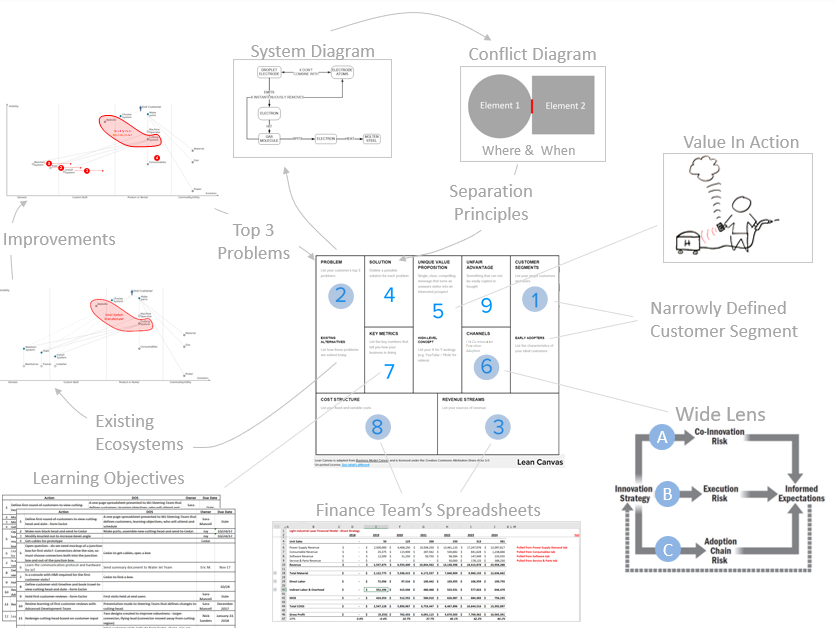
Ash’s Lean Canvas is the backplane. Ron’s Wide Lens supports 6 (Channel), forcing a broader look than a traditional channel view. Ron’s Winning The Right Game and Simon’s Wardley Map are smashed together to support 2 (Existing Alternatives/Problems). A map is created for the existing system with system elements (infants on the left, retirees on the right) and partners/players, which are signified by color (red blob). Then, a second map is created to define the improvements to be made (red circles with arrows toward a more mature state). Victor’s Functional Analysis/System diagram defines the problematic system, and TRIZ tools, e.g., Separation Principles, are used to solve the problem.
When I want to understand a system (ecosystem or technological system), I make a map. And when I want to make a good map, I put it on one page. And when I want to create a new technological system that’s nested in a new business model that’s nested in a new ecosystem, I force myself to put the whole universe on one page.
Image credit – Giuseppe Zeta
Measureable or magical?
August 21st, 2024
 We all have to-do lists. We add things and we check them off. This list grows and shrinks. We judge ourselves negatively when we check off fewer than expected and positively when we check off more than that. But what’s the right number of completed tasks for us to feel good? How many completed tasks is enough?
If you complete one task per week that saves $5000, is that enough? Is it enough to complete fifty tasks per year? If you create the conditions that make possible a new product line that delivers $1B over three years, but you do that only once every five years, is that enough? Is it enough to do just that one right thing over five years? What does it look like to others when you complete one exceptionally meaningful task every five years? I think it looks like most of the time you are doing very little.
Sometimes you complete small things and sometimes you don’t. And sometimes you learn what doesn’t work and that’s the completed task. And sometimes there are long stretches where nothing is accomplished until you create something magical. Counting tasks is no way to go through life.
But counting and measuring is all the rage. Look at your yearly goals. Do ten of these. Run six of those. Complete twelve of the other. Why do we think we can predict what we should do next year? Even sillier, do we really believe we know how many of these, those, and the others we will be able to get done next year? C’mon. Really?
What if all this counting prevents us from imagining the future? And what if our unhealthy fascination with measuring blocks us from creating it?
If it’s all about the measurable, there’s no room for the Magical.
Why not make some room for the Magical?
Image credit — Philip McErlean
Posted in Authentic, Imagination, Top Line Growth, TRIZ |
Tags: Competitiveness, meaning |
No Comments »
The Difficulty of Goal Setting in Domains of High Uncertainty
February 22nd, 2023
 When you work in domains of high uncertainty, creating goals for the next year is exceptionally difficult.
When you try to do something that hasn’t been done before, things may blow up instantly, things may work out after two years of hard work, or things may never work. So, how do you create the goal for that work? Do you give yourself one month to complete the work? And things haven’t worked out at the end of the month, do you stop the work or do you keep going? If it blows up instantly, but you think you know why, do you keep going? Do you extend the due date for the goal? At the start of the work, should the timeline have been set to one year instead of one month? And who decides that? And how do they decide?
When you have to create your goals for something that hasn’t been done before and the objectives of the work are defined by another team, yet that team hasn’t done the prework and cannot provide those objectives, what do you do? Do you create a goal for the other team to define the objectives? And what if you have no control over that team’s priorities and you don’t know when (or if) they’ll provide the needed information? What does a goal look like when you don’t know the objectives of the work nor do you know when (or if) you’ll get that information. Can you even create a goal for the work when you don’t know what that work is? And how do you estimate a completion date or the resource requirements (both the flavor and quantity) when you don’t know the objectives? What does that goal look like?
When you have to create your goals for a team of ten specialized people who each have unique skills, but you don’t know the objectives of the work, when that work can start, or when that work will finish, how do you cascade the team’s goals to each team members? What do their goals look like? Is the first goal to figure out the goal? How many goals does it take to fill up their year when you don’t know what the work is or how long it will take?
When working in domains of high uncertainty, the goals go like this: define the system as it is, define something you want to improve, try to improve it, and then do the next right thing. Unfortunately, that doesn’t fit well with the traditional process of setting yearly goals.
And your two questions should be: How do you decide what to improve? and How do you choose the next right thing?
Image credit — Rab Lawrence
Posted in Seeing Things As They Are, Technology, The Future, TRIZ, Trust |
Tags: less-with-far-less, no-to-yes, Understanding Physics |
No Comments »
Radical Cost Reduction and Reinvented Supply Chains
October 26th, 2022
 As geopolitical pressures rise, some countries that supply the parts that make up your products may become nonviable. What if there was a way to reinvent the supply chain and move it to more stable regions? And what if there was a way to guard against the use of child labor in the parts that make up your product? And what if there was a way to shorten your supply chain so it could respond faster? And what if there was a way to eliminate environmentally irresponsible materials from your supply chain?
Our supply chains source parts from countries that are less than stable because the cost of the parts made in those countries is low. And child labor can creep into our supply chains because the cost of the parts made with child labor is low. And our supply chains are long because the countries that make parts with the lowest costs are far away. And our supply chains use environmentally irresponsible materials because those materials reduce the cost of the parts.
The thing with the supply chains is that the parts themselves govern the manufacturing processes and materials that can be used, they dictate the factories that can be used and they define the cost. Moving the same old parts to other regions of the world will do little more than increase the price of the parts. If we want to radically reduce cost and reinvent the supply chain, we’ve got to reinvent the parts.
There are methods that can achieve radical cost reduction and reinvent the supply chain, but they are little known. The heart of one such method is a functional model that fully describes all functional elements of the system and how they interact. After the model is complete, there is a straightforward, understandable, agreed-upon definition of how the product functions which the team uses to focus the go-forward design work. And to help them further, the method provides guidelines and suggestions to prioritize the work.
I think radical cost reduction and more robust supply chains are essential to a company’s future. And I am confident in the ability of the methods to deliver solid results. But what I don’t know is: Is the need for radical cost reduction strong enough to cause companies to adopt these methods?
“Zen” by g0upil is licensed under CC BY-SA 2.0.
The first step is to understand the system as it is.
August 10th, 2022
 If there’s a recurring problem, take the time to make sure the system hasn’t changed since last time and make sure the context and environment are still the same. If everything is the same, and there are no people involved in the system, it’s a problem that resides in the clear domain. Here’s a link from Dave Snowden who talks about the various domains. In this video, Dave calls this domain the “simple” domain. Solve it like you did last time.
If there’s a new problem, take the time to understand the elements of the system that surround the problem. Define the elements and define how they interact, and define how they set the context and constraints for the problem. And then, define the problem itself. Define when it happens, what happens just before, and what happens after. If there are no people involved, if the solution is not immediately evident, if it’s a purely mechanical, electromechanical, chemical, thermal, software, or hardware, it’s a problem in the complicated domain (see Dave’s video above) and you’ll be able to solve it with the right experts and enough time.
If you want to know the next evolution of the system, how it will develop and evolve, the situation is more speculative and there’s no singular answer. Still, the first step is the same – take the time to understand the elements of the system and how they interact. Then, look back in time and learn the previous embodiments of the system and define its trajectory – how it evolved into its current state. If there has been consistent improvement along a singular line of goodness, it’s likely the system will want to continue to evolve in that direction. If the improvement has flattened, it’s likely the system will try to evolve along a different line of evolution.
I won’t go into the specifics of lines of evolution of technological systems, as it’s a big topic. But if you want to know more, here’s a nice description of evolution along the line of adaptability by my teacher, Victor Fey – The best products know how to adapt.
If there are people involved with the system, it’s a complex system (see Dave’s video). (There are complex systems that don’t involve people, but I find this a good way to talk about complex systems.) The first step is to define the system as it is, but because the interactions among the elements are not predictable, your only hope is to probe, sense, and respond by doing more of what works and less of what doesn’t. Thanks to Dave Snowden for that language.
The first step is always to understand the system as it is.
“Space – Antennae Galaxies” by Trodel is licensed under CC BY-SA 2.0.
Posted in Fundementals, Innovation, Seeing Things As They Are, Top Line Growth, TRIZ |
Tags: Understanding Physics |
No Comments »
Free Resources
June 29th, 2022
 Since resources are expensive, it can be helpful to see the environment around your product as a source of inexpensive resources that can be modified to perform useful functions. Here are some examples.
Gravity is a force you can use to do your bidding. Since gravity is always oriented toward the center of the earth, if you change the orientation of an object, you change the direction gravity exerts itself relative to the object. If you flip the object upside down, gravity will push instead of pull.
And it’s the same for buoyancy but in reverse. If you submerge an object of interest in water and add air (bubbles) from below, the bubbles will rise and push in areas where the bubbles collect. If you flip over the object, the bubbles will collect in different areas and push in the opposite direction relative to the object.
And if you have water and bubbles, you have a delivery system. Add a special substance to the air which will collect at the interface between the water and air and the bubbles will deliver it northward.
If you have motion, you also have wind resistance or drag force (but not in deep space). To create more force, increase speed or increase the area that interacts with the moving air. To change the direction of the force relative to the object, change the orientation of the object relative to the direction of motion.
If you have water, you can also have ice. If you need a solid substance look to the water. Flow water over the surface of interest and pull out heat (cool) where you want the ice to form. With this method, you can create a protective coating that can regrow as it gets worn off.
If you have water, you can make ice to create force. Drill a blind hole in a piece of a brittle material (granite), fill the hole with water, and freeze the water by cooling the granite (or leave it outside in the winter). When the water freezes it will expand, push on the granite and break it.
These are some contrived examples, but I hope they help you see a whole new set of free resources you can use to make your magic.
Thank you, VF.
Image credit – audi_insperation
Posted in Clarity, Fundementals, Intellectual Intertia, Seeing Things As They Are, TRIZ |
Tags: Creativity, Engineering Mindset, Understanding Physics |
No Comments »
How To Solve Transparent Problems
June 8th, 2022
 One of the best problems to solve for your customers is the problem they don’t know they have. If you can pull it off, you will create an entirely new value proposition for them and enable them to do things they cannot do today. But the problem is they can’t ask you to solve it because they don’t know they have it.
To identify problems customs can’t see, you’ve got to watch them go about their business. You’ve got to watch all aspects of their work and understand what they do and why they do it that way. And it’s their why that helps you find the transparent problems. When they tell you their why, they tell you the things they think cannot change and the things they consider fundamental constraints. Their whys tell you what they think is unchangeable. And from their perspective, they’re right. These things are unchangeable because they don’t know what’s possible with new technologies.
Once you know their unchangeable constraints, choose one to work on and turn it into a tight problem statement. Then use your best tools and methods to solve it. Once solved, you’ve got to make a functional prototype and show them in person. Without going back to them with a demonstration of a functional prototype, they won’t believe you. Remember, you did something they didn’t think was possible and changed the unchangeable.
When demonstrating the prototype to the customer, just show it in action. Don’t describe it, just show them and let them ask questions. Listen to their questions so you can see the prototype through their eyes. And to avoid leading the witness, limit yourself to questions that help you understand why they see the prototype as they do. The way they see the prototype will be different than your expectations, and that difference is called learning. And if you find yourself disagreeing with them, you’re doing it wrong.
This first prototype won’t hit the mark exactly, but it will impress the customer and it will build trust with them. And because they watched the prototype in action, they will be able to tell you how to improve it. Or better yet, with their newfound understanding of what’s possible, they might be able to see a more meaningful transparent problem that, once solved, could revolutionize their industry.
Customers know their work and you know what’s possible. And prototypes are a great way to create the future together.
“Transparent” by Rene Mensen is licensed under CC BY 2.0.
Posted in Assumptions, Clarity, How To, Imagination, Innovation, Problems, Technology, TRIZ |
Tags: Learning, Trust-based approach |
No Comments »
What do you like to do?
January 5th, 2022
 I like to help people turn complex situations into several important learning objectives.
I like to help people turn important learning objectives into tight project plans.
I like to help people distill project plans into a single-page spreadsheet of who does what and when.
I like to help people start with problem definition.
I like to help people stick with problem definition until the problems solve themselves.
I like to help people structure tight project plans based on resource constraints.
I like to help people create objective measures of success to monitor the projects as they go.
I like to help people believe they can do the almost impossible.
I like to help people stand three inches taller after they pull off the unimaginable.
I like to help people stop good projects so they can start amazing ones.
If you want to do more of what you like and less of what you don’t, stop a bad project to start a good one.
So, what do you like to do?
Image credit — merec0
Posted in Authentic, Fundementals, How To, Innovation, Top Line Growth, TRIZ |
Tags: Competitiveness, no-to-yes, Success |
No Comments »
 Mike Shipulski