Archive for the ‘How To’ Category
Workshop On Designing Out Product Cost
 October 21st, 2026
This one isn’t a blog post!
After more than sixteen years of blog posts, I’ll host my first live workshop on October 29 at 11:00 am Eastern Time! This marks a new phase for me, and I’m super excited!
In the workshop, I’ll share the tools and approaches for Designing Out Product Cost that I’ve developed over the last 25+ years. Using the methods, I increased profit per square foot by 7X and reduced warranty cost per unit by 4X (see results below), which earned a cover story in IE Magazine. And my results have been published in Design News, ASSEMBLY Magazine, Digital Engineering, IE Magazine, ASME, and I’ve presented them at GE Research and Development, MIT, WPI, and Tuck.
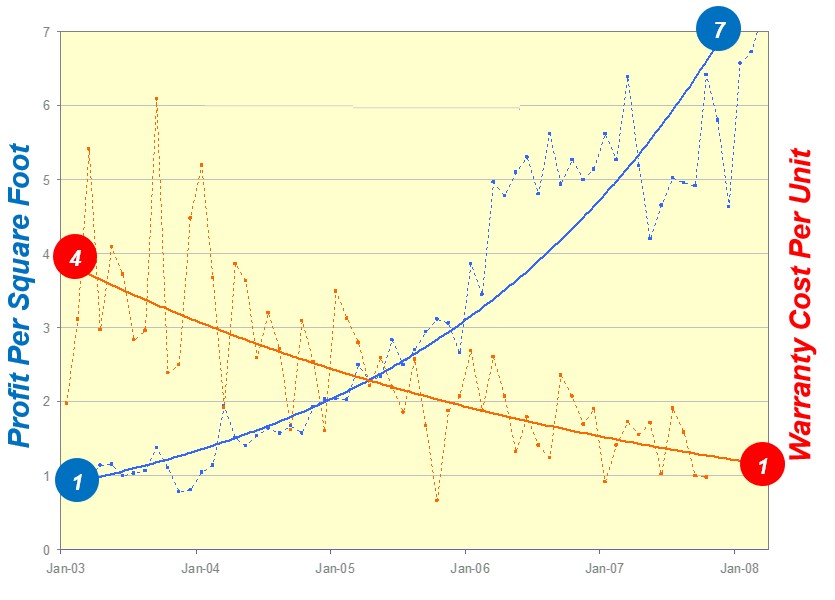
In the workshop, you’ll see real before-and-after examples which will give you a feel for what’s possible; you’ll see real data on part count and cost; you’ll learn how to use data to create a design approach; and you’ll learn the ins and outs of a successful implementation.
And for the first 15 people to register, I am offering a complimentary strategy session after the workshop. To book your 30-minute strategy session, a link will be provided in the registration confirmation email.
Workshop Details
- Topic: Designing Out Product Cost
- Date: 10/29/26 at 11 AM EST
- Price: $100.00
 Posted in A/B Data, DFA, DFMA, Fundementals, How To |
  Tags: Design for Assembly, Engineering Mindset, Product Design, Product Development Engine |
  No Comments »
Two Ways To Look At It
September 9th, 2026
 See something TO say something.
Say something TO do something.
Gotta get it right TO gotta give it a try.
Progress BEFORE perfection.
I failed TO I learned.
Can’t be done TO here’s how.
It might not work TO I’ll do it anyway.
Progress AT THE EXPENSE OF perfection.
Me TO we.
My way or the highway TO what do you think?
Why BEFORE what.
This will be difficult AND we’ll do it together.
Them TO us.
Condemnation TO best intention.
Don’t do that TO why not try this?
This is what I expect BEFORE this is not good.
You messed up TO how can I help?
What BEFORE how.
Do this TO what should we do?
Finish BEFORE starting.
Quiet criticism TO public praise.
Image credit — Fraser Mummery
Posted in Authentic, Clarity, How To, Seeing Things As They Are, Trust |
Tags: Words |
No Comments »
Map The Territory Before Improving It
August 26th, 2026
 I had the best teachers. They taught me to assess the situation as it is before trying to improve it. Early in my career, my leaders did not understand the importance of spending the time to define the current state. Hurry up and fix it! Why are you spending time analyzing the existing product? Why do you want to create a functional analysis of the product we want to obsolete? Why do you want to understand why customers purchased our legacy products?
By assessing the system/products as they are, I learned how to identify the elements to reuse, to improve, and to reinvent. This has been a great way to focus the resources on the most important elements and increase the intensity the allocated resources. When you don’t spend time on the 50% of the system that can be reused, you double the resource intensity over a complete redesign.
So, I ask you – how do you decide what can be reused, what must be improved, and what must be reinvented?
Regardless of the system’s size or scope of the project, assessing the current state is the right first step. For example, there is great interest in improving the business model. First question (that no one can answer) – What is our business model? There are tools to define business models visually to show the partners, competitors, customers, data flow, money flow, product flow. The tools show who does what to whom and how, who helps whom and how, and what’s missing. One of the tools I like is Wardley Maps. While Simon (Wardley) doesn’t talk much about mapping business models, I’ve misused his maps for business model mapping.
A rule for business models: If you can’t describe your business model visually on one page, you don’t know what your business model is and you can’t improve it.
And assessing the current state is effective at the leaf-level (the lowest level). Mapping the system functionally (functional decomposition with Axiomatic Design) and defining a problem rigorously (TRIZ), allows the team to place the problem in the context of the whole system AND to define the problem at the smallest level possible (think telescope to microscope).
A rule for problems – There’s nothing worse than solving the wrong problem, so you better be sure you’re solving the right one.
A long time ago, I led a project that took the time to assess the baseline product (existing product) for cost, part count, and part type. Using DFMA, ee knew where the parts were, and we designed them out and we knew where the cost was and we designed it out. It took a “long time” to do that work, but we radically improved the profitability of the new product (7X improvement in profit per square foot of the factory). We also did a full functional decomposition on the baseline product and learn that there was one subsystem that caused trouble with all the electronic systems and created problems for customers. We hardened the design against that subsystem’s devilish energy. And we created robustness tests where we tested the baseline product and demonstrated improved robustness on the new product. (We used TRIZ to solve the right problems.) Those efforts reduced warranty cost per unit by 4X.
Rigorously assessing the current state (products, processes, systems, business models) seems too slow and a big waste of time. It is my experience, though, that it’s faster and improves the outcomes of the new product development and improvement projects.
But don’t take my word for it. Give it a try. And if you need some help, let me know.
Image credit – Calsidyrose
Posted in Business Model, Cost Savings, DFMA, Downstream Savings, Fundementals, How To, Manufacturing Competitiveness, Product Development, Product Robustness, Seeing Things As They Are, TRIZ |
Tags: Design for Assembly, DFMA Culture, Manufacturing Competitveness, Part Count, Problem Definition, Product Development Engine |
No Comments »
Hearing, Talking, and Listening
August 19th, 2026
 Hearing is not listening.
You can hear and choose not to listen.
But if you don’t hear, you can’t listen.
Listening is an active process.
Listening requires energy.
Listening is a choice.
Talking and listening are partners.
Talking appreciates listening and listening appreciates talking.
Talking before listening gets the conversation going.
Continued talking without listening isn’t a conversation.
Skillful talking is informed by listening.
Measure twice and cut once, and it’s the same for listening and talking.
When you talk, you can only hear yourself. Don’t you already know what you know?
Well-timed talking starts after well-timed listening.
Talk less, and you’ll listen more.
And listening helps you say more while you talk less.
Image credit — David Salafia
Designing your new product starts by understanding your existing one.
July 29th, 2026
 Everything starts from what’s been done before. Designing a new product starts with assessing the subassemblies of your existing product. Here’s how the assessments go for the subassemblies.
First, make two Pareto charts: cost by subassembly and part count by subassembly. Prioritize the subassemblies on the left of both charts.
If the functionality is sufficient and the cost is right, reuse it as-is. This allows you to spend your time and energy elsewhere.
If the cost is right but the functionality needs to be adjusted, adjust it and move on. The technical risk is low, and the cost will still be right. Spend your energy where the problems are.
If functionality is good and the cost is high, simplify the product using part count reduction. Create a bench test to verify functionality and robustness are better than the old one.
If the functionality is insufficient and the cost is too high, spend your energy here. Create a bench test to quantify the performance of the existing subassembly. Turn up the dials to increase the stress on the subassembly until it breaks. Fix the part that breaks. Repeat until you run out of time. Create two Pareto charts for the subassembly: cost by part and part count by part type (main part, fastener, connector, protection, label). Design out the highest cost parts and redesign the highest cost parts that remain. Design out fasteners, connectors, protection parts, and labels.
Create a functional test for the product as a whole (think miles per gallon for a new car) and test the old one until it breaks. Build the new product with the new subassemblies and test it until it breaks. The performance must be better, and it must perform under stress longer than the baseline product. Break the new product, fix the weakest link, and retest. Do this until you run out of time and launch it.
This is The Way.
Image credit — George Redgrave
Posted in Clarity, Cost Savings, DFA, DFMA, Floor Space, Fundementals, How To, Manufacturing Competitiveness, Part Count Reduction, Product Development, Product Robustness, Risk, Seeing Things As They Are, Seven Wastes, Top Line Growth |
Tags: Design for Assembly, DFA, DFMA Culture, Downstream Savings, Engage Design; Product Design; Cost Savings, Manufacturing Competitveness, Product Design, Understanding Physics |
No Comments »
Elevating the performance of engineering teams is the most rewarding work for me.
July 15th, 2026
 I’ve built engineering teams that developed the world’s most successful products in their space.
At the start of the team’s migration to greatness, they don’t believe in themselves. And that’s why you, as their leader, have to believe in them. Every day, you must tell them why you believe in them. Every day, you must give them examples of their behaviors that justify your belief in them. At the start of the journey, they don’t know how to do their work differently. And that’s why you, as their leader, must show them how. You can’t simply tell them how to do the new work because they won’t believe you. And that’s why you must show them. There are no half measures here. You’ve got to be all in.
As their leader, you must set exceptionally challenging goals. They cannot be impossible goals, but they can be almost impossible. And when the team pushes back on your almost impossible request, you must explain HOW you will help them do the almost impossible.
None of this is free. You must create the tools, training, and time for the exceptional performance to emerge. You must give them the new tools, the training, and you must give them the time to learn the tools and use them appropriately.
Pro Tip: If you don’t give the team the tools, training, and time to use them, you’ll get what you got last time.
At the earliest sign of the new behaviors, you must praise them publicly. “This is what I’m talking about! This is great! I like how you used the new tools. Thank you.” Tell everyone what they did. Tell their spouse or partner. Tell their kids. Be proud.
And as the new behaviors build on each other (and they will), continue to show them your happiness. Turn up your excitement for their remarkable work. Tell them what they did because they won’t know. Tell them why it was so good. And push them for more. Tell them you know they can do more. And now they’ll believe you because they’ve seen what’s possible. And they’ll believe in themselves. And once they believe in themselves, it’s off to the races.
The products will work better, will sell more, will cost less, and won’t break. They will be easy to build, easy to test, and easy to troubleshoot. And they will be profitable as hell. But that’s not the real value. The real value is that you helped build a team that believes they can do it better next time.
I have helped engineering teams do work they could not imagine. I have helped technicians elevate their performance and outperform engineers. I have helped Ph.Ds. learn from customers. And I have helped engineers grow into Principal Engineers, Engineering Directors, GMs, and CEOs.
This has been the most rewarding work of my life.
Image credit — Mikhail Esteves – Piggy Back
Posted in Authentic, Fundementals, How To, Leadership, Seeing Things As They Are, Trust |
Tags: Engineering Mindset, Product Development Engine, Trust-based approach |
2 Comments »
Is it time for a new course heading?
July 8th, 2026
 I’m tired of hearing about North Stars and Idealized Future States. I much prefer to define the current state.
I want to move from “let’s do this!” to “how are we doing it today?”
Stop: Imaging what could be. Start: Defining what’s going on right now.
Every journey starts with a first step. And that first step is taken from where you are.
Location before destination, that’s what I say.
Where are you?
Before you can decide if you need a course change, you’ve got to know your direction of travel.
Instead of arguing about a new course heading, analyze the current direction of travel.
To determine your direction of travel, look where you were three years ago, two years ago, and one year ago. From the past, draw a line through today and onward. That’s your trajectory.
Before you can know where you’re going, you’ve got to know where you’ve been.
Where have you been?
Now that you know where you were, where you are, and where you’re going, you’re ready to run small experiments to find the fertile design space.
Mari Dallavara — small cairn
Posted in Fundementals, How To, Seeing Things As They Are, The Future, Uncertainty |
Tags: Destination |
No Comments »
Start From Where You Are
June 10th, 2026
 Progress is made through the processes you have, so it’s helpful to define your processes
Work is done with the tools you have, so make a list of your tools.
Teams are made from the people you have, so create a spreadsheet of the people you have and their knowledge, skills, and abilities.
Projects are completed with processes, tools, and people you have, so measure the goodness and timeliness of your projects.
Improvements of your processes start with the processes you have.
Improvements of your tools start with the tools you have.
Improvements of your projects start with processes, tools, and people you have.
Improvements in your progress are measured against how you do it now.
We get caught up in creating idealized future states and North Stars. I think it’s more effective to define things as they are and set a direction from there.
Journeys start from where you are, so why not figure out where you are?
Image credit — JOP
Battle China With New Thinking
June 3rd, 2026
 China, as a country, is eating important industries. Here’s the process. They choose an industry that they want to eat; they coordinate their massive network of world-class suppliers and OEMs and let them compete against each other; they create unmatched manufacturing scale; they innovate faster than imaginable; they design and commercialize products that work well and are priced far less than the competition; they sell those killer products to customers in other countries. They start in the east and move west country-by-country and displace in-country manufacturers one-by-one.
The best example is the Electric Vehicle (EV) industry. Their cars look great, perform well, have new and interesting features, and cost far less. In Europe, the Chinese EVs are displacing the cars made by European manufacturers. And the same thing is happening in other countries.
If China decides it wants to eat your industry, you’ll lose if you try to compete head-to-head with them. You cannot out-scale them, and you can’t outlast them. Simply put, you cannot beat them at their game. And that’s why it’s time to play a different game.
Here are some new ways to think that may help you win a different game.
Less With Far Less – Turn more with less on its head. Instead of bigger for the same price, think smaller for a far lower price. Instead of more performance, think less performance for a far lower price. Instead of more range, think less range with a radically lower price. I don’t know what will come of it, but you will be working in new design space. Other companies will not compete with you because they’ll think you’re nuts for working in that space. It could give you time to get out in front and create a new market or industry.
Partnership Of Rivals – Turn the company with the rival technology into a partner. Ask them to co-create a hybrid product that brings together the best of your technology and theirs. Because you’re rivals, your partnership will be unimaginable, and no one will see it coming. I don’t know what’s possible when you combine forces with your rival, but neither do you. However, I know the design is uninvestigated, and you have an opportunity to create a new product category.
Obsolete Your Best Work – Create the conditions for your teams to purposefully and vigorously obsolete your best product. Incentivize them to create something that will make your customers throw away your best product and buy two of the new ones. This will accelerate innovation and open up new design space. I don’t know what your team will come up with, and neither do you. But it will be exciting and different. And no one will expect you to obsolete your best work, so you’ll catch them off guard when you reinvent your industry.
Learn What Your Company Already Knows – Your teams have demonstrated technologies in the lab that would radically slash the cost signature of your product, but you don’t know about them. You have prototypes that would create new industries, but you don’t know about them. You have people in your company who have solved intractable problems that would underpin a new generation of products, but you don’t know about them. You have unimaginable gems that your teams have created from things that don’t belong together, but you don’t know about them. And because these crazy prototypes defy logic, you have the opportunity to create a new category in a compete-with-no-one way.
If you battle China with traditional thinking, I think you’ll lose. If you employ new thinking, you could live to fight another day.
Image credit – pete beard
Posted in Culture, How To, Innovation, Intellectual Intertia, Level 5 Courage, Top Line Growth, TRIZ |
Tags: Manufacturing Competitveness |
No Comments »
AI makes it more difficult to be an Engineering Leader.
April 29th, 2026
 AI may be wonderful in some contexts, but AI makes it more difficult to be an effective engineering leader. Using AI in engineering elevates the training, development, and mentorship requirements that companies must address to make their engineering leaders successful.
When asked questions, AI gives answers. The answers may be correct or not. In day-to-day life, that’s not such a big deal. But in engineering, that’s not good enough. In engineering, the answers must be right. Not almost right. Not maybe right. Not kinda right. The answers must be right. When engineering leaders design products, those products must work, function as advertised, satisfy customers’ needs, meet the cost target, and not hurt people. If an engineering leader follows AI blindly, there’s no guarantee the product will be successful, profitable, or safe.
When asked the wrong question, AI gives an incorrect answer to the question that should have been asked. If an engineering leader misunderstands the context, there’s a good chance they’ll ask the wrong question. And they won’t know it. At best, this will create rework and project delays. And in the worst case, the company could launch a product that hurts people.
And there’s an even more troubling situation: when the engineering team presents solutions to the engineering leader without informing the leader that AI was used to generate the solutions. To protect against this failure mode, the engineering leader must recognize when AI has been used and dig into the questions/prompts the AI was given. From there, the engineering leader must use their knowledge of the design context to decide whether the prompts were valid and whether the answer is useful or viable. This is a heavy lift and requires highly capable engineering leaders who have been trained to recognize AI use and verify the validity of its solutions.
Can your engineering leaders use their knowledge of the design context to provide the right prompts to an AI?
Can your engineering leaders challenge the applicability of an AI’s answer even when they think they’ve provided good prompts to the AI?
Can your engineering leaders detect when their teams have used AI to generate solutions?
Can your engineering leaders challenge the engineering teams when they suspect AI has misled the engineering team?
I hope the answer to those four questions is yes.
Image credit — Richard
Posted in Assumptions, Decisions, Fundementals, How To, Leadership, Seeing Things As They Are |
Tags: Lessons Learned, Product Design |
No Comments »
Developing Engineering Leaders Is Done Differently
April 22nd, 2026
 Go faster. Do it better. Do more with less. Meet the growth objective. All good ideas, but how? In two words: Engineering Leadership.
Going forward, competition will be fiercer. Engineering organizations will be asked to do better engineering work, even though they did that on the previous project. And to do that, engineering leaders will have to up their game. They will have to improve the engineers’ performance on the job and their own performance.
I think engineering leadership development is a singular challenge for companies that want to thrive and grow. And for mature companies, I think it will become more difficult as these companies reduce headcount. The burden on engineering leaders will grow as there are fewer leaders, more projects to complete, more work to elevate, and each leader will have more direct reports. It’s already difficult for engineering leaders to make time to grow engineers and to do it without guidance and support, but I think it will become more difficult.
And developing engineering leaders is difficult for younger companies that want to grow. These companies have engineering leaders with less experience and are new to the company and the industry. The organizational design is still forming and fluid, the work processes are still under development, and there are far more projects to deliver. Engineering leaders must create the organizational structure, identify engineering talent to develop, fill organizational holes, and increase design productivity to meet the company’s growth targets. These are big challenges for new-to-role engineering leaders who must get it done without mentorship and guidance.
Often, companies try to use standard leadership development programs to grow engineering leaders, but in my experience, these generic leadership programs don’t cut it. Every aspect of engineering leadership work has a technical bias that shapes the work, the processes, and the approaches. Generic leadership development programs are not built on a technical backplane and don’t provide the specialized guidance and support for the work.
Engineering leadership development is different.
Engineering leadership development comes with unique challenges. And to further complicate things, those challenges differ between mature companies and younger companies.
Your products and technologies are different.
Your processes are different.
Your business models are different.
And your engineering leadership development program should be different.
Image credit — Bennilover
 Mike Shipulski