Archive for October, 2026
Workshop On Designing Out Product Cost
 October 21st, 2026
This one isn’t a blog post!
After more than sixteen years of blog posts, I’ll host my first live workshop on October 29 at 11:00 am Eastern Time! This marks a new phase for me, and I’m super excited!
In the workshop, I’ll share the tools and approaches for Designing Out Product Cost that I’ve developed over the last 25+ years. Using the methods, I increased profit per square foot by 7X and reduced warranty cost per unit by 4X (see results below), which earned a cover story in IE Magazine. And my results have been published in Design News, ASSEMBLY Magazine, Digital Engineering, IE Magazine, ASME, and I’ve presented them at GE Research and Development, MIT, WPI, and Tuck.
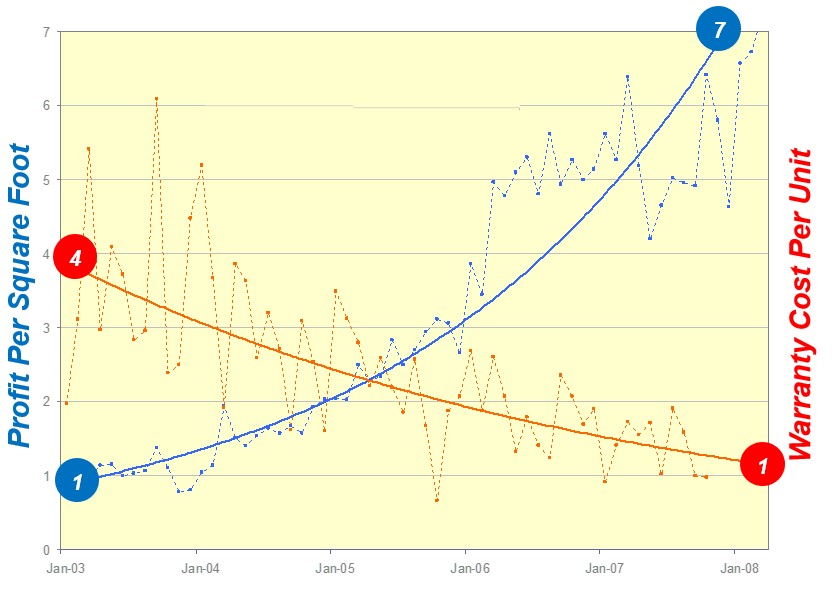
In the workshop, you’ll see real before-and-after examples which will give you a feel for what’s possible; you’ll see real data on part count and cost; you’ll learn how to use data to create a design approach; and you’ll learn the ins and outs of a successful implementation.
And for the first 15 people to register, I am offering a complimentary strategy session after the workshop. To book your 30-minute strategy session, a link will be provided in the registration confirmation email.
Workshop Details
- Topic: Designing Out Product Cost
- Date: 10/29/26 at 11 AM EST
- Price: $100.00
 Posted in A/B Data, DFA, DFMA, Fundementals, How To |
 Tags: Design for Assembly, Engineering Mindset, Product Design, Product Development Engine |
 No Comments »
Product simplification is a battle for hearts and minds.
October 14th, 2026
 With product simplification, it’s a battle for hearts and minds. You cannot simply ask the engineering community to design out half the parts because they don’t think it’s possible. The first step is to help them believe it’s possible.
Posted in Cost Savings, Design Engineers, DFA, DFMA, Downstream Savings, New Thinking, Product Development |
No Comments »
Engineering Leadership Development Is Company-Specific
October 7th, 2026
 Customers buy products. Manufacturing makes the products. Design engineering designs the products. Engineering leaders guide and grow the engineers. In a “start with the customer” way, engineering leaders are important to growing revenue and profitability.
Engineering leadership requires both technical leadership and people leadership. You need to understand the technology, or you can’t use good professional judgement. And you need to understand people, or you can’t create the conditions for them to do work they thought was impossible. (I call this the almost impossible.)
Is it 90% technical and 10% people? Or is it 90% people and 10% technical? Or is it split down the middle at 50-50? The answer is yes. Sometimes it’s a 90/10 meeting followed by a 50/50 conversation in the hall. Sometimes it’s 10/90 for a whole week. Sometimes it’s 90/10 in the morning and 10/90 in the afternoon. Once in a while it’s 100/0 for a hot minute or 0/100 on rare occasions. (Most of the time, though, it feels like 75/75.) A great engineering leader must know technology and people and must know how to set their balance based on the context.
I think the curriculum for an engineering leadership development program must be context-specific. And because each company’s context is different, I think an engineering leadership development program should be company-specific. The new product development process is unique. The products are unique. The analytical tools and how they’re used are unique. The ins and outs of the design reviews are different. So, when in doubt, I suggest you make your engineering leadership development process more company-specific and use context-specific artifacts and examples.
More specifically, I think the curriculum to teach new product development is the new product development projects themselves. Junior engineering leaders work alongside senior engineering leaders during the actual projects in an apprenticeship way. The senior leader demonstrates an activity, and the junior leader watches. Next time, the senior leader demonstrates less, and the junior leader does more. This responsibility balance shifts over time until the junior leader demonstrates and the senior leader doesn’t have to watch anymore. The junior leader is certified activity by activity under the guidance of a senior leader. And when the junior leader has demonstrated all the necessary activities, they become a senior leader. And the cycle continues.
Companies win when their customers buy their products. And I think one of the best ways to do that is a formal (company-specific) program to develop engineering leaders.
Image credit – Willy Verhulst.
Posted in Fundementals, Leadership, Product Development |
Tags: Piano Teacher, Trust-based approach, Understanding Physics |
No Comments »
 Mike Shipulski