Archive for the ‘Bottom Line Growth’ Category
Product design is limiting the next level of profits.
 September 2nd, 2026
 Process, process, process. Everything has been about process improvement over the last decade. And Lean has had a good run. But let’s face it. Its improvements have diminished, and it has largely hit a wall. And yet, we are doubling down on this tired old horse.
S-curves are real. Improvements are slow in the early stages, steep in mid-life, and they roll off as the system hits its asymptotic constraint. And that’s where Lean is now. It has hit its physical constraints defined by the product design. Yes, I said the product is the constraint. And without a radical change to the product, the next level of process improvement is blocked from coming to be. But it’s not as bad as it seems. In a sense, the bad news is the good news.
Over the last couple of decades, we forgot that the total cost is largely defined by the product design, not the manufacturing process. The design engineering community has been let off the hook and has not been tasked with designing the product with less material cost or designing it in a way that opens up space for the next generation of process simplification (Lean). The bad news is the product design has not changed and is blocking the next evolution of Lean. The good news is that because the product design hasn’t changed, it’s ripe for radical cost reduction. And the better news – changing the product itself can reduce material cost, and the material cost is at least 75% of the total cost. And, by definition, Lean, in its current and future embodiments, cannot reduce material cost. The only way to reduce material cost is to change the product design.
Lean has saved money, but because it cannot make changes to the product itself, it can only reduce labor cost. Here’s the math. If material cost is 75% of total cost, overhead is 5%, and labor cost is 20%, the domain of Lean’s savings has always been limited to about 20% of total cost. (There has never been a project that successfully reduced overhead, so that’s always off limits.) When the product itself becomes open to change, the potential for cost reduction is almost four times larger (20% to 70%). And that’s the good news. But the good news is also the bad news.
Yes, if the design can be changed, cost savings can be astronomical. But the bad news – there are no engineering leaders who know how to do it. And without engineering leaders advocating for, cajoling, prodding, and teaching product simplification, the engineering team cannot and will not pull it off.
The tools for product simplification exist, but the appreciation for their power has aged out with the previous generation of engineering leaders. And the knowledge of how to wield the tools has also aged out.
If you want to open up the next level of company profitability, you’ve got to simplify the product. Full stop. And if you want to achieve those 4X savings, you’ve got to hire an old pro who has done it before. Yes, I said old. (Maybe “experienced” is a better word?)
And before you get the bad idea to research the history of product simplification and the associated tools in the hopes of doing it on your own, don’t. More than anything, this journey is an emotional journey. You have to create the right conditions for the engineers to succeed, and that knowledge is not captured in the history books.
If you want to succeed, you’ll have to hire an old pro. This is The Way.
Image credit — Crosa
Product-First Thinking – A Way To Accelerate Growth
May 27th, 2026

This is the third in a series of blog posts on transformation (changes that make a difference). The first post described the power and benefit of focusing on the current state at the expense of the future state. The second post described moving from dilution to distillation, where resources focus on fewer things to create intensity of resource allocation. The topic of this third post is moving from process to product.
There is immense pressure on company leaders to grow their businesses. And with new competitors and a faster pace of change, it’s harder than ever to grow. The growth from process-first thinking (Lean Manufacturing and Six Sigma) has reached maturity, and the returns have diminished. It’s time to take a product-first approach.
Lean improves our processes by simplifying them; Six Sigma improves our processes by reducing variation. But customers don’t buy our processes; they buy our products. Bad process and good product – sale. Good process and bad product – no sale. And more sales create top-line growth.
Products solve problems for customers and help them make progress, which is why customers buy our products. Customers buy our products, not our processes, and that’s why I think we should take a product-first approach.
When your product works better than the competition, you sell more. When your internal process is better than the competition, customers don’t really care, and you don’t sell more. Sell more, grow more.
The sales-driven growth described above is all about the top line. And for top-line growth, I think product-first is far better than process-first. But product-first is also far better for bottom-line growth.
Lean can reduce labor costs by 30%. Labor cost is likely about 5% of your product cost. Do the math, and that’s a cost reduction of 1.5%. Note – labor savings can be realized only when people lose their jobs. I won’t bother calculating the savings from Six Sigma because they are less than the savings from Lean.
Product simplification through part count reduction can reduce material cost by 20-40%, and material cost is likely around 80% of your product cost. Do the math, and that’s a 16-32% cost reduction for the entire product. This level of cost reduction can grow profit per unit by 50-100% (not a typo). That is radical bottom-line growth. Product beats process hands-down.
I bashed process-first thinking to make the point that product-first is more important. But process thinking IS important, though I think it should come after product thinking. Softening the message I delivered above, I think it’s product BEFORE process.
Here’s my recommendation. Improve product function, design out half the parts, and introduce a low-waste design into the production system. Then, use Lean to streamline the process, and then use Six Sigma to reduce variation.
Here’s the magic sequence that delivers growth: product function, product simplification, process waste reduction, process variation reduction.
This is The Way.
Image credit – Ray in Manila
 Posted in Bottom Line Growth, DFA, DFMA, Lean, Product Development, Six Sigma, Top Line Growth |
  Tags: Design for Assembly, DFMA Culture, Part Count, Product Design |
  No Comments »
996 or Bust
October 1st, 2025
 996 is all the rage. You work 9 am to 9 pm, 6 days a week. Startups are doing it. Might non-startups start doing it?
Productivity is important and competition is severe. And I’m all for working hard, but I don’t think the 996 schedule is the most effective way to achieve productivity goals, at least not for all jobs.
My decision-making capabilities diminish when I am tired, and I would be tired if I worked a 996 schedule. My interpersonal and organizational effectiveness would suffer if I worked 996. My planning skills would degrade if I worked 996. My family life would suffer if I worked 996. And my physical and mental health would degrade..
In my work, I make many decisions, I create conditions for teams and organizations to do new work, and I contemplate the future and figure out what to do next. Maybe I should be able to do this work well with a 996 schedule. But I know myself, and I know I would be far less effective working 996. Maybe my work is uniquely unfit for 996? Maybe I am uniquely unfit for 996?
Some questions for you:
- How many hours can you concentrate in one day?
- How about the second day?
- If you worked a 996 schedule, would you get more done?
- How many weeks could you work 996 before the wheels fall off?
The startup pace is rapid. Progress must be made before the money runs out. At these early stages, when a company’s existence depends on hitting the super agressive timelines, I think 996 is especially attractive to startup companies The potential financial upside is large which may make for a fair trade – more hours for the chance of outsized compensation.
But what if an established company sets extremely tight timelines and offers remarkable compensation if those timelines are met? Does 996 become viable? What if an established company sets startup-like timelines but without added compensation? Would 996 be viable in that case?
Some countries and regions work a 996 schedule as a matter of course – no limited to startups and (likely) no special compensation. And it seems to work for them, at least from the outside. And 996 may be an important supporting element of their impressively low costs, high quality, and speed.
If those countries amd regions can sustain their 996 culture, and I think they will, it will create pressure on other countries to adopt a similar approach to avoid falling further behind.
I’m unsure what broad adoption of 996 would mean for the world.
Image credit — Evan
How I Develop Engineering Leaders
May 14th, 2025

For the past twenty-five years, I’ve actively developed engineering leaders. Here is the curriculum in the form of How Tos:
How to build trust. This is the first thing. Always. Done right, the trust-based informal networks are stronger than the formal organization chart. Done right, the informal networks can protect the company from bad decisions. Done right, the right information flows among the right engineers at the right time so the right work happens in the right way.
How to decide what to do next. This is a broad one. We start with a series of questions: What are we doing now? What’s the problem? How do you know? What should we do more of? What should we do less of? What resources are available? When must we be done?
How to map the current state. We don’t define the idealized future state or the North Star, we start with what’s happening now. We make one-page maps of the territory. We use drawings, flow charts, boxes/arrows, and the fewest words. And we take no action before there’s agreement on how things are. The value of GPS isn’t to define your destination, it’s to establish your location. That’s why we map the current state.
How to build momentum. It’s easy to jump onto a moving steam train, but a stationary one is difficult to get moving. We define the active projects and ask – How might we hitch our wagon to a fast-moving train?
How to start something new. We start small and make a thought-provoking demo. The prototype forces us to think through all the elements, makes things real, and helps others understand the concept. If that doesn’t work, we start smaller.
How to define problems so we can solve them easily. We define problems with blocks and arrows, and limit ourselves to one page. The problem is defined as a region of contact between two things, and we identify it with the color red. That helps us know where the problem is and when it occurs. If there are two problems on a page, we break it up into two pages with one problem. Then we decide to solve the problem before, during, or after it occurs.
How to design products that work better and cost less. We create Pareto charts of the cost of the existing product (cost by subassembly and cost by part) and set a cost reduction goal. We create Pareto charts of the part count of the existing product (part count by subassembly and part count by individual part number) and define a goal for part count reduction. We define test protocols that capture the functionality customers care about. We test the existing product and set performance improvement goals for the new one. We test the new product using the same protocols and show the data in a simple A-B format. We present all this data at formal design reviews.
How to define technology projects. We define how the customer does their work. We then define the evolutionary history of our products and services, and project that history forward. For lines of goodness with trajectories that predict improvement, we run projects to improve them. For lines of goodness with stalled trajectories, we run projects to establish new technologies and jump to the next S-curve. We assess our offerings for completeness and create technologies to fill the gap.
How to file the right patents. We ask these questions: How quickly will the customer notice the new functionality or benefit? Once recognized, will they care? Will the patent protect high-volume / high-margin consumables? There are more questions, but these are the ones we start with. And the patent team is an integral part of the technology reviews and product development process.
How to do the learning. We start with the leader’s existing goals and deliverables and identify the necessary How Tos to get their work done. There are no special projects or extra work.
If you’re interested in learning more about the curriculum, send me an email at mike@shipulski.com.
Image credit — Paul VanDerWerf
Posted in A/B Data, Allocating Cost, Bottom Line Growth, Clarity, Cost Savings, Design Engineers, DFA, DFMA, Engineering Leaders, Fundementals, How To, Innovation, Maps, One Page Thinking, Part Count Reduction, Problems, Product Development, Product Robustness, Technology, The Future, Trust |
Tags: Cost Reduction, Cost Savings, Design for Assembly, Engage Design; Product Design; Cost Savings, Fear, Part Count, Problem Definition, Problems, Product Design, Product Development Engine, Trust-based approach, Understanding Physics, Words |
No Comments »
Resurrecting Manufacturing Through Product Simplification
October 2nd, 2024
Product simplification can radically improve profits and radically improve product robustness. Here’s a graph of profit per square foot ($/ft^2) which improved by a factor of seven and warranty cost per unit ($/unit), a measure of product robustness), which improved by a factor of four. The improvements are measured against the baseline data of the legacy product which was replaced by the simplified product. Design for Assembly (DFA) was used to simplify the product and Robust Design methods were used to reduce warranty cost per unit.
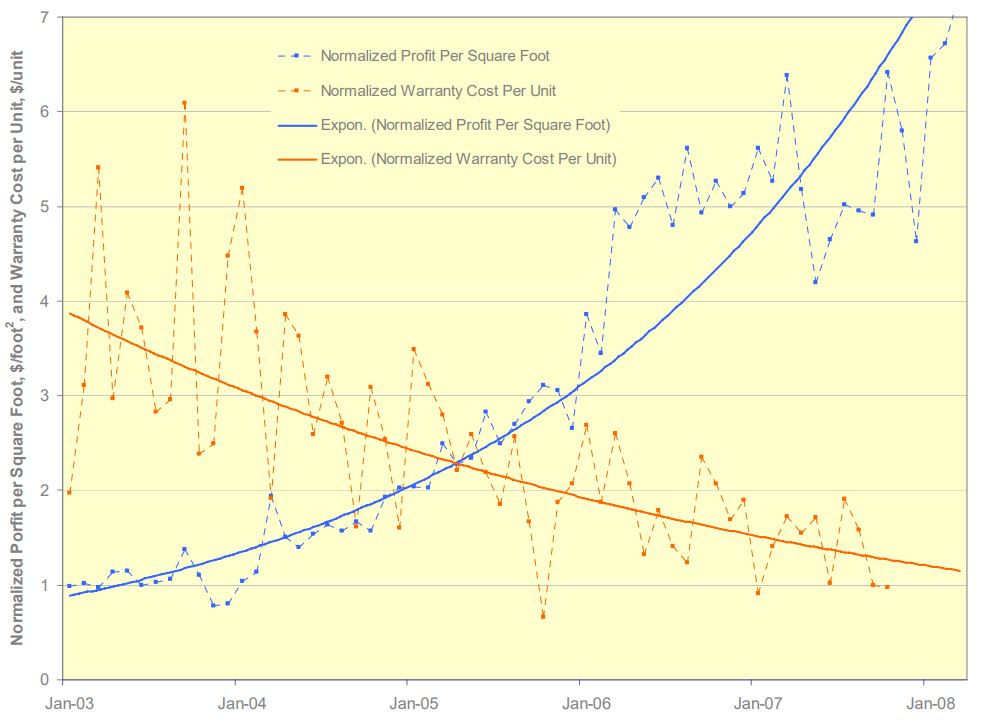
I will go on record that everyone will notice when profit per square foot increases by a factor of seven.
And I will also go on record that no one will believe you when you predict product simplification will radically improve profit per square foot.
And I will go on record that when warranty cost per unit is radically reduced, customers will notice. Simply put, the product doesn’t break and your customers love it.
But here’s the rub. The graph shows data over five years, which is a long time. And if the product development takes two years, that makes seven long years. And in today’s world, seven years is at least four too many. But take another look at the graph. Profit per square foot doubled in the first two years after launch. Two years isn’t too long to double profit per square foot. I don’t know of a faster way, More strongly, I don’t know of another way to get it done, regardless of the timeline.
I think your company would love to double the profit per square foot of its assembly area. And I’ve shown you the data that proves it’s possible. So, what’s in the way of giving it a try?
For the details about the work, here’s a link – Systematic DFMA Deployment, It Could Resurrect US Manufacturing.
Posted in Assembly Time Reduction, Bottom Line Growth, Cost Savings, Design Engineers, DFA, DFMA, Downstream Savings, Floor Space, Fundementals, How To, Lean, Manufacturing Competitiveness, Part Count Reduction, Product Development, Product Robustness, Robust Economy, Seven Wastes, Top Line Growth |
No Comments »
The Next Evolution of Your Success
July 19th, 2023
 New ways to work are new because they have not been done before.
How many new ways to work have you demonstrated over the last year?
New customer value is new when it has not been shown before.
What new customer value have you demonstrated over the last year?
New ways to deliver customer value are new when you have not done it that way before.
How much customer value have you demonstrated through non-product solutions?
The success of old ways of working block new ways.
How many new ways to work have been blocked by your success?
The success of old customer value blocks new customer value.
How much new customer value has been blocked by your success with old customer value?
The success of tried and true ways to deliver customer value blocks new ways to deliver customer value.
Which new ways to deliver unique customer value have been blocked by your success?
Might you be more successful if you stop blocking yourself with your success?
How might you put your success behind you and create the next evolution of your success?
Image credit — Andy Morffew
Posted in Bottom Line Growth, Brand, Business Model, Fear, Level 5 Courage, Top Line Growth |
Tags: Competitiveness, Lessons Learned, Success |
No Comments »
You are defined by the problems you solve.
April 12th, 2023
 You can solve problems that reduce the material costs of your products.
You can solve problems that reduce the number of people that work at your company.
You can solve problems that save your company money.
You can solve problems that help your customers make progress.
You can solve problems that make it easier for your customers to buy from you.
You can solve too many small problems and too few big problems.
You can solve problems that ripple profits through your whole organization.
You can solve local problems.
You can solve problems that obsolete your best products.
You can solve problems that extend and defend your existing products.
You can solve problems that spawn new businesses.
You can solve the wrong problems.
You can solve problems before their time or after it is too late.
You can solve problems that change your company or block it from change.
You are defined by the problems you solve. So, which type of problems do you solve and how do you feel about that?
Image credit – Maureen Barlin
The best time to design cost out of our products is now.
July 13th, 2022
 With inflation on the rise and sales on the decline, the time to reduce costs is now.
But before you can design out the cost you’ve got to know where it is. And the best way to do that is to create a Pareto chart that defines product cost for each subassembly, with the highest cost subassemblies on the left and the lowest cost on the right. Here’s a pro tip – Ignore the subassemblies on the right.
Use your costed Bill of Materials (BOMs) to create the Paretos. You’ll be told that the BOMs are wrong (and they are), but they are right enough to learn where the cost is.
For each of the highest-cost subassemblies, create a lower-level Pareto chat that sorts the cost of each piece-part from highest to lowest. The pro tip applies here, too – Ignore the parts on the right.
Because the design community designed in the cost, they are the ones who must design it out. And to help them prioritize the work, they should be the ones who create the Pareto charts from the BOMs. They won’t like this idea, but tell them they are the only ones who can secure the company’s future profits and buy them lots of pizza.
And when someone demands you reduce labor costs, don’t fall for it. Labor cost is about 5% of the product cost, so reducing it by half doesn’t get you much. Instead, make a Pareto chart of part count by subassembly. Focus the design effort on reducing the part count of subassemblies on the left. Pro tip – Ignore the subassemblies on the right. The labor time to assemble parts that you design out is zero, so when demand returns, you’ll be able to pump out more products without growing the footprint of the factory. But, more importantly, the cost of the parts you design out is also zero. Designing out the parts is the best way to reduce product costs.
Pro tip – Set a cost reduction goal of 35%. And when they complain, increase it to 40%.
In parallel to the design work to reduce part count and costs, design the test fixtures and test protocols you’ll use to make sure the new, lower-cost design outperforms the existing design. Certainly, with fewer parts, the new one will be more reliable. Pro tip – As soon as you can, test the existing design using the new protocols because the only way to know if the new one is better is to measure it against the test results of the old one.
And here’s the last pro tip – Start now.
Image credit — aisletwentytwo
Posted in A/B Data, Allocating Cost, Bottom Line Growth, Cost Savings, Design Engineers, DFA, DFMA, Downstream Savings, Floor Space, How To, Manufacturing Competitiveness, Product Robustness |
Tags: Competitiveness, Design for Assembly, DFA, DFMA Culture, Downstream Savings, Engage Design; Product Design; Cost Savings, Lessons Learned, Manufacturing Competitveness, Part Count, Seven Wastes |
No Comments »
Taking vacations and holidays are the most productive things you can do.
July 28th, 2021
 It’s not a vacation unless you forget about work.
It’s not a holiday unless you leave your phone at home.
If you must check-in at work, you’re not on vacation.
If you feel guilty that you did not check-in at work, you’re not on holiday.
If you long for work while you’re on vacation, do something more interesting on vacation.
If you wish you were at work, you get no credit for taking a holiday.
If people know you won’t return their calls, they know you are on vacation.
If people would rather make a decision than call you, they know you’re on holiday.
If you check your voicemail, you’re not on vacation.
If you check your email, you’re not on holiday.
If your company asks you to check-in, they don’t understand vacation.
If people at your company invite you to a meeting, they don’t understand holiday.
Vacation is productive in that you return to work and you are more productive.
Holiday is not wasteful because when you return to work you don’t waste time.
Vacation is profitable because when you return you make fewer mistakes.
Holiday is skillful because when you return your skills are dialed in.
Vacation is useful because when you return you are useful.
Holiday is fun because when you return you bring fun to your work.
If you skip your vacation, you cannot give your best to your company and to yourself.
If neglect your holiday, you neglect your responsibility to do your best work.
Don’t skip your vacation and don’t neglect your holiday. Both are bad for business and for you.
“CatchingButterflies on Vacation” by OakleyOriginals is licensed under CC BY 2.0
Posted in Bottom Line Growth, Culture, Fundementals, Seeing Things As They Are, Top Line Growth |
Tags: Vacation |
No Comments »
Goals, goals, goals.
November 11th, 2020
 All goals are arbitrary, but some are more arbitrary than others.
When your company treats goals like they’re not arbitrary, welcome to the US industrial complex.
What happens if you meet your year-end goals in June? Can you take off the rest of the year?
What happens if at year-end you meet only your mid-year goals? Can you retroactively declare your goals unreasonable?
What happens if at the start of the year you declare your year-end goals are unreasonable? Can you really know they’re unreasonable?
You can’t know a project’s completion date before the project is defined. That’s a rule.
Why does the strategic planning process demand due dates for projects that are yet to be defined?
The ideal future state may be ideal, but it will never be real.
When the work hasn’t been done before, you can’t know when you’ll be done.
When you don’t know when the work will be done, any due date will do.
A project’s completion date should be governed by the work content, not someone’s year-end bonus.
Resources and progress are joined at the hip. You can’t have one without the other.
If you are responsible for the work, you should be responsible for setting the completion date.
Goals are real, but they’re not really real.
“Arbitrary limitations II” by Marcin Wichary is licensed under CC BY 2.0
Posted in Bottom Line Growth, Motivation, Seeing Things As They Are, Top Line Growth, Trust, Uncertainty |
Tags: Trust-based approach |
No Comments »
Use less, make more.
January 8th, 2020
 If you use fewer natural resources, your product costs less.
If you use recycled materials, your product costs less.
If you use less electricity, your product costs less.
If you use less water to make your product, your product costs less.
If you use less fuel to ship your product, your product costs less.
If you make your product lighter, your product costs less.
If you use less packaging, your product costs less.
If you don’t want to be environmentally responsible because you think it’s right, at least do it to be more profitable.
Image credit — Sandrine Néel
 Mike Shipulski