Archive for the ‘Top Line Growth’ Category
Designing your new product starts by understanding your existing one.
 July 29th, 2026
 Everything starts from what’s been done before. Designing a new product starts with assessing the subassemblies of your existing product. Here’s how the assessments go for the subassemblies.
First, make two Pareto charts: cost by subassembly and part count by subassembly. Prioritize the subassemblies on the left of both charts.
If the functionality is sufficient and the cost is right, reuse it as-is. This allows you to spend your time and energy elsewhere.
If the cost is right but the functionality needs to be adjusted, adjust it and move on. The technical risk is low, and the cost will still be right. Spend your energy where the problems are.
If functionality is good and the cost is high, simplify the product using part count reduction. Create a bench test to verify functionality and robustness are better than the old one.
If the functionality is insufficient and the cost is too high, spend your energy here. Create a bench test to quantify the performance of the existing subassembly. Turn up the dials to increase the stress on the subassembly until it breaks. Fix the part that breaks. Repeat until you run out of time. Create two Pareto charts for the subassembly: cost by part and part count by part type (main part, fastener, connector, protection, label). Design out the highest cost parts and redesign the highest cost parts that remain. Design out fasteners, connectors, protection parts, and labels.
Create a functional test for the product as a whole (think miles per gallon for a new car) and test the old one until it breaks. Build the new product with the new subassemblies and test it until it breaks. The performance must be better, and it must perform under stress longer than the baseline product. Break the new product, fix the weakest link, and retest. Do this until you run out of time and launch it.
This is The Way.
Image credit — George Redgrave
 Posted in Clarity, Cost Savings, DFA, DFMA, Floor Space, Fundementals, How To, Manufacturing Competitiveness, Part Count Reduction, Product Development, Product Robustness, Risk, Seeing Things As They Are, Seven Wastes, Top Line Growth |
  Tags: Design for Assembly, DFA, DFMA Culture, Downstream Savings, Engage Design; Product Design; Cost Savings, Manufacturing Competitveness, Product Design, Understanding Physics |
  No Comments »
Back To Basics – Solving The Right Problems
July 22nd, 2026
 I’ve been solving problems for a long time. And what I’ve learned is that it’s important to know the specific problem you want to solve. There’s nothing worse than solving the wrong problem because you spend all the resources and get a solution to something that’s non-monetizable. Here’s a post I wrote that talks about how to know if a problem is worth solving before investing the resources to solve it – Solving The Wrong Problem.
Engineers see problems as opportunities to provide novel solutions to customers, which can lead to creating whole new markets. But, often, engineers can struggle to communicate the problem, opportunity (a whole new market?), and potential solution. This blog post defines a process to formalize the commercial space, to create a distilled definition of the problem, and communicate the solution. And in the post, there’s a link to a template to help you – How Engineers Create New Markets.
Customers don’t always know what to ask for because they don’t know what’s possible with new technology. That’s why the Voice of the Customer (VOC) can sometimes lead you astray. And though technology can be fickle, it does have ideas about what it wants to be when it grows up. I call this the Voice of Technology (VOT). In this blog post I describe the importance of understanding VOT and using it to move forward in a fruitful direction Voice of the Technology.
Pulling it all together, once you know you know the right problem to solve andTur where the technology wants to go, you can create an Innovation Burst Event to investigate the relevant design space. The blog post describes the Burst Event and its elements – tightly constrained design challenges (perspective shift), starvation of resources (too little time), and immediate report-outs to tighten the feedback loops. Don’t Boost Innovation, burst it.
The thinking contained in the set of blog posts has helped me deliver innovative new products. I hope the thinking is helpful to you.
Image credit – conall, strike a match
Posted in Clarity, Innovation, Technology, Top Line Growth |
Tags: Creativity, Problem Definition, Problems, Understanding Physics |
1 Comment »
Battle China With New Thinking
June 3rd, 2026
 China, as a country, is eating important industries. Here’s the process. They choose an industry that they want to eat; they coordinate their massive network of world-class suppliers and OEMs and let them compete against each other; they create unmatched manufacturing scale; they innovate faster than imaginable; they design and commercialize products that work well and are priced far less than the competition; they sell those killer products to customers in other countries. They start in the east and move west country-by-country and displace in-country manufacturers one-by-one.
The best example is the Electric Vehicle (EV) industry. Their cars look great, perform well, have new and interesting features, and cost far less. In Europe, the Chinese EVs are displacing the cars made by European manufacturers. And the same thing is happening in other countries.
If China decides it wants to eat your industry, you’ll lose if you try to compete head-to-head with them. You cannot out-scale them, and you can’t outlast them. Simply put, you cannot beat them at their game. And that’s why it’s time to play a different game.
Here are some new ways to think that may help you win a different game.
Less With Far Less – Turn more with less on its head. Instead of bigger for the same price, think smaller for a far lower price. Instead of more performance, think less performance for a far lower price. Instead of more range, think less range with a radically lower price. I don’t know what will come of it, but you will be working in new design space. Other companies will not compete with you because they’ll think you’re nuts for working in that space. It could give you time to get out in front and create a new market or industry.
Partnership Of Rivals – Turn the company with the rival technology into a partner. Ask them to co-create a hybrid product that brings together the best of your technology and theirs. Because you’re rivals, your partnership will be unimaginable, and no one will see it coming. I don’t know what’s possible when you combine forces with your rival, but neither do you. However, I know the design is uninvestigated, and you have an opportunity to create a new product category.
Obsolete Your Best Work – Create the conditions for your teams to purposefully and vigorously obsolete your best product. Incentivize them to create something that will make your customers throw away your best product and buy two of the new ones. This will accelerate innovation and open up new design space. I don’t know what your team will come up with, and neither do you. But it will be exciting and different. And no one will expect you to obsolete your best work, so you’ll catch them off guard when you reinvent your industry.
Learn What Your Company Already Knows – Your teams have demonstrated technologies in the lab that would radically slash the cost signature of your product, but you don’t know about them. You have prototypes that would create new industries, but you don’t know about them. You have people in your company who have solved intractable problems that would underpin a new generation of products, but you don’t know about them. You have unimaginable gems that your teams have created from things that don’t belong together, but you don’t know about them. And because these crazy prototypes defy logic, you have the opportunity to create a new category in a compete-with-no-one way.
If you battle China with traditional thinking, I think you’ll lose. If you employ new thinking, you could live to fight another day.
Image credit – pete beard
Posted in Culture, How To, Innovation, Intellectual Intertia, Level 5 Courage, Top Line Growth, TRIZ |
Tags: Manufacturing Competitveness |
No Comments »
Product-First Thinking – A Way To Accelerate Growth
May 27th, 2026

This is the third in a series of blog posts on transformation (changes that make a difference). The first post described the power and benefit of focusing on the current state at the expense of the future state. The second post described moving from dilution to distillation, where resources focus on fewer things to create intensity of resource allocation. The topic of this third post is moving from process to product.
There is immense pressure on company leaders to grow their businesses. And with new competitors and a faster pace of change, it’s harder than ever to grow. The growth from process-first thinking (Lean Manufacturing and Six Sigma) has reached maturity, and the returns have diminished. It’s time to take a product-first approach.
Lean improves our processes by simplifying them; Six Sigma improves our processes by reducing variation. But customers don’t buy our processes; they buy our products. Bad process and good product – sale. Good process and bad product – no sale. And more sales create top-line growth.
Products solve problems for customers and help them make progress, which is why customers buy our products. Customers buy our products, not our processes, and that’s why I think we should take a product-first approach.
When your product works better than the competition, you sell more. When your internal process is better than the competition, customers don’t really care, and you don’t sell more. Sell more, grow more.
The sales-driven growth described above is all about the top line. And for top-line growth, I think product-first is far better than process-first. But product-first is also far better for bottom-line growth.
Lean can reduce labor costs by 30%. Labor cost is likely about 5% of your product cost. Do the math, and that’s a cost reduction of 1.5%. Note – labor savings can be realized only when people lose their jobs. I won’t bother calculating the savings from Six Sigma because they are less than the savings from Lean.
Product simplification through part count reduction can reduce material cost by 20-40%, and material cost is likely around 80% of your product cost. Do the math, and that’s a 16-32% cost reduction for the entire product. This level of cost reduction can grow profit per unit by 50-100% (not a typo). That is radical bottom-line growth. Product beats process hands-down.
I bashed process-first thinking to make the point that product-first is more important. But process thinking IS important, though I think it should come after product thinking. Softening the message I delivered above, I think it’s product BEFORE process.
Here’s my recommendation. Improve product function, design out half the parts, and introduce a low-waste design into the production system. Then, use Lean to streamline the process, and then use Six Sigma to reduce variation.
Here’s the magic sequence that delivers growth: product function, product simplification, process waste reduction, process variation reduction.
This is The Way.
Image credit – Ray in Manila
Posted in Bottom Line Growth, DFA, DFMA, Lean, Product Development, Six Sigma, Top Line Growth |
Tags: Design for Assembly, DFMA Culture, Part Count, Product Design |
No Comments »
Double-Barreled Profitability
May 6th, 2026
 The need to grow revenue and profit is ever-present. And as the pace of change accelerates and competitors elevate their game, it’s getting more difficult.
Growth must be built on top of your best work. To grow, you must develop new products and services that make your customers swap out the old offering they just bought from you for the new one you just launched. And you must develop the new product with the team that developed the old one. This is difficult. You need to create the conditions for the team to see their best work as crap and prevent them from seeing themselves as crap.
For customers to replace an existing product with a new one, the new product must help customers make more progress than the old one. In a word, the new one must be better, or customers won’t buy it. And if they don’t buy the new one, there can be no growth. But here’s the difficult part – when the team built the old one, they designed in as much goodness as possible, yet your task is to help the team design a better one. Hey Team, congratulations on the wonderful success of the existing product. You did new work in new ways; you stretched; you hustled; you sprinted. Now, you must outdo yourselves, even though you just did that. This is quite the balancing act for the engineering leader.
Growth comes when the team designs a product that works better than the one they designed last time.
Designing a new product that works better is only half of the profitability recipe. It must also cost less. Yes, it must work better AND cost less. Yes, I said AND. Most teams don’t believe they can design a new product that costs less, and they think you’re crazy when you tell them the new one must work better and cost less. But this type of double-barreled profitability improvement is possible and proven. But only if the engineering leader believes it. And most don’t.
Growth is realized when the team designs a new product that works better AND costs less.
You can radically improve profitability with this double-barreled approach. I’ve used it to more than double the profit per square foot of the assembly area. And that makes the CFO smile and gets you lunch with the CEO. It’s good for profitability and better for your career.
Radical growth comes from obsoleting your best work, but only if you think it’s possible.
Image credit — Don Miller – double rainbow
Do you have what it takes?
January 14th, 2026
 When there’s no light, no one can see.
When no one can see, what do you do?
Can you be a source of light?
Do you care enough to do that?
When there’s too much input, focus is difficult.
When there’s a shortfall of focus, what do you do?
Can you dampen things and bring focus?
Do you have the emotional energy for that?
When there’s too much emotional stress, people become scattered.
When scattering comes, what do you do?
Can you pull people together?
Do you take responsibility and do that?
When the old recipe no longer works, people pucker.
When there is puckering, what do you do?
Can you recognize the pucker and plot a new course?
Do you bring the energy for that?
When there is support and guidance, people do great work.
When they did great work, did you play a role?
When they did great work, did you tell them?
Do you have the mojo to do it again?
When there is air cover and protection, people take risks.
When they took a risk, did you create the causes and conditions?
When they took a risk, did you praise them in public?
Do you have what it takes to praise in public?
When there is a teacher and time to learn, everything gets better.
When they learned, were you the teacher?
When they learned, did you create the opportunity for them to demonstrate their learning?
Do you have what it takes to teach and create the causes and conditions for learning to come more easily?
Image credit — Darren Flinders, Flamborough Lighthouse
Projects generate progress.
January 7th, 2026
 Companies make progress through projects.
Projects have objectives that are defined by the company’s growth or improvement objectives.
Projects have quantifiable goals that are, hopefully, time-bound.
Projects require resources, and those resources limit the number of projects that are completed.
Projects are run with the resources allocated, not with the resources we want to allocate.
Projects have timelines that are governed by the work content, novelty, and resources.
Project timelines cannot violate the governing constraints of work content, novelty, and resources.
Projects have project managers, or they’re not projects.
Projects can be accelerated by eliminating waiting. To find the waiting, look for the work queued up in front of the bottleneck resources. Those resources are usually resources that support multiple projects (shared resources). When it comes to waiting, shared resources are almost always the culprit.
Projects have a critical path. A one-day delay (waiting) on the critical path delays project completion by a day. That’s how you know it’s the critical path.
If you don’t know the project’s critical path, you don’t know much.
When it comes to projects, effectiveness is far more important than efficiency, yet we fixate on efficiency. Would you rather run the wrong project efficiently (ineffective) or run the right project inefficiently (effective)?
Regardless of the business you’re in, it’s all about the projects.
Image credit — State Library of South Australia
Solving The Wrong Problem
August 27th, 2025
 The CEO doesn’t decide if it’s good enough. The VP of Marketing doesn’t decide if it’s good enough. The VP of Engineering doesn’t decide if it’s good enough. The customer decides if it’s good enough.
If the product isn’t selling, the price may be okay, but the performance may not be good. In this case, it’s time to add some sizzle. And who decides if the sizzle is sufficient? You guessed it – the customer. And if you add the sizzle and they buy more, the sizzle was the problem. If they don’t buy more, it wasn’t the sizzle.
If the product isn’t selling, the performance may be okay, but the price may be too high. In this case, it’s time to pull some cost out of the product and reduce the price. Maybe a better way is to test a lower price with customers. If they buy more, it’s worth doing the work to pull out the cost. If they don’t buy at the lower price, the price isn’t the problem. You still have some work to do.
If the product isn’t selling, both the performance and the price may be the problem. It’s time to add some sizzle and lower the price. But there’s no need to do the work until you test the hypothesis. Make a one-page sales tool with the new sizzle and price. If they like it, make it so. If they don’t like it, make another sales tool with some different sizzle and a different price. Repeat the process until the customer likes the new offering. Then, make it so.
If the product isn’t selling, it’s possible the sales channel isn’t making enough money when they sell your product. To test this, go on several sales calls with them. If they are unwilling to bring you on the sales calls, it’s a good sign that there’s not enough money in it for them. There are three ways to move forward. Reduce the price to the channel partner. If they sell more, you’re off to the races if, of course, there is enough margin in the product to support the reduced price. Make it easier for them to sell your product so they spend less time and effort and make more profit. Sell through a different channel.
When your product isn’t selling, figure out why it isn’t selling. And because there are many possible reasons your product isn’t selling, it’s best to create a hypothesis and test it. Your job is not to solve the problem; rather, your job is to figure out what the problem is and to decide whether it’s worth solving.
If you create a one-page sales tool with a lower price and customers still don’t want to buy it, don’t bother to design out the cost or reduce the price. If you create a one-page sales tool with a new DVP and the customers still don’t want to buy it, don’t do the work to develop that new DVP. If you test a reduced price to the channel and they sell a few more systems, don’t reduce the price because it’s not worth it.
Once you have objective evidence that you know what the problem is and it’s worth solving, do the work to solve it and implement the solution. If you don’t have objective evidence that you know what the problem is, it’s not yet time to solve it.
There’s nothing worse than solving the wrong problem. And the customer decides if the problem is worth solving.
Image credit — Geoff Henson
Posted in Fundementals, How To, Problems, Selling, Top Line Growth |
Tags: Competitiveness, Cost Reduction, no-to-yes, Problems |
No Comments »
It’s time for the art of the possible.
March 12th, 2025
 Tariffs. Economic uncertainty. Geopolitical turmoil. There’s no time for elegance. It’s time for the art of the possible.
Give your sales team a reason to talk to customers. Create something that your salespeople can talk about with customers. A mildly modified product offering, a new bundling of existing products, a brochure for an upcoming new product, a price reduction, a program to keep prices as they are even though tariffs are hitting you. Give them a chance to talk about something new so the customers can buy something (old or new).
Think Least Launchable Unit (LLU). Instead of a platform launch that can take years to develop and commercialize, go the other way. What’s the minimum novelty you can launch? What will take the least work to launch the smallest chunk of new value? Whatever that is, launch it now.
Take a Frankensteinian approach. Frankenstein’s monster was a mix and match of what the good doctor had scattered about his lab. The head was too big, but it was the head he had. And he stitched onto the neck most crudely with the tools he had at his disposal. The head was too big, but no one could argue that the monster didn’t have a head. And, yes, the stitching was ugly, but the head remained firmly attached to the neck. Not many were fans of the monster, but everyone knew he was novel. And he was certainly something a sales team could talk about with customers. How can you combine the head from product A with the body of product B? How can you quickly stitch them together and sell your new monster?
Less-With-Far-Less. You’ve already exhausted the more-with-more design space. And there’s no time for the technical work to add more. It’s time for less. Pull out some functionality and lots of cost. Make your machines do less and reduce the price. Simplify your offering and make things easier for your customers. Removing, eliminating, and simplifying usually comes with little technical risk. Turning things down is far easier than turning them up. You’ll be pleasantly surprised how excited your customers will be when you offer them slightly less functionality for far less money.
These are trying times, but they’re not to be wasted. The pressure we’re all under can open us up to do new work in new ways. Push the envelope. Propose new offerings that are inelegant but take advantage of the new sense of urgency forced.
Be bold and be fast.
Image credit — Geoff Henson
Posted in Clarity, Constraints, Decisions, Fundementals, How To, Seeing Things As They Are, Selling, Top Line Growth, Uncertainty |
Tags: Manufacturing Competitveness |
No Comments »
How To Make Progress
January 29th, 2025
 Improvement is progress. Improvement is always measured against a baseline, so the first thing to do is to establish the baseline, the thing you make today, the thing you want to improve. Create an environment to test what you make today, create the test fixtures, define the inputs, create the measurement systems, and write a formal test protocol. Now you have what it takes to quantify an improvement objectively. Test the existing product to define the baseline. No, you haven’t improved anything, but you’ve done the right first thing.
Improving the right thing to make progress. If the problem invalidates the business model, stop what you’re doing and solve it right away because you don’t have a business if you don’t solve it. Any other activity isn’t progress, it’s dilution. Say no to everything else and solve it. This is how rapid progress is made. If the customer won’t buy the product if the problem isn’t solved, solve it. Don’t argue about priorities, don’t use shared resources, don’t try to be efficient. Be effective. Do one thing. Solve it. This type of discipline reduces time to market. No surprises here.
Avoiding improvement of the wrong thing to make progress. For lesser problems, declare them nuisances and permit yourself to solve them later. Nuisances don’t have to be solved immediately (if at all) so you can double down on the most important problems (speed, speed, speed). Demoting problems to nuisances is probably the most effective way to accelerate progress. Deciding what you won’t do frees up resources and emotional bandwidth to make rapid progress on things that matter.
Work the critical path to make progress. Know what work is on the critical path and what is not. For work on the critical path, add resources. Pull resources from non-critical path work and add them to the critical path until adding more slows things down.
Eliminate waiting to make progress. There can be no progress while you wait. Wait for a tool, no progress. Wait for a part from a supplier, no progress. Wait for raw material, no progress. Wait for a shared resource, no progress. Buy the right tools and keep them at the workstations to make progress. Pay the supplier for priority service levels to make progress. Buy inventory of raw materials to make progress. Ensure shared resources are wildly underutilized so they’re available to make progress whenever you need to. Think fire stations, fire trucks, and firefighters.
Help the team make progress. As a leader, jump right in and help the team know what progress looks like. Praise the crudeness of their prototypes to help them make them cruder (and faster) next time. Give them permission to make assumptions and use their judgment because that’s where speed comes from. And when you see “activity” call it by name so they can recognize it for themselves, and teach them how to turn their effort into progress.
Be relentless and respectful to make progress. Apply constant pressure, but make it sustainable and fun.
Image credit — Clint Mason
Resurrecting Manufacturing Through Product Simplification
October 2nd, 2024
Product simplification can radically improve profits and radically improve product robustness. Here’s a graph of profit per square foot ($/ft^2) which improved by a factor of seven and warranty cost per unit ($/unit), a measure of product robustness), which improved by a factor of four. The improvements are measured against the baseline data of the legacy product which was replaced by the simplified product. Design for Assembly (DFA) was used to simplify the product and Robust Design methods were used to reduce warranty cost per unit.
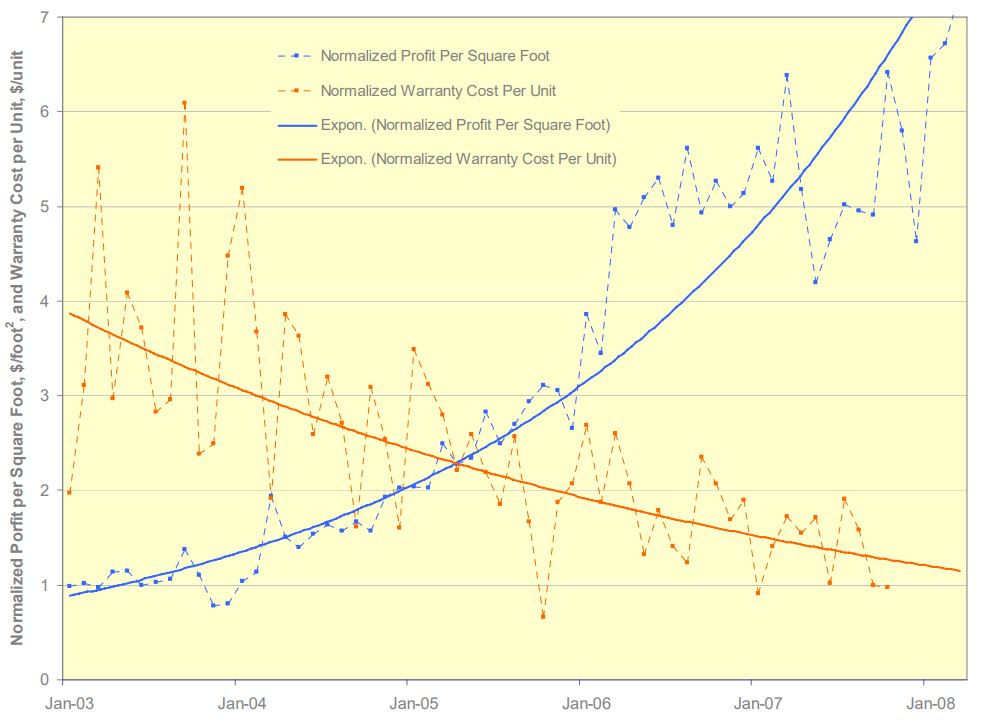
I will go on record that everyone will notice when profit per square foot increases by a factor of seven.
And I will also go on record that no one will believe you when you predict product simplification will radically improve profit per square foot.
And I will go on record that when warranty cost per unit is radically reduced, customers will notice. Simply put, the product doesn’t break and your customers love it.
But here’s the rub. The graph shows data over five years, which is a long time. And if the product development takes two years, that makes seven long years. And in today’s world, seven years is at least four too many. But take another look at the graph. Profit per square foot doubled in the first two years after launch. Two years isn’t too long to double profit per square foot. I don’t know of a faster way, More strongly, I don’t know of another way to get it done, regardless of the timeline.
I think your company would love to double the profit per square foot of its assembly area. And I’ve shown you the data that proves it’s possible. So, what’s in the way of giving it a try?
For the details about the work, here’s a link – Systematic DFMA Deployment, It Could Resurrect US Manufacturing.
Posted in Assembly Time Reduction, Bottom Line Growth, Cost Savings, Design Engineers, DFA, DFMA, Downstream Savings, Floor Space, Fundementals, How To, Lean, Manufacturing Competitiveness, Part Count Reduction, Product Development, Product Robustness, Robust Economy, Seven Wastes, Top Line Growth |
No Comments »
 Mike Shipulski