Workshop On Designing Out Product Cost
 October 21st, 2026
This one isn’t a blog post!
After more than sixteen years of blog posts, I’ll host my first live workshop on October 29 at 11:00 am Eastern Time! This marks a new phase for me, and I’m super excited!
In the workshop, I’ll share the tools and approaches for Designing Out Product Cost that I’ve developed over the last 25+ years. Using the methods, I increased profit per square foot by 7X and reduced warranty cost per unit by 4X (see results below), which earned a cover story in IE Magazine. And my results have been published in Design News, ASSEMBLY Magazine, Digital Engineering, IE Magazine, ASME, and I’ve presented them at GE Research and Development, MIT, WPI, and Tuck.
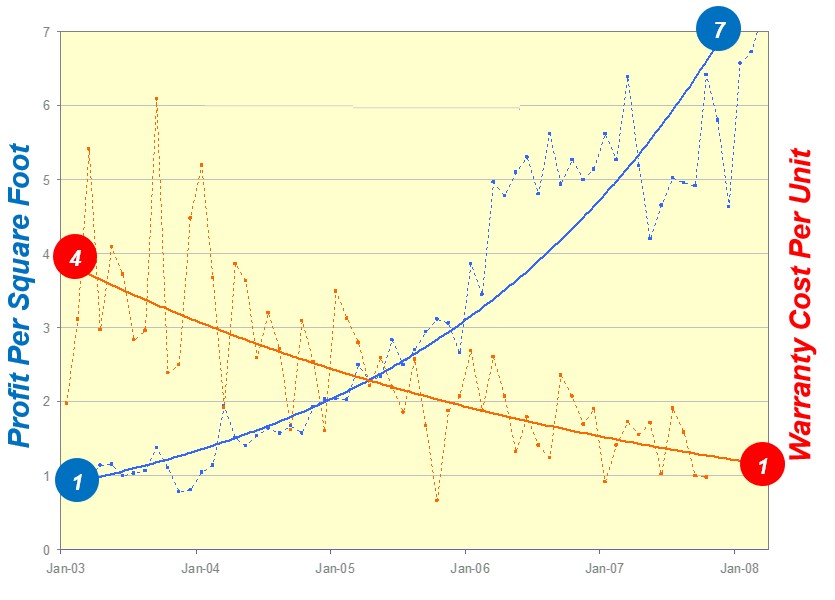
In the workshop, you’ll see real before-and-after examples which will give you a feel for what’s possible; you’ll see real data on part count and cost; you’ll learn how to use data to create a design approach; and you’ll learn the ins and outs of a successful implementation.
And for the first 15 people to register, I am offering a complimentary strategy session after the workshop. To book your 30-minute strategy session, a link will be provided in the registration confirmation email.
Workshop Details
- Topic: Designing Out Product Cost
- Date: 10/29/26 at 11 AM EST
- Price: $100.00
 Posted in A/B Data, DFA, DFMA, Fundementals, How To |
  Tags: Design for Assembly, Engineering Mindset, Product Design, Product Development Engine |
  No Comments »
Product simplification is a battle for hearts and minds.
October 14th, 2026
 With product simplification, it’s a battle for hearts and minds. You cannot simply ask the engineering community to design out half the parts because they don’t think it’s possible. The first step is to help them believe it’s possible.
Posted in Cost Savings, Design Engineers, DFA, DFMA, Downstream Savings, New Thinking, Product Development |
No Comments »
Engineering Leadership Development Is Company-Specific
October 7th, 2026
 Customers buy products. Manufacturing makes the products. Design engineering designs the products. Engineering leaders guide and grow the engineers. In a “start with the customer” way, engineering leaders are important to growing revenue and profitability.
Engineering leadership requires both technical leadership and people leadership. You need to understand the technology, or you can’t use good professional judgement. And you need to understand people, or you can’t create the conditions for them to do work they thought was impossible. (I call this the almost impossible.)
Is it 90% technical and 10% people? Or is it 90% people and 10% technical? Or is it split down the middle at 50-50? The answer is yes. Sometimes it’s a 90/10 meeting followed by a 50/50 conversation in the hall. Sometimes it’s 10/90 for a whole week. Sometimes it’s 90/10 in the morning and 10/90 in the afternoon. Once in a while it’s 100/0 for a hot minute or 0/100 on rare occasions. (Most of the time, though, it feels like 75/75.) A great engineering leader must know technology and people and must know how to set their balance based on the context.
I think the curriculum for an engineering leadership development program must be context-specific. And because each company’s context is different, I think an engineering leadership development program should be company-specific. The new product development process is unique. The products are unique. The analytical tools and how they’re used are unique. The ins and outs of the design reviews are different. So, when in doubt, I suggest you make your engineering leadership development process more company-specific and use context-specific artifacts and examples.
More specifically, I think the curriculum to teach new product development is the new product development projects themselves. Junior engineering leaders work alongside senior engineering leaders during the actual projects in an apprenticeship way. The senior leader demonstrates an activity, and the junior leader watches. Next time, the senior leader demonstrates less, and the junior leader does more. This responsibility balance shifts over time until the junior leader demonstrates and the senior leader doesn’t have to watch anymore. The junior leader is certified activity by activity under the guidance of a senior leader. And when the junior leader has demonstrated all the necessary activities, they become a senior leader. And the cycle continues.
Companies win when their customers buy their products. And I think one of the best ways to do that is a formal (company-specific) program to develop engineering leaders.
Image credit – Willy Verhulst.
Posted in Fundementals, Leadership, Product Development |
Tags: Piano Teacher, Trust-based approach, Understanding Physics |
No Comments »
Improvement Goals Are Arbitrary
September 30th, 2026
 We do our best, and it’s either good enough or it isn’t. But it IS our best. Some questions: How was the good/not good bar set? Who set it? Was the bar set unreasonably? Were the measurement criteria clear? Was there agreement on the good/not good delineation? Does there need to be agreement? If there’s a disagreement, how is it arbitrated? Can there be disagreement?
Truth is, all goals, including the goals used to decide if you did a good job last year, are arbitrary.
20% improvement over last year. Arbitrary. Why not 21%?
15% faster than last time. Arbitrary. Why not 85%? Or 300%?
80% more “things” than last year. Arbitrary. Why not 9%?
If you do a sh*tty job last year, wouldn’t that set next year’s bar arbitrarily low?
Unless, of course, last year’s bar was set arbitrarily high and you actually did a great job.
If your leader likes what you did last year, you’ll get a good rating. And how do they decide if they like what you did last year? Kinda arbitrary.
If you made your leader look good last year, you’ll get a good review. But someone else arbitrarily set your leader’s good/bad threshold. One step removed from you, but still arbitrary.
If you do what you say you’ll do, that’s not arbitrary.
If you keep your promises, that’s not arbitrary.
If you help people, that’s not arbitrary. (And they will remember you helped them.)
If you tell the truth, that’s not arbitrary.
If you treat people with respect, that’s not arbitrary.
If you see something then say something, that’s not arbitrary.
If you listen to people, that’s not arbitrary.
If you treat people with kindness, that’s not arbitrary.
If you advocate for people, that’s not arbitrary.
If you say what everyone else is afraid to say, that’s not arbitrary.
When you take responsibility, that’s not arbitrary.
When you maintain someone’s confidence, that’s not arbitrary.
When you take action, that’s not arbitrary.
When you care, that’s not arbitrary.
When you help the team laugh, that’s not arbitrary.
When you give guidance, that’s not arbitrary.
When you tell people they did a good job, that’s not arbitrary.
When you ask people what they’re working on, that’s not arbitrary.
When you demonstrate trust, that’s not arbitrary.
Improvement goals are arbitrary.
Demonstrating that you care is not.
Image credit — Marcin Wichary
Working With Someone For A Long Time
September 23rd, 2026
 When you see others get promoted, what do you do? Do you beat yourself up because you didn’t get promoted? Are you happy for them? A little of both?
When someone you worked with for a long time gets a wonderful new role outside the company, what do you do? Do you hold onto the fact that things will be harder for you because they won’t be there for you? Do you worry about the organizational gap that you’ll be asked to fill? Do you actively celebrate their good fortune and praise them to the sky?
When you work with someone for a long time, you build trust. And trust allows you to have difficult conversations. You can talk about the real deal. You can discuss situations that have strong emotional energy. You can get to the real root cause, however inconvenient. You can share your fears and struggles. You can support each other in bad times and celebrate success in good times. When you have trust, it’s less lonely for both of you.
When the person you work with for a long time is a pro, they teach you because you are willing to learn from them. And you teach them because they’re willing to learn from you. They elevate their pro-ness, and so do you. Sure, it feels good to both of you, but it also feels good to the broader organization.
When you work with someone for a long time, you invest in each other. You don’t keep score; you simply invest. They need some investment, and you give it freely. And when they need some investment, you don’t hesitate. You grow from the giving as much as the receiving. This respectful give-and-take ratchets up performance on both sides of the interaction.
I think working with someone for a long time creates immense value. However, I think it’s difficult to measure and takes time to develop and yield fruit. I don’t think companies can effectively calculate the return on investment of its people working together for a long time, but that’s okay. There is great personal value that comes from working with someone for a long time. And I think that’s reason enough to find someone to invest in for the long haul.
Image credit — Veit (Can I trust you?)
The Most Important Question – What do we do next?
September 16th, 2026
 With companies, there are always competing demands and too few resources. Always. Don’t feel special. And there is always noise in the signals. Always. And it always comes down to a single question:
What do we do next?
Don’t believe me? Think about your meetings last week. During the meetings, there was discussion about the current situation followed by discussion on what to do next. And at the end of the meetings, there were lists of things to do next. Those things may not get done, but there were lists of things to do next.
The competing demands create the set of possible problems to address. And the problems are inputs to the critical decision: What do we do next? The demands are not fully defined, which adds noise to the decision process, and there is no agreement on the underlying problem, if the problem is formulated at all. This adds noise to the signal. There are more demands/problems than resources, and they compete with each other for the small pool of unallocated resources and the sea of double-booked resources. This creates emotional stress and also adds noise to the signal.
Situation Normal for all companies: Partially formed (competing) demands, disagreement on the relative priority of the ill-formed demands, incomplete (or missing) problem formulation, limited understanding of the required resources other than everyone knows there are more demands/problems than resources, and immense pressure to violate resource constraints.
I cannot give you a recipe to answer the all-important question (What do we do next?), but I can suggest ways to reduce the noise and better assess the options.
Spend some time formally fleshing out the demands before the meeting. Dig in. Bring data. What is the output required? Who is asking for it? What are the inputs? What happens if we do it? What happens if we don’t? Come to the meeting with your analysis, but call it “a draft”. Let others ask questions and challenge your assumptions. Don’t be defensive. They are not attacking you; they are trying to improve understanding to make a better decision.
The cost of making a bad decision is immense, so it makes sense to spend a lot of time preparing a good description/assessment. The cost of over-preparing is low, so over-prepare. Here’s a rule:
For big decisions, preparation time should be at least ten times longer than your first estimate.
Another type of assessment is often overlooked. It’s the assessment of how well the opportunity fits with what you do well, with how you do things, and with the dispositional state of the larger system. In short, you’re trying to answer: Is it easy?
Here are some things to consider to answer the “Is it easy?” question. If the opportunity requires new knowledge, skills, and abilities, it will not be easy. If it requires you to work in different ways with new partners, it will not be easy. If it cuts against an industry trend, it won’t be easy. This is not an exhaustive list, and you should come up with your own assessment themes. To be clear, though, these lines of assessment are different than “How many people do we need?”
Here’s a rule:
You can’t run a marathon wearing running shoes that are three sizes too small.
There is nothing wrong with having too many good opportunities and too many competing demands. In fact, I think that’s a good sign. I think it says you are in high demand. And there is nothing wrong with having too few resources because, again, it means you’re in high demand. I’ve never met a profitable company that had too few opportunities and too many resources.
Image credit — Mitchell Hirsch
Posted in Assumptions, Clarity, Decisions |
Tags: Competitiveness, Problems, Product Development Engine |
No Comments »
Two Ways To Look At It
September 9th, 2026
 See something TO say something.
Say something TO do something.
Gotta get it right TO gotta give it a try.
Progress BEFORE perfection.
I failed TO I learned.
Can’t be done TO here’s how.
It might not work TO I’ll do it anyway.
Progress AT THE EXPENSE OF perfection.
Me TO we.
My way or the highway TO what do you think?
Why BEFORE what.
This will be difficult AND we’ll do it together.
Them TO us.
Condemnation TO best intention.
Don’t do that TO why not try this?
This is what I expect BEFORE this is not good.
You messed up TO how can I help?
What BEFORE how.
Do this TO what should we do?
Finish BEFORE starting.
Quiet criticism TO public praise.
Image credit — Fraser Mummery
Posted in Authentic, Clarity, How To, Seeing Things As They Are, Trust |
Tags: Words |
No Comments »
Product design is limiting the next level of profits.
September 2nd, 2026
 Process, process, process. Everything has been about process improvement over the last decade. And Lean has had a good run. But let’s face it. Its improvements have diminished, and it has largely hit a wall. And yet, we are doubling down on this tired old horse.
S-curves are real. Improvements are slow in the early stages, steep in mid-life, and they roll off as the system hits its asymptotic constraint. And that’s where Lean is now. It has hit its physical constraints defined by the product design. Yes, I said the product is the constraint. And without a radical change to the product, the next level of process improvement is blocked from coming to be. But it’s not as bad as it seems. In a sense, the bad news is the good news.
Over the last couple of decades, we forgot that the total cost is largely defined by the product design, not the manufacturing process. The design engineering community has been let off the hook and has not been tasked with designing the product with less material cost or designing it in a way that opens up space for the next generation of process simplification (Lean). The bad news is the product design has not changed and is blocking the next evolution of Lean. The good news is that because the product design hasn’t changed, it’s ripe for radical cost reduction. And the better news – changing the product itself can reduce material cost, and the material cost is at least 75% of the total cost. And, by definition, Lean, in its current and future embodiments, cannot reduce material cost. The only way to reduce material cost is to change the product design.
Lean has saved money, but because it cannot make changes to the product itself, it can only reduce labor cost. Here’s the math. If material cost is 75% of total cost, overhead is 5%, and labor cost is 20%, the domain of Lean’s savings has always been limited to about 20% of total cost. (There has never been a project that successfully reduced overhead, so that’s always off limits.) When the product itself becomes open to change, the potential for cost reduction is almost four times larger (20% to 70%). And that’s the good news. But the good news is also the bad news.
Yes, if the design can be changed, cost savings can be astronomical. But the bad news – there are no engineering leaders who know how to do it. And without engineering leaders advocating for, cajoling, prodding, and teaching product simplification, the engineering team cannot and will not pull it off.
The tools for product simplification exist, but the appreciation for their power has aged out with the previous generation of engineering leaders. And the knowledge of how to wield the tools has also aged out.
If you want to open up the next level of company profitability, you’ve got to simplify the product. Full stop. And if you want to achieve those 4X savings, you’ve got to hire an old pro who has done it before. Yes, I said old. (Maybe “experienced” is a better word?)
And before you get the bad idea to research the history of product simplification and the associated tools in the hopes of doing it on your own, don’t. More than anything, this journey is an emotional journey. You have to create the right conditions for the engineers to succeed, and that knowledge is not captured in the history books.
If you want to succeed, you’ll have to hire an old pro. This is The Way.
Image credit — Crosa
Map The Territory Before Improving It
August 26th, 2026
 I had the best teachers. They taught me to assess the situation as it is before trying to improve it. Early in my career, my leaders did not understand the importance of spending the time to define the current state. Hurry up and fix it! Why are you spending time analyzing the existing product? Why do you want to create a functional analysis of the product we want to obsolete? Why do you want to understand why customers purchased our legacy products?
By assessing the system/products as they are, I learned how to identify the elements to reuse, to improve, and to reinvent. This has been a great way to focus the resources on the most important elements and increase the intensity the allocated resources. When you don’t spend time on the 50% of the system that can be reused, you double the resource intensity over a complete redesign.
So, I ask you – how do you decide what can be reused, what must be improved, and what must be reinvented?
Regardless of the system’s size or scope of the project, assessing the current state is the right first step. For example, there is great interest in improving the business model. First question (that no one can answer) – What is our business model? There are tools to define business models visually to show the partners, competitors, customers, data flow, money flow, product flow. The tools show who does what to whom and how, who helps whom and how, and what’s missing. One of the tools I like is Wardley Maps. While Simon (Wardley) doesn’t talk much about mapping business models, I’ve misused his maps for business model mapping.
A rule for business models: If you can’t describe your business model visually on one page, you don’t know what your business model is and you can’t improve it.
And assessing the current state is effective at the leaf-level (the lowest level). Mapping the system functionally (functional decomposition with Axiomatic Design) and defining a problem rigorously (TRIZ), allows the team to place the problem in the context of the whole system AND to define the problem at the smallest level possible (think telescope to microscope).
A rule for problems – There’s nothing worse than solving the wrong problem, so you better be sure you’re solving the right one.
A long time ago, I led a project that took the time to assess the baseline product (existing product) for cost, part count, and part type. Using DFMA, ee knew where the parts were, and we designed them out and we knew where the cost was and we designed it out. It took a “long time” to do that work, but we radically improved the profitability of the new product (7X improvement in profit per square foot of the factory). We also did a full functional decomposition on the baseline product and learn that there was one subsystem that caused trouble with all the electronic systems and created problems for customers. We hardened the design against that subsystem’s devilish energy. And we created robustness tests where we tested the baseline product and demonstrated improved robustness on the new product. (We used TRIZ to solve the right problems.) Those efforts reduced warranty cost per unit by 4X.
Rigorously assessing the current state (products, processes, systems, business models) seems too slow and a big waste of time. It is my experience, though, that it’s faster and improves the outcomes of the new product development and improvement projects.
But don’t take my word for it. Give it a try. And if you need some help, let me know.
Image credit – Calsidyrose
Posted in Business Model, Cost Savings, DFMA, Downstream Savings, Fundementals, How To, Manufacturing Competitiveness, Product Development, Product Robustness, Seeing Things As They Are, TRIZ |
Tags: Design for Assembly, DFMA Culture, Manufacturing Competitveness, Part Count, Problem Definition, Product Development Engine |
No Comments »
Hearing, Talking, and Listening
August 19th, 2026
 Hearing is not listening.
You can hear and choose not to listen.
But if you don’t hear, you can’t listen.
Listening is an active process.
Listening requires energy.
Listening is a choice.
Talking and listening are partners.
Talking appreciates listening and listening appreciates talking.
Talking before listening gets the conversation going.
Continued talking without listening isn’t a conversation.
Skillful talking is informed by listening.
Measure twice and cut once, and it’s the same for listening and talking.
When you talk, you can only hear yourself. Don’t you already know what you know?
Well-timed talking starts after well-timed listening.
Talk less, and you’ll listen more.
And listening helps you say more while you talk less.
Image credit — David Salafia
Moving From Fixing To Growing
August 12th, 2026
 When I was younger, I tried to fix everything right away. See a problem, fix a problem. Regardless of the urgency, I tried to fix it right now. And regardless of the importance, I tried to fix it right now. And because of this, I was always too busy to think things through. And because I was too busy, I was always too tired to bring my whole self to things.
See it and fix it did not work.
When I was younger, when I thought someone was wrong, I would disagree right away. At every meeting I would push on perspectives I disagreed with. In every conversation, I would add nuance to someone’s position to make it righter. These approaches created distance, drained my energy, and limited my effectiveness.
Disagreement at every turn did not work.
And then I was given a project I could not do myself. I had to align and energize a diverse team. My “smartest guy in the room” tactics would not work. And my “always being right” approach would bring about the opposite of what was needed. I realized I needed to work differently. As the team leader, I had to create the conditions for the team members to trust each other and work well together. And to do that, I realized they had to trust me. And to do that, my actions had to match my words, and I had to actively reinforce positive behaviors.
Instead of disagreeing with the team, I showed them the way. Instead of telling them when they were wrong, I helped them do the right work the right way. If they did not know how to do the right work, I showed them. And after they did the right work, I praised them in front of their peers.
Helping the team do the right work led to more good work.
Instead of calling out their mistakes, I prevented the team from making them. I guided them on the approach and watched. If things went well, I praised them. I told them what they did well and why I liked it. I told them loudly so everyone could hear. If things started to head south, I jumped in and shifted the approach toward fertile design space. And instead of my old behavior of calling out the wrongness, I told them I liked the new course heading.
Guiding and praising the team led to more good work.
Instead of taking credit to prove how smart I was, I set up presentations that gave the team members opportunities to show their best work to company leaders. And during those presentations, I told everyone that their work was good. I gave them credit for doing the good work. And that led to them wanting to do more good work.
Creating the condition for the team to show their good work led to more good work.
Through the project, I learned that being right did not matter.
I learned that what mattered was creating the conditions for the right work to happen.
I learned that reinforcing positive behavior was much more powerful than calling out the wrongness.
I learned that putting people in a position to succeed creates more success than anything else.
I learned that people recognize and appreciate when you help them grow and improve.
And I learned that when you help people grow and improve, you develop trust-based relationships that last for decades.
Posted in Authentic, Level 5 Courage, Positivity |
Tags: Lessons Learned, People, Trust-based approach |
1 Comment »
 Mike Shipulski