Archive for the ‘Technology’ Category
Don’t boost innovation, burst it.
 November 19th, 2014
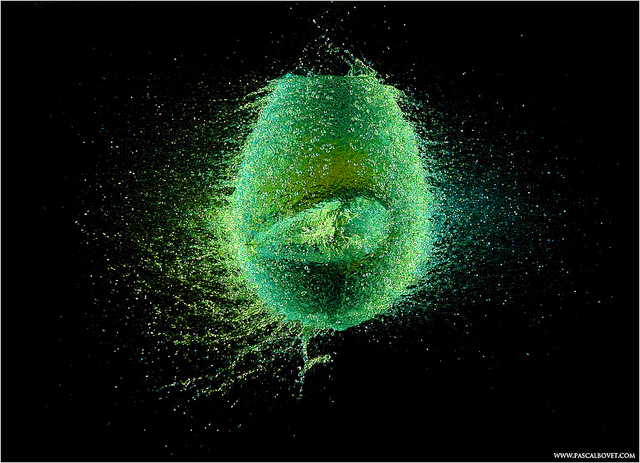 The most difficult part of innovation is starting, and the best way to start is the Innovation Burst Event, or IBE. The IBE is a short, focused event with three objectives: to learn innovation methods, to provide hands-on experience, and to generate actual results. In short, the IBE is a great way to get started.
There are a couple flavors of IBEs, but the most common is a single day even where a small, diverse group gets together to investigate some bounded design space and to create novel concepts. At the start, a respected company leader explains to the working group the importance of the day’s work, how it fits with company objectives, and sets expectations there will be a report out at the end of the day to review the results. During the event, the working group is given several design challenges, and using innovation tools/methods, creates new concepts and builds “thinking prototypes.” The IBE ends with a report out to company leaders, where the working group identifies patentable concepts and concepts worthy of follow-on work. Company leaders listen to the group’s recommendations and shape the go-forward actions.
The key to success is preparation. To prepare, interesting design space is identified using multiple inputs: company growth objectives, new market development, the state of the technology, competitive landscape and important projects that could benefit from new technology. And once the design space is identified, the right working group is selected. It’s best to keep the group small yet diverse, with several important business functions represented. In order to change the thinking, the IBE is held at location different than where the day-to-day work is done – at an off-site location. And good food is provided to help the working group feel the IBE is a bit special.
The most difficult and most important part of preparation is choosing the right design space. Since the selection process starts with your business objectives, the design space will be in line with company priorities, but it requires dialing in. The first step is to define the operational mechanism for the growth objective. Do you want a new product or process? A new market or business model? The next step is to choose if you want to radically improve what you have (discontinuous improvement) or obsolete your best work (disruption). Next, the current state is defined (knowing the starting point is more important than the destination) – Is the technology mature? What is the completion up to? What is the economy like in the region of interest? Then, with all that information, several important lines of evolution are chosen. From there, design challenges are created to exercise the design space. Now it’s time for the IBE.
The foundation of the IBE is the build-to-think approach and its building blocks are the design challenges. The working group is given a short presentation on an innovation tool, and then they immediately use the tool on a design challenge. The group is given a short description of the design challenge (which is specifically constructed to force the group from familiar thinking), and the group is given an unreasonably short time, maybe 15-20 minutes, to create solutions and build thinking prototypes. (The severe time limit is one of the methods to generate bursts of creativity.) The thinking prototype can be a story board, or a crude representation constructed with materials on hand – e.g., masking tape, paper, cardboard. The group then describes the idea behind the prototype and the problem it solves. A mobile phone is used to capture the thinking and the video is used at the report out session. The process is repeated one or two times, based on time constraints and nature of the design challenges.
About an hour before the report out, the working group organizes and rationalizes the new concepts and ranks them against impact and effort. They then recommend one or two concepts worthy of follow on work and pull together high level thoughts on next steps. And, they choose one or two concept that may be patentable. The selected concepts, the group’s recommendations, and their high level plans are presented at the report out.
At the report out, company leaders listen to the working group’s thoughts and give feedback. Their response to the group’s work is crucial. With right speech, the report out is an effective mechanism for leaders to create a healthy innovation culture. When new behaviors and new thinking are praised, the culture of innovation moves toward the praise. In that way, the desired culture can be built IBE by IBE and new behaviors become everyday behaviors.
Innovation is a lot more than Innovation Burst Events, but they’re certainly a central element. After the report out, the IBE’s output (novel concepts) must be funneled into follow on projects which must be planned, staffed, and executed. And then, as the new concepts converge on commercialization, and the intellectual comes on line, the focus of the work migrates to the factory and the sales force.
The IBE is designed to break through the three most common innovation blockers – no time to do innovation; lack of knowledge of how do innovation (though that one’s often unsaid); and pie-in-the-sky, brainstorming innovation is a waste of time. To address the time issue, the IBE is short – just one day. To address the knowledge gap, the training is part of the event. And to address the pie-in-the-sky – at the end of the day there is tangible output, and that output is directly in line with the company’s growth objectives.
It’s emotionally challenging to do work that destroys your business model and obsoletes your best products, but that’s how it is with innovation. But for motivation, think about this – if your business model is going away, it’s best if you make it go away, rather than your competition. But your competition does end up changing the game and taking your business, I know how they’ll do it – with Innovation Burst Events.
Image credit – Pascal Bovet
 Posted in Culture, How To, Innovation, Intellectual Intertia, Problems, Technology, The Future, TRIZ |
  Tags: Creativity, less-with-far-less, Problem Definition, Understanding Physics |
  2 Comments »
What’s your innovation intention?
November 5th, 2014
 If you want to run a brainstorming session to generate a long list of ideas, I’m out. Brainstorming takes the edge off, rounds off the interesting corners and rubs off any texture. If you want me to go away for a while and come back with an idea that can dismantle our business model, I’m in.
If you can use words to explain it, don’t bother – anything worth its salt can’t be explained with PowerPoint. If you need to make a prototype so others can understand, you’ve got my attention.
If you have to ask my permission before you test out an idea that could really make a difference, I don’t want you on my team. If you show me a pile of rubble that was your experiment and explain how, if it actually worked, it could change the game, I’ll run air cover, break the rules, and jump in front of the bullets so you can run your next experiments, whatever they are.
If you load me up to with so many projects I can’t do several I want, you’ll get fewer of yours. If you give me some discretion and a little slack to use it, you’ll get magic.
If, before the first iteration is even drawn up, you ask me how much it will cost, I will tell you what you want to hear. If, after it’s running in the lab and we agree you’ll launch it if I build it, I won’t stop working until it meets your cost target.
If there’s total agreement it’s a great idea, it’s not a great idea, and I’m out. If the idea is squashed because it threatens our largest, most profitable business, I’m in going to make it happen before our competitors do.
If twice you tell me no, yet don’t give me a good reason, I’ll try twice as hard to make a functional prototype and show your boss.
To do innovation, real no-kidding innovation, requires a different mindset both to do the in-the-trenches work and to lead it. Innovation isn’t about following the process and fitting in, it’s about following your instincts and letting it hang out. It’s about connecting the un-connectable using the most divergent thinking. And contrary to belief, it’s not in-the-head work, it’s a full body adventure.
Innovation isn’t about the mainstream, it’s about the fringes. And it’s the same for the people that do the work. But to be clear, it’s not what it may look like at the surface. It’s not divergence for divergence’s sake and it’s not wasting time by investigating the unjustified and the unreasonable. It’s about unique people generating value in unique ways. And at the core it’s all guided by their deep intention to build a resilient, lasting business.
image credit: Chris Martin.
Posted in Authentic, Independence, Innovation, Intellectual Intertia, Level 5 Courage, Technology |
Tags: Competitiveness, Creativity, Trust-based approach |
No Comments »
Starting starts with starting.
October 29th, 2014
 If you haven’t done it before and you want to start, you have only one option – to start.
Much as there’s a huge difference between lightning and lightning bug, there’s a world of difference between starting and talking about starting. Where talking about starting flutters aimlessly flower to flower, starting jolts trees from the ground; fries all the appliances in your house; and leaves a smoldering crater in its wake. And where it’s easy to pick a lightning bug out of the grass and hold it in your hand, it’s far more difficult to grab lightning and wrestle it into submission.
Words to live by: When in mid conversation you realize you’re talking about starting – Stop talking and start starting. Some examples:
Instead of talking about starting a community of peers, send a meeting request to people you respect. Keep the group small for now, but set the agenda, hold the meeting, and set up the next one. You’re off and running. You started.
Replace your talk of growing a culture of trust with actions to demonstrate trust. Take active responsibility for the group’s new work that did not go as planned (aka – failure) so they feel safe to do more new work. Words don’t grow trust, only actions do.
Displace your words of building a culture of innovation with deeds that demonstrate caring. When someone does a nice job or goes out of their way to help, send words of praise in an email their boss – and copy them, of course. Down the road, when you want help with innovation you’ll get it because you cared enough to recognize good work. Ten emails equal twenty benefactors for your future innovation effort. Swap your talk of creating alignment with a meeting to thank the group for their special effort. But keep the meeting to two agenda items – 1. Thank you. 2. Pizza.
When it comes to starting, start small. When you can’t start because you don’t have permission, reduce size/scope until you do, and start. When you’re afraid to start, create a safe-to-fail experiment, and start. When no one asks you to start, that’s the most important time – build the minimum viable prototype you always wanted to build. Don’t ask – build. And if you’re afraid to start even the smallest thing because you think you may get fired – start anyway. Any company that fires you for taking initiative will be out of business soon enough. You might as well start.
Talk is cheap and actions are priceless. And if you never start a two year project you’re always two years away. Start starting.
Image credit – Vail Marston
Orchids and Innovation – Blooms from the Same Stem
October 15th, 2014
 Innovation is like growing orchids – both require a complex balance of environmental factors, both take seasoned green thumbs to sprout anything worth talking about, what worked last time has no bearing on this time, and they demand caring and love.
A beautiful orchid is a result of something, and so is innovation. It all starts with the right seeds, but which variety? Which color? With orchids, there are 21,950 – 26,049 species found in 880 genera and with innovation there are far more options. So which one and why? Well, it depends.
It’s no small feat to grow orchids or innovate:
To propagate orchids from seed, you must work in sterile conditions. The seeds must be grown in a gelatinous substance that contains nutrients and growth hormones. You must also be very patient. It takes months for the first leaves to develop, and, even then, they will only be visible with a magnifying glass. Roots appear even later. It will be at least three, and possibly as many as eight years before you see a bloom. — https://www.gardeners.com/how-to/growing-orchids/5072.html
[This is one of the best operational definitions of innovation I’ve ever seen.]
But there’s another way:
It is far easier to propagate orchids by division. But remember that dividing a plant means forsaking blooms for at least a year. Also, the larger the orchid plant, the more flowers it will produce. Small divisions take many years to mature. — https://www.gardeners.com/how-to/growing-orchids/5072.html
So do you grow from seed or propagate by division? It depends. There are strengths and weaknesses of both methods, so which best practice is best? Neither – with orchids and innovation no practices are best, even the ones described in the best books.
If you’ve been successful growing other flowers, you’re success is in the way and must be unlearned. Orchids aren’t flowers, they’re orchids. And if you’ve been successful with lean and Six Sigma, you’ve got a culture that will not let innovation take seed. Your mindset is wrong and you’ve got to actively dismantle the hothouse you’ve built – there’s no other way. Orchids and innovation require the right growing climate – the right soil, the right temperature, the right humidity, the right amount of light, and caring. Almost the right trowel, almost the right pot, and almost the right mindset and orchids and innovation refuse to flower.
And at the start the right recipe is unknown, yet the plants and the projects are highly sensitive to imperfect conditions. The approach is straightforward – start a lot of seeds, start a lot of propagation experiments, and start a lot of projects. But in all cases, make them small. (Orchids do better in small pots.)
Good instincts are needed for the best orchids to come to be, and these instincts can be developed only one way – by growing orchids. Some people’s instincts are to sing to their orchids and some play them classical music, and they’re happy to do it. They’re convinced it makes for better and fuller blooms and who’s to say if it matters? With orchids, if you think it matters, the orchids think it matters, so it matters. And let’s not kid ourselves – innovation is no different.
With orchids and innovation, mindset, instincts, and love matter, maybe more than anything else. And for that, there are no best practices.
Image credit — lecercle.
Customer Value – the Crowned Jewel of Innovation
September 24th, 2014

Innovation results in things that are novel, useful, and successful. These things can be products, services, data, information, or business models, but regardless of the flavor, they’re all different from what’s been done before.
And when things are different, they’re new; and that means we don’t know how to do them. We don’t know how to start; don’t know how to measure; don’t know how they’ll be received; don’t know if they’ll be successful.
In the commercial domain, successful means customers buy your products and pay for your services. When customers value your new stuff more than they value their money, they pay; and when they pay it’s success. But first things first – before there can be success, before there can be innovation, there must be customer value. With innovation, customer value is front and center.
How do you come up with ideas that may have customer value? There’s a goldmine of ideas out there, with some veins better than others, and any dowsing you can use to pan the high grade ore is time well spent. There are two tools of choice: one that channels the voice of the customer and a second that channels the voice of the technology.
Your technology has evolved over time and has developed a trajectory which you can track. (Innovation On Demand, Fey and Riven.) But at the highest level, as a stand-in for technology, it’s best to track the trajectory of your products – how they’ve improved over time. You can evaluate how your products improved over multiple lines of evolution, and each line will help you to channel the future from a different perspective.
The voice of your customers is the second divining rod of choice. What they say about you, your company, and your products can help you glean what could be. But this isn’t the same as VOC. This is direct, unfiltered, continuous real time capture of self-signified micro stories. This is VOC without the soothsaying, this is direct connection with the customer. (Sensemaker.)
There are two nuggets to pan for: limiting cant’s and purposeful misuse. You seek out groups of customer stories where customers complain about things your product cannot do and how those cant’s limit them. These limiting cant’s are ripe for innovation since your customers already want them. Purposeful misuse is when the radical fringe of your customer base purposely uses your product in a way that’s different than you hoped. These customers have already looked into the future for you.
Do these ideas have customer value? The next step is to evaluate the value of your diamonds in the rough. The main point here is only customers can tell you if you’ve hit the mother lode. But, since your ideas are different than anything they’ve experienced, in order assay the ideas you’ve got to show them. You’ve got to make minimum viable prototypes and let them use their loop to judge the potential cut, color, clarity, and carat. As a prospector, it’s best to evaluate multiple raw gemstones in parallel, and whatever customers say, even if you disagree, the learning is better than gold.
How can we deliver on the customer value? With your innovations in the rough – ideas you know have customer value – it’s time to figure out what it will take to convert your pyrite prototypes into 24 carat products. There are missing elements to be identified and fundamental constraints to be overcome and backplane of the transmutation is problem definition. Done right, the technology development work is a series of well-defined problems with clear definitions of success. From the cleaving, blocking and cutting of technology development the work moves to the polishing of product development and commercialization.
Innovation can’t be fully defined with a three question framework. But, as long as customer value is the crowned jewel of your innovation work, most everything else will fall into place.
Posted in How To, Innovation, Technology, TRIZ, VOC |
Tags: Problem Definition, Understanding Physics |
No Comments »
If it’s not different, it’s not innovation.
September 10th, 2014
 Creative products are novel and useful; Innovative products are novel, useful, and successful. Beforehand, it’s impossible to know if something will be successful, but if it’s useful there’s a chance it could be; beforehand, it’s subjective whether something will be useful, but if it’s novel there’s a chance; but no one is sure what novel means, so replace it with “different” and you’re onto something. It’s clear if something is different, and if it’s different, there’s a chance it could be creative and innovative. Said another way,
if something isn’t different it cannot be creative, nor can it be innovative.
If you can generate more things that are different, you’ve increased your chances of creativity and innovation. And if you generate more ideas that are different, you’ll create more things that are different. Go on a quest to create more ideas that are different and you’ll have more creativity and innovation.
Ideas that are different come from the firing of different neural pathways. And to get different pathways to fire, you’ve got to first recognize when the old ones are firing. To do this, you’ve got to be aware of your worn pathways and be aware you’re reusing the overused. A different environment is needed – an environment that governs speed. If you have a culture of speed and productivity, this will be different. It doesn’t matter what the different environment is, it matters what it isn’t.
Different ideas result from the collision of old ideas seen from a new perspective. Put different people together who have different old ideas and different perspectives and different ideas will grow from the collisions. There’s no recipe for the exact distribution of people, but if you don’t put them together now, then those are them.
And to break new neural pathways, the environment in which ideas should be different. Again, there’s no prescription for the type of space or the furniture, just that it’s different. If the engine that creates the old ideas lives in an ordered space, make the different one disordered; if there’s carpet all around, lay down some linoleum; if there’s no art on the corporate walls, hang some; if the furniture matches across the teams, make it a clustered-jumble of mismatched pieces. The general approach: whatever it looks like and feels like where the same ideas are regurgitated day-in-day-out, do the opposite.
And to attract different colliders and their ideas, provide something different in the different space. If your regular coffee is terrible, the different coffee should be amazing; where people queue up to use the same tired tools, provide too many seats of the newest and best; where low fat, low calorie, responsible food is doled out in reasonable portions, provide free (and unlimited) access to irresponsible junk food.
Creativity and innovation start with different.
Image credit: quinet.
Posted in Imagination, Independence, Innovation, Intellectual Intertia, Level 5 Courage, Technology |
Tags: Engineering Mindset |
No Comments »
Prototypes Are The Best Way To Innovate
September 3rd, 2014
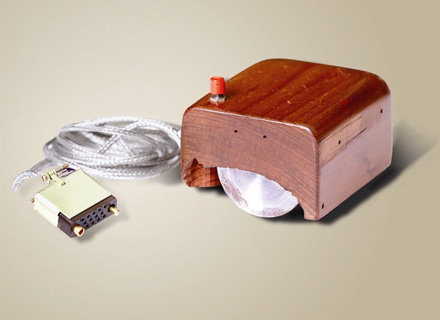 If you’re serious about innovation, you must learn, as second nature, to convert your ideas into prototypes.
Funny thing about ideas is they’re never fully formed – they morph and twist as you talk about them, and as long as you keep talking they keep changing. Evolution of your ideas is good, but in the conversation domain they never get defined well enough (down to the nuts-and-bolts level) for others (and you) to know what you’re really talking about. Converting your ideas into prototypes puts an end to all the nonsense.
Job 1 of the prototype is to help you flesh out your idea – to help you understand what it’s all about. Using whatever you have on hand, create a physical embodiment of your idea. The idea is to build until you can’t, to build until you identify a question you can’t answer. Then, with learning objective in hand, go figure out what you need to know, and then resume building. If you get to a place where your prototype fully captures the essence of your idea, it’s time to move to Job 2. To be clear, the prototype’s job is to communicate the idea – it’s symbolic of your idea – and it’s definitely not a fully functional prototype.
Job 2 of the prototype is to help others understand your idea. There’s a simple constraint in this phase – you cannot use words – you cannot speak – to describe your prototype. It must speak for itself. You can respond to questions, but that’s it. So with your rough and tumble prototype in hand, set up a meeting and simply plop the prototype in front of your critics (coworkers) and watch and listen. With your hand over your mouth, watch for how they interact with the prototype and listen to their questions. They won’t interact with it the way you expect, so learn from that. And, write down their questions and answer them if you can. Their questions help you see your idea from different perspectives, to see it more completely. And for the questions you cannot answer, they the next set of learning objectives. Go away, learn and modify your prototype accordingly (or build a different one altogether). Repeat the learning loop until the group has a common understanding of the idea and a list of questions that only a customer can answer.
Job 3 is to help customers understand your idea. At this stage it’s best if the prototype is at least partially functional, but it’s okay if it “represents” the idea in clear way. The requirement is prototype is complete enough for the customer can form an opinion. Job 3 is a lot like Job 2, except replace coworker with customer. Same constraint – no verbal explanation of the prototype, but you can certainly answer their direction questions (usually best answered with a clarifying question of your own such as “Why do you ask?”) Capture how they interact with the prototype and their questions (video is the best here). Take the data back to headquarters, and decide if you want to build 100 more prototypes to get a broader set of opinions; build 1000 more and do a small regional launch; or scrap it.
Building a prototype is the fastest, most effective way to communicate an idea. And it’s the best way to learn. The act of building forces you to make dozens of small decisions to questions you didn’t know you had to answer and the physical nature the prototype gives a three dimensional expression of the idea. There may be disagreement on the value of the idea the prototype stands for, but there will be no ambiguity about the idea.
If you’re not building prototypes early and often, you’re not doing innovation. It’s that simple.
Ratcheting Toward Problems of a Lesser Degree
August 27th, 2014

Here’s how innovation goes:
(Words uttered. // Internal thoughts.)
That won’t work. Yes, this is a novel idea, but it won’t work. You’re a heretic. Don’t bring that up again. // Wow, that scares me, and I can’t go there.
Yes, the first experiment seemed to work, but the test protocol was wrong, and the results don’t mean much. And, by the way, you’re nuts. // Wow. I didn’t believe that thing would ever get off the ground.
Yes, you modified the test protocol as I suggested, but that was only one test and there are lots of far more stressful protocols that surely cannot be overcome. // Wow. They listened to me and changed the protocol as I suggested, and it actually worked!
Yes, the prototype seemed to do okay on the new battery of tests, but there’s no market for that thing. // I thought they were kidding when they said they’d run all the tests I suggested, but they really took my input seriously. And, I can’t believe it, but it worked. This thing may have legs.
Yes, the end users liked the prototypes, but the sample size was small and some of them don’t buy any of our exiting products. I think we should make these two changes and take it to more end users. // This could be exciting, and I want to be part of this.
Yes, they liked the prototypes better once my changes were incorporated, but the cost is too high. // Sweet! They liked my design! I hope we can reduce the cost.
I made some design changes that reduce the cost and my design is viable from a cost standpoint, but manufacturing has other priorities and can’t work on it. // I’m glad I was able to reduce the cost, and I sure hope we can free up manufacting resources to launch my product.
Wow, it was difficult to get manufacturing to knuckle down, but I did it, and my product will make a big difference for the company. // Thanks for securing resources for me, and I’m glad you did the early concept work when I was too afraid.
Yes, my product has been a huge commercial success, and it all strarted with this crazy idea I had. You remember, right? // Thank you for not giving up on me. I know it was your idea. I know I was a stick-in-the-mud. I was scared. And thanks for kindly and effectively teaching me how to change my thinking. Maybe we can do it again sometime.
________________
There’s nothing wrong with this process; in fact, everything is right about it because that’s what people do. We’ve taught them to avoid risk at all costs, and even still, they manage to walk gingerly toward new thinking.
I think it’s important to learn to see the small shifts in attitude as progress, to see the downgrade from an impossible problem to a really big problem as progress.
Instead of grabbing the throat of radical innovation and disrupting yourself, I suggest a waterfall approach of a stepwise ratchet toward problems of a lesser degree. This way you can claim small victories right from the start, and help make it safe to try new things. And from there, you can stack them one on top of another to build your great pyramid of disruption.
And don’t forget to praise the sorceres and heretics who bravely advance their business model-busting ideas without the safety net of approval.
Posted in Culture, Fear, How To, Innovation, New Thinking, Seeing Things As They Are, Technology |
Tags: Engineering Mindset, Problems, Trust-based approach |
No Comments »
Occam’s Razor For Innovation
June 18th, 2014
 There are many flavors of innovation – incremental, disruptive, and seven flavors in between. And there is lots of argument about the level of innovation – mine’s radical and yours isn’t; that’s just improving what we already have; that’s too new – no one will ever buy it. We want to label the work in order to put it in the right bucket, to judge if we’re doing the right work. But the labels get in the way – they’re loaded with judgments, both purrs and snarls.
Truth is, innovation work falls on a continuum of newness and grouping them makes little sense. And, it’s not just newness that matters – it’s how the newness fits (or doesn’t) within the context of how things happen today and how customers think they should happen tomorrow. So what to do?
Customers notice the most meaningful innovations, and they notice the most meaningful ones before the less meaningful. Evaluate the time it takes a customer to notice the innovation and there may be hope to evaluate the importance of the innovation.
The technology reduces cost, and at the end of the month when the numbers are rolled up the accountants can see the improvement. This is real improvement, but there’s a significant lag and the people doing the work don’t see it as meaningful. This one’s a tough sell – buy this new thing, train on it, use it for three months, and if you keep good records and do some nifty statistics you’ll see an improvement.
The technology reduces scrap, and at the end of the week the scrap bin will be half full instead of fully full. Scrap is waste and waste reduction is real improvement. This is an easier sell – buy it and train on it and at the end of the week you’ll notice a reduction in scrap. This is important but only to those who are measured on scrap. And today the scrap is emptied every week, now we can empty it every other week. The time to notice is reduced, but the impact may not be there.
The technology increases throughput, and at the end of the shift the bins will be fuller than full. Here – try it for a shift and see what you think. If you like it, you can buy it. I’ll be back tomorrow with a quote. This is noticeable within eight hours. And at the end of eight hours there are more things that can be sold. That’s real money, and real money gets noticed.
The technology makes the product last two hours instead of one. Here – try it for a couple hours. I’ll go get a coffee and come back and see what you think. You won’t have to stop the machine nearly as often and you’ll put more parts into finished goods inventory. The technology gets noticed within two hours and the purchase order is signed in three.
Where the old technology was load, this is quiet. Don’t bother with ear protection, just give it a go. Pretty cool, isn’t it. Go get your boss and I’ll sell you a couple units right now. This one shows its benefits the end user right away – first try.
The most meaningful innovations get noticed instantly. Stop trying to label the innovation and simply measure how long it takes your customer to notice.
Posted in Innovation, Intellectual Intertia, New Thinking, Seeing Things As They Are, Technology, Uncategorized |
Tags: Creativity, time |
No Comments »
The Ladder Of Your Own Making
April 30th, 2014
 There’s a natural hierarchy to work. Your job, if you choose to accept it is to climb the ladder of hierarchy rung-by-rung. Here’s how to go about it:
Level 1. Work you can say no to – Say no to it. Say no effectively as you can, but say it. Saying no to level 1 work frees you up for the higher levels.
Level 2. Work you can get someone else to do – Get someone else to do it. Give the work to someone who considers the work a good reach, or a growth opportunity. This isn’t about shirking responsibility, it’s about growing young talent. Maybe you can spend a little time mentoring and the freed up time doing higher level work. Make sure you give away the credit so next time others will ask you for the opportunity to do this type of work for you.
Level 3. Work you’ve done before, but can’t wiggle out of – Do it with flair, style, and efficiency; do it differently than last time, then run away before someone asks you to do it again. Or, do it badly so next time they ask someone else to do it. Depending on the circumstance, either way can work.
Level 4. Work you haven’t done before, but can’t wiggle out of – Come up with a new recipe for this type of work, and do it so well it’s unassailable. This time your contribution is the recipe; next time your contribution is to teach it to someone else. (See level 2.)
Level 5. Work that scares others – Figure out why it scares them; break it into small bites; and take the smallest first bite (so others can’t see the failure). If it works, take a bigger bite; if it doesn’t, take a different smallest bite. Repeat, as needed. Next time, since you’ve done it before, treat it like level 3 work. Better still, treat it like level 2.
Level 6. Work that scares you – Figure out why it scares you, then follow the steps for level 5.
Level 7. Work no one knows to ask you to do – You know your subject matter better than anyone, so figure out the right work and give it a try. This flavor is difficult because it comes at the expense of work you’re already signed up to do and no one is asking you to do it. But you should have the time because you followed the guidance in the previous levels.
Level 8. Work that obsoletes the very thing that made your company successful – This is rarified air – no place for the novice. Ultimately, someone will do this work, and it might as well be you. At least you’ll be able to manage the disruption on your own terms.
In the end, your task, if you choose to accept it, is to migrate toward the work that obsoletes yourself. For only then can you start back at level 1 on the ladder of your own making.
Posted in Authentic, Fear, Intellectual Intertia, Level 5 Courage, New Thinking, Risk, Technology |
Tags: Competitiveness, Engineering Mindset |
No Comments »
Crossword Puzzle – Product, Technology, Innovation
November 26th, 2013
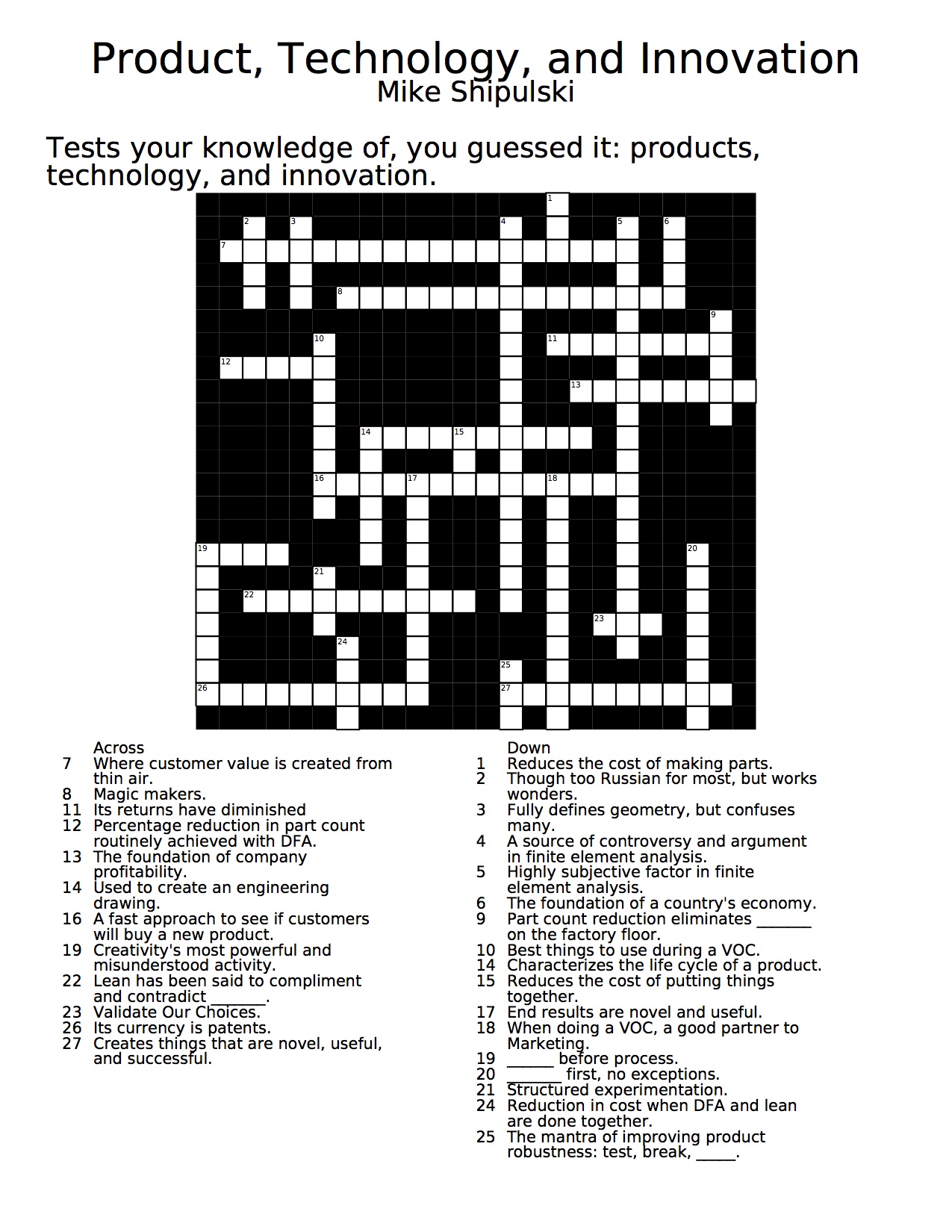
Here’s something a little different – a crossword puzzle to test your knowledge on products, technology, and innovation. Complete the puzzle using the image below, or download it (and answer key) using the green arrows below, and take your time with it over the Thanksgiving holiday.
[wpdm_file id=5]
[wpdm_file id=4]
Posted in Design Engineers, DFA, Innovation, Product Development, Product Robustness, Technology |
Tags: Crossword Puzzle |
No Comments »
 Mike Shipulski