Archive for the ‘Part Count Reduction’ Category
Pull the product lever, now.
 April 6th, 2011
 If you’re reading this you’ve probably survived the great recession. You had to do some radical stuff, but you pulled it off. You cut to the bone as demand fell off, but you managed to shed staff and capacity and kept your company alive. Congratulations. Amazing work. But now the hard part: increased demand!
Customers are ordering, and they want product now. You’re bringing on capacity, re-hiring, and re-training, and taking waste out of your processes with lean and even extending lean to your supply chain and logistics. You’re pulling the levers as hard as you can, but you know it won’t be enough. What you need is another lever, a big, powerful, magical lever to make everything better. You need to pull the product lever.
So, you’re telling me to look at my product as a way to meet increased demand? Yes. To get more products out of few factories? Yes. To make more products with a short staff? Yes. To reduce supply chain complexity? Yes. Pull the product lever, pull it hard, and pull it now.
But meeting increased demand is a manufacturing/supply chain problem, right? No. What about flogging suppliers for unreasonably short lead times? No. What about quickly bringing on unproven suppliers? No. What about bringing on a totally new factory by next week? No. What about using folks of the street to make the product? No. Pull the product lever, pull hard, and pull it now.
Dust off the value stream map of your supply chain and identify the three longest lead times, and design them out of your product. Dust off your routings and identify the three largest labor times, and design them out of our product. Dust off your BOMs and identify the three highest cost parts, and design them out of your product. Pull the product lever. Then, identify the next three, and pull it again. Then repeat. Pull it hard, and pull it now.
Meeting increased demand will be challenging, but your customers and stockholders deserve your best. So, pull hard on all your levers, and pull them now.
Too afraid to make money and create jobs.
January 26th, 2011
 What if you could double your factory throughput without adding people?
What if you could reduce your product costs by 50%?
How much money would you make?
How many jobs would you create?
Why aren’t you doing it?
What are you afraid of?
A Unifying Theory for Manufacturing?
January 5th, 2011
 The notion of a unifying theory is tantalizing – one idea that cuts across everything. Though there isn’t one in manufacturing, I think there’s something close: Design simplification through part count reduction. It cuts across everything – across-the-board simplification. It makes everything better. Take a look how even HR is simplified.
HR takes care of the people side of the business and fewer parts means fewer people – fewer manufacturing people to make the product, fewer people to maintain smaller factories, fewer people to maintain fewer machine tools, fewer resources to move fewer parts, fewer folks to develop and manage fewer suppliers, fewer quality professionals to check the fewer parts and create fewer quality plans, fewer people to create manufacturing documentation, fewer coordinators to process fewer engineering changes, fewer RMA technicians to handle fewer returned parts, fewer field service technicians to service more reliable products, fewer design engineers to design fewer parts, few reliability engineers to test fewer parts, fewer accountants to account for fewer line items, fewer managers to manage fewer people.
Before I catch hell for the fewer-people-across-the-board language, product simplification is not about reducing people. (Fewer, fewer, fewer was just a good way to make a point.) In fact, design simplification is a growth strategy – more output with the people you have, which creates a lower cost structure, more profits, and new hires.
A unifying theory? Really? Product simplification?
Your products fundamentally shape your organization. Don’t believe me? Take a look at your businesses – you’ll see your product families in your org structure. Take look at your teams – you’ll see your BOM structure in your org structure. Simplify your product to simplify your company across-the-board. Strange, but true. Give it a try. I dare you.
I don’t know the question, but the answer is jobs.
December 22nd, 2010
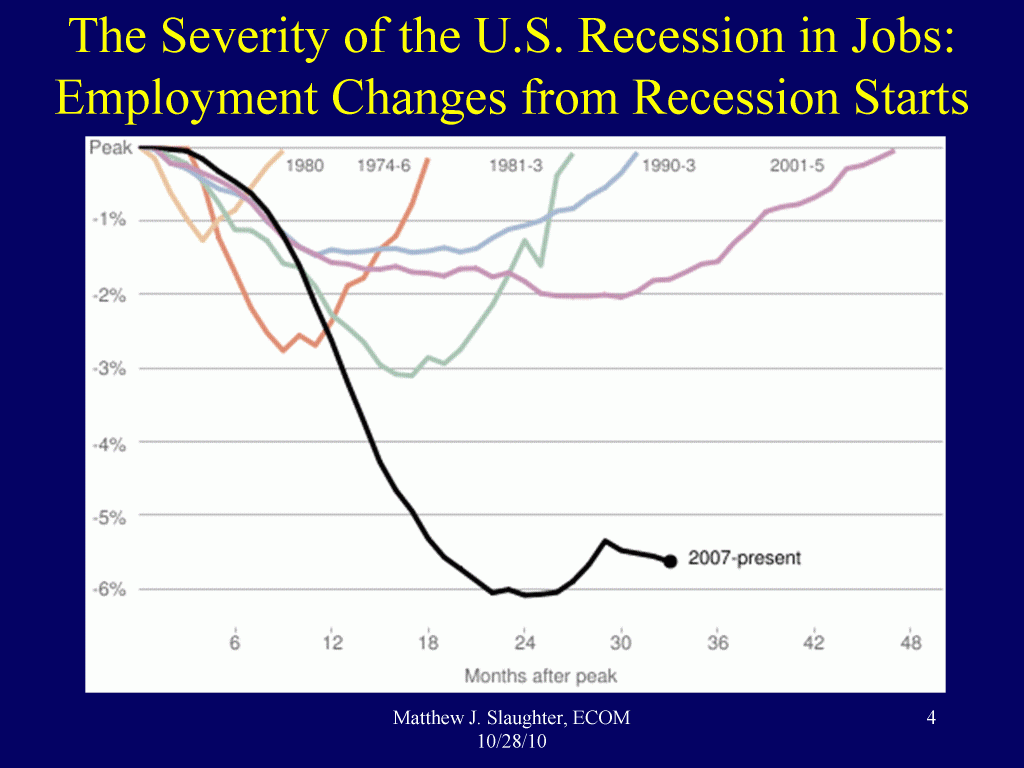 Some sobering facts: (figure and facts from Matt Slaughter)
- During the Great Recession, US job loss (peak to trough) was 8.4 million payroll jobs were lost (6.1%) and 8.5 million private-sector jobs (7.3%).
- In Sept. 2010 there were 108 million U.S. private-sector payroll jobs, about the same as in March 1999.
- It took 48 months to regain the lost 2.0% of jobs in the 2001 recession. At that rate, the U.S. would again reach 12/07 total payroll jobs around January 2020.
The US has a big problem. And I sure as hell hope we are willing do the hard work and make the hard sacrifices to turn things around.
To me it’s all about jobs. To create jobs, real jobs, the US has got to become a more affordable place to invent, design, and manufacture products. Certainly modified tax policies will help and so will trade agreements to make it easier for smaller companies to export products. But those will take too long. We need something now.
To start, we need affordability through productivity. But not the traditional making stuff productivity, we need inventing and designing productivity.
Here’s the recipe: Invent technology in-country, design and develop desirable products in-country (products that offer real value, products that do something different, products that folks want to buy), make the products in-country, and sell them outside the country. It’s that straightforward.
To me invention/innovation is all about solving technical problems. Solving them more productively creates much needed invention/innovation productivity. The result: more affordable invention/innovation.
To me design productivity is all about reducing product complexity through part count reduction. For the same engineering hours, there are few things to design, fewer things to analyze, fewer to transition to manufacturing. The result: more affordable design.
Though important, we can’t wait for new legislation and trade agreements. To make ourselves more affordable we need to increase productivity of our invention/innovation and design engines while we work on the longer term stuff.
If you’re an engineering leader who wants more about invention/innovation and or design productivity, send me an email at
and use the subject line to let me know which you’re interested in. (Your contact information will remain confidential and won’t be shared with anyone. Ever.)
Together we can turn around the country’s economy.
What if labor was free?
November 10th, 2010
 The chase for low cost labor is still alive and well. And it’s still a mistake. Low cost labor is fleeting. Open a plant in a low cost country and capitalism takes immediate hold. Workers see others getting rich off their hard work and demand to be compensated. It’s an inevitable death spiral to a living wage. Time to find the next low cost country.
The truth is labor costs are an extremely small portion of product cost. (The major cost, by far, is the material and the associated costs of moving it around the planet and managing its movement.) And when design engineers actively design out labor costs (50% reductions are commonplace) it becomes so small it should be ignored altogether. That’s right – ignored. No labor costs. Free labor. What would you do if labor was free?
Eliminate labor costs from the equation and it’s clear what to do. Make it where you can achieve the highest product quality, make it where you can run the smallest batches, and make it where you sell it. Design out labor and you’re on your way.
Design engineers are the key. Only they can design out labor. Management can’t do it without engineers, but engineers can do it without management.
A call to arms for design engineers: organize yourselves, design out labor, and force your company to do the right thing. Your kids and your economy will thank you.
Cure for offshoring: The design side of product development, from Machine Design
October 3rd, 2010
 A recent article written by Leslie Gordon of Machine Design.
You have probably seen it yourself: images of Chinese workers toiling in mud-floored factories, each feeding a separate punch press, as if part and parcel of a living, progressive die. The lure of this cheap labor has sent many U.S. manufacturers scrambling overseas to cut production costs.
Although design-for-manufacturing tools that would have made this exodus unnecessary have been around for more than 20 years, companies continue to overlook them, says Mike Shipulski, chief engineer of plasma-cutter manufacturer Hypertherm, hypertherm.com, Hanover, N.H. “Companies are sticking their heads in the sand. Many U.S. firms have become too entrenched in doing things the same way. For example, a typical product-cost breakdown shows material to be the largest cost at about 72%. Overhead is around 24% and labor is only about 4%. The question becomes, why continue to move manufacturing to so-called ‘low-cost countries’ to chase 50% labor reductions for a whopping 2% cost reduction? And it’s sillier than that because companies don’t account for cost increases in shipping and quality control.”
The problem is that companies neglect to efficiently account for cost during the design side of product development….
Back to Basics with DFMA
June 27th, 2010
 About eight years ago, Hypertherm embarked on a mission to revamp the way it designed products. Despite the fact its plasma metal-cutting technology was highly regarded and the market leader in the field, the internal consensus was that product complexity could be reduced and thus made more consistently reliable, and there was an across-the-board campaign to reduce product development and manufacturing costs. Instead of entailing novel engineering tactics or state-of-the-art process change, it was a back-to-basics strategy around design for manufacture and assembly (DFMA) that propelled Hypertherm to meet its goals.
The first step in the redesign program was determining what needed to change. A steering committee with representation from engineering, manufacturing, marketing, and business leadership spent weeks trying to determine what was required from a product standpoint to deliver radical improvements in both product performance and product economics. As a result of that collaboration, the team established aggressive new targets around robustness and reliability in addition to the goal of cutting the parts count and labor costs nearly in half.
Custom Model, exploring customized manufacturing (Mechanical Engineering Magazine)
April 24th, 2010
 By reducing parts count and easing assembly, one plasma cutter maker explores customized manufacturing.
By Jean Thilmany, Associate Editor, Mechanical Engineering Magazine
Ask nearly any engineer or manufacturer about customized manufacturing and—to a person—they’ll all say the same thing: Have you heard the Dell story?
Dell is offered up again and again as the number one example of customized manufacturing done right and done successfully. Shortly after its founding in 1984, Dell began what it calls a configure-to-order approach to manufacturing. The computer company lets customers customize their own computers on the Dell Web site. Buyers select how much memory and disk space they desire and the resulting computer is manufactured and shipped to them.
The approach has helped the computer maker see skyrocket growth. Last year, it held the second-highest spot for desktops and laptops shipped, behind Hewlett Packard, according to market-share numbers from research firm International Data Corp. in Framingham, Mass.
Manufacturers—particularly electronics manufacturers—have long been taking notice. Many of them are investigating how the configure-to-order model could be put to use at their own companies. And some of them have implemented the method—along with the necessary software to get the job done—with great success.
Take Hypertherm Inc. of Hanover, N.H., maker of plasma metal cutting equipment. The company has recently started allowing customers to choose online from ten CNC Edge Pro product configurations, up from three configurations in the former product line, said John Sobr, head designer on the project.
Hypertherm recently redesigned its plasma metal cutting equipment to reduce part count by 27 percent while doubling the number of inputs available. Customers can now choose from ten product configurations.
DFMA Won’t Work
April 21st, 2010
 Ask a company or team to do DFMA, and you get a great list of excuses on why DFMA is not applicable and won’t work. Product volumes are too low for DFMA, or too high; product costs are too low, or too high; production processes are too simple, or complex; production mix is too low, or too high. That’s all crap – just excuses to get out of doing the work. DFMA is applicable; it’s just a question of how to prioritize the work.
To prioritize the work, take a look at product volumes. They’ll put you in the right ballpark. Here are three categories, low, medium, and high volume:
 Posted in DFMA, How To, Intellectual Intertia, Part Count Reduction, Product Development |
  2 Comments »
DFMA to Control Controller Design – Design2Part Magazine
April 5th, 2010
Design for Manufacture and Assembly is reported to improve CNC performance, modularity, durability, and serviceability
When Hypertherm (www.hypertherm.com) was getting ready to design its next generation of metal cutting CNCs, the engineering team’s goal was to make improvements. But the controllers, which automate the Hanover, New Hampshire-based company’s advanced cutting tools and systems, were already well-accepted in the marketplace and highly regarded in the industry. So why redesign? And how would they go about it?
See this link for the full article – Using DFMA to Control Controller Design
Posted in Cost Savings, DFA, DFMA, Lean, Part Count Reduction, Product Development, Product Robustness |
No Comments »
Pareto’s Three Lenses for Product Design
March 24th, 2010
 Axiom 1 – Time is short, so make sure you’re working on the most important stuff.
Axiom 2 – You can’t design out what you can’t see.
In product development, these two axioms can keep you out of trouble. They’re two sides of the same coin, but I’ll describe them one at a time and hope it comes together in the end.
With Axiom 1, how do you make sure you’re working on the most important stuff? We all know it’s function first – no learning there. But, sorry design engineers, it doesn’t end with function. You must also design for lean, for cost, and factory floor space. Great. More things to design for. Didn’t you say time was short? How the hell am I going to design for all that?
Now onto the seeing business of Axiom 2. If we agree that lean, cost, and factory floor space are the right stuff, we must “see it” if we are to design it out. See lean? See cost? See factory floor space? You’re nuts. How do you expect us to do that?
Pareto to the rescue – use Pareto charts to identify the most important stuff, to prioritize the work. With Pareto, it’s simple: work on the biggest bars at the expense of the smaller ones. But, Paretos of what?
There is no such thing as a clean sheet design – all new product designs have a lineage. A new design is based on an existing design, a baseline design, with improvements made in several areas to realize more features or better function defined by the product specification. The Pareto charts are created from the baseline design to allow you to see the things to design out (Axiom 2). But what lenses to use to see lean, cost, and factory floor space?
Here are Pareto’s three lenses so see what must be seen:
To lean out lean out your factory, design out the parts. Parts create waste and part count is the surrogate for lean.

To design out cost, measure cost. Cost is the surrogate for cost.

To design out factory floor space, measure assembly time. Since factory floor space scales with assembly time, assembly time is the surrogate for factory floor space.

Now that your design engineers have created the right Pareto charts and can see with the right glasses, they’re ready to focus their efforts on the most important stuff. No boiling the ocean here. For lean, focus on part count of subassembly 1; for cost, focus on the cost of subassemblies 2 and 4; for floor space, focus on assembly time of subassembly 5. Leave the others alone.
Focus is important and difficult, but Pareto can help you see the light.
 Tags:
Tags:  Mike Shipulski