Archive for the ‘Innovation’ Category
Problems are good
 October 20th, 2009
Everyone laughs at the person who says “We don’t have problems, we have opportunities.” Why do we say that? We know that’s crap. We have problems; problems are real; and it’s okay to call them by name. In fact, it’s healthy. Problems are good. Problems focus our thinking. There is a serious and important nature to the word problem, and it sets the right tone. Everyone knows if the situation has risen to the level of a problem it’s important and action must be taken. People feel good about organizing themselves around a problem – problems help rally the troops.
In a previous post on innovation, I talked about the tight linkage between problems and innovation. In the pre-innovation state there is a problem; in the post-innovation state there is no problem. The work in the middle is a good description of the thing we call innovation. It could also be called problem solving.
Behind every successful product launch is a collection of solved problems. The engineering team defines the problems, understands the physics, changed the design, and makes problems go away. Behind every unsuccessful product launch is at least one unsolved problem. These unsolved problems disrupt product launches – limiting product function, delaying launches, and cancelling others altogether. All this can be caused by a single unsolved problem. Read the rest of this entry »
 Posted in

Innovation, problems, and stomach aches
October 6th, 2009
In the last post on innovation I said I’d provide data on number of hits for a post with innovation in the title. Well, apparently the word recession is more relevant than the word innovation as there were 50% more hits with recession. Next time I should use both recession and innovation in the title and see what happens.
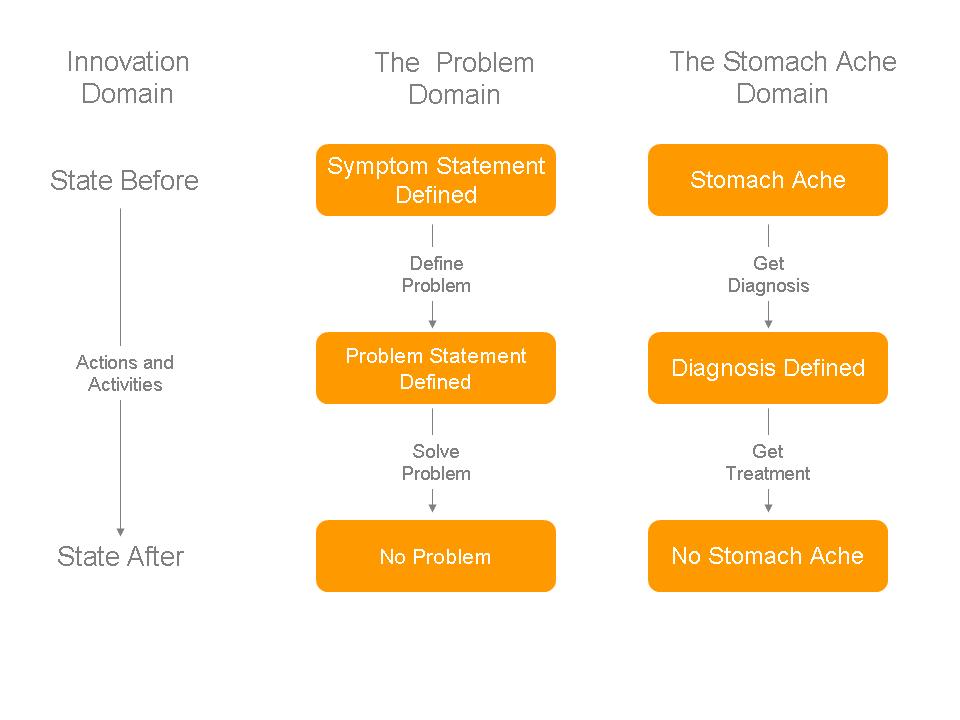
In the last post on innovation I left off with the notion of an operational definition as a way to assign meaning to the word innovation. I ended with a question — can you put your hand over your mouth and point to innovation? In other words, what can we observe to bring innovation into the range of our experience? Starting with the state of things before innovation – what does it look like? And what about the state of things after innovation – what does that look like? And what does it look like to transition between the states?
Starting simply, the state before innovation is defined by a symptom statement, an ill-defined, un-actionable statement of something undesirable. It has not yet risen to the level of an actionable problem statement, but clearly there is a realization of an undesirable situation. Here are several examples of symptom statements. Read the rest of this entry »
 Tags:
Innovation – words and actions
September 28th, 2009
I sat down to write my weekly post with the hope of coming up with something meaningful on innovation. Nothing came. I asked the all-powerful oracle named Google for some guidance, and my thinking diverged. I realized that there are too many definitions for the word innovation, too many contexts, too many facets. There is too much written about the word and too little written about the actions. I, too, am guilty of using the word for its multiple meanings and sex appeal. I put it in the title of this post to get some attention (I’ll let you know if Google Analytics reports more hits). Heck, I even use the word in the description of the blog.
When I started writing my dissertation, Chris Brown, my advisor, handed me a book and said something like, “You should learn how to write, so read this”. The book was Language In Thought and Action, by S.I. Hayakawa. I read it, finished my dissertation, and, most importantly, learned about words. Since my struggle with innovation was all about the word, I dusted off Hayakawa and asked him to help. Here is what the senator had to say.
To map meaning to a word it is best to point to the physical world (extensional meaning). Putting your hand over your mouth and pointing to a chair is a good way to assign meaning to the word chair. Closing your eyes and talking about a chair (intensional meaning) is not as good. So, to understand innovation it would be best to point your finger at it. But how?
Using an operational definition is a good way to point to the physical world. He quotes physicist P.W. Bridgeman who coined the term.
To find the length of an object, we have to perform certain physical operations. The concept of length is therefore fixed when the operations by which length is measured is fixed….. In general, we mean by any concept nothing more than a set of operations; the concept is synonymous with the corresponding set of operations.”
Hayakawa would ask, “Can you put your hand over your mouth and point to innovation?” Bridgeman would ask, “Can you define the set of operations for innovation? ”
This week my answer is “Not yet”.
 Mike Shipulski