Archive for the ‘Fundementals’ Category
Prototypes Are The Best Way To Innovate
 September 3rd, 2014
 If you’re serious about innovation, you must learn, as second nature, to convert your ideas into prototypes.
Funny thing about ideas is they’re never fully formed – they morph and twist as you talk about them, and as long as you keep talking they keep changing. Evolution of your ideas is good, but in the conversation domain they never get defined well enough (down to the nuts-and-bolts level) for others (and you) to know what you’re really talking about. Converting your ideas into prototypes puts an end to all the nonsense.
Job 1 of the prototype is to help you flesh out your idea – to help you understand what it’s all about. Using whatever you have on hand, create a physical embodiment of your idea. The idea is to build until you can’t, to build until you identify a question you can’t answer. Then, with learning objective in hand, go figure out what you need to know, and then resume building. If you get to a place where your prototype fully captures the essence of your idea, it’s time to move to Job 2. To be clear, the prototype’s job is to communicate the idea – it’s symbolic of your idea – and it’s definitely not a fully functional prototype.
Job 2 of the prototype is to help others understand your idea. There’s a simple constraint in this phase – you cannot use words – you cannot speak – to describe your prototype. It must speak for itself. You can respond to questions, but that’s it. So with your rough and tumble prototype in hand, set up a meeting and simply plop the prototype in front of your critics (coworkers) and watch and listen. With your hand over your mouth, watch for how they interact with the prototype and listen to their questions. They won’t interact with it the way you expect, so learn from that. And, write down their questions and answer them if you can. Their questions help you see your idea from different perspectives, to see it more completely. And for the questions you cannot answer, they the next set of learning objectives. Go away, learn and modify your prototype accordingly (or build a different one altogether). Repeat the learning loop until the group has a common understanding of the idea and a list of questions that only a customer can answer.
Job 3 is to help customers understand your idea. At this stage it’s best if the prototype is at least partially functional, but it’s okay if it “represents” the idea in clear way. The requirement is prototype is complete enough for the customer can form an opinion. Job 3 is a lot like Job 2, except replace coworker with customer. Same constraint – no verbal explanation of the prototype, but you can certainly answer their direction questions (usually best answered with a clarifying question of your own such as “Why do you ask?”) Capture how they interact with the prototype and their questions (video is the best here). Take the data back to headquarters, and decide if you want to build 100 more prototypes to get a broader set of opinions; build 1000 more and do a small regional launch; or scrap it.
Building a prototype is the fastest, most effective way to communicate an idea. And it’s the best way to learn. The act of building forces you to make dozens of small decisions to questions you didn’t know you had to answer and the physical nature the prototype gives a three dimensional expression of the idea. There may be disagreement on the value of the idea the prototype stands for, but there will be no ambiguity about the idea.
If you’re not building prototypes early and often, you’re not doing innovation. It’s that simple.
Inspiration, Imagination, and Innovation – in that order.
August 6th, 2014
 Inspiration is the fuel for imagination and imagination is the power behind innovation.
All companies want innovation and try lots of stuff to increase its supply. But innovation isn’t a thing in itself and not something to be conjured from air – it’ a result of something. The backplane of innovation, its forcing function, is imagination.
But imagination is no longer a sanctioned activity. Since it’s not a value-added activity; and our financial accounting system has no column for it; and it’s unpredictable, it has been leaned out of our work. (Actually, she’s dead – Imagination’s Obituary.) We squelch imagination yet demand more innovation. That’s like trying to make ice cream without the milk.
No inspiration, no imagination – that’s a rule. Again, like innovation, imagination isn’t a thing in itself, it’s a result of something. If you’re not inspired you don’t have enough mojo to imagine what could be. I’ve seen many campaigns to increase innovation, but none to bolster imagination, and fewer to foster inspiration. (To be clear, motivation is not a substitute for inspiration – there are plenty of highly motivated, uninspired folks out there.)
If you want more innovation, it’s time to figure out how to make it cool to openly demonstrate imagination. (Here’s a hint – dust off your own imagination and use it. Others will see your public display and start to see it as sanctioned behavior.) And if you want more imagination, it’s time demonstrate random acts of inspiration.
Inspiration feeds imagination and imagination breeds innovation. And the sequence matters.
Image credit – AndYaDontStop
 Posted in Fear, Feelings, Fundementals, Imagination, Innovation, Level 5 Courage, Meaning, The Future |
  Tags: Inspiration |
  No Comments »
The Illusion of Planning
May 21st, 2014

Planning is important work, but it’s non-value added work. Short and sweet – planning is waste.
Lean has taught us waste should be reduced, and the best way to reduce waste from planning is to spend less time planning. (I feel silly writing that.) Lean has taught us to reduce batch size, and the best way to reduce massive batch size of the annual planning marathon is to break it into smaller sessions. (I feel silly writing that too.)
Unreasonable time constraints increase creativity. To create next year’s plan, allocate just one for the whole thing. (Use a countdown timer.) And, because batch size must be reduced, repeat the process monthly. Twelve hours of the most productive planning ever, and countless planning hours converted into value added work.
Defining the future state and closing the gap is not the way to go. The way to go is to define the current state (where you are today) and define how to move forward. Use these two simple rules to guide you:
- Do more of what worked.
- Do less of what didn’t.
Here’s an example process:
The constraint – no new hires. (It’s most likely the case, so start there.)
Make a list of all the projects you’re working on. Decide which to stop right now (the STOP projects) and which you’ll finish by the end of the month (the COMPLETED projects). The remaining projects are the CONTINUE projects, and, since they’re aptly named, you should continue them next month. Then, count the number of STOP and COMPLETED projects – that’s the number of START projects you can start next month.
If the sum of STOP and COMPLETED is zero, ask if you can hire anyone this month. If the answer is no, see you next month.
If the sum is one, figure out what worked well, figure out how to build on it, and define the START project. Resources for the START project should be the same as the STOP or COMPLETED project.
If the sum is two, repeat.
Now ask if you can hire anyone this month. If the answer is no, you’re done. If the answer is yes, define how many you can hire.
With your number in hand, and building on what worked well, figure out the right START project. Resources must be limited by the number of new hires, and the project can’t start until the new hire is hired. (I feel silly writing that, but it must be written.) Or, if a START project can’t be started, use the new resource to pile on to an important CONTINUE project.
You’re done for the month, so send your updated plan to your boss and get back to work.
Next month, repeat.
The process will evolve nicely since you’ll refine it twelve times per year.
Ultimately, planning comes down to using your judgment to choose the next project based on the resources you’re given. The annual planning process is truly that simple, it’s just doesn’t look that way because it’s spread over so many months. So, if the company tells its leaders how many resources they have, and trusts them to use good judgment, yearly planning can be accomplished in twelve hours per year (literally). And since the plan is updated monthly, there’s no opportunity for emergency re-planning, and it will always be in line with reality.
Less waste and improved quality – isn’t that what lean taught us?
Posted in Decisions, Fundementals, How To, Lean, Seeing Things As They Are, The Future |
Tags: Planning |
No Comments »
Summoning The Courage To Ask
April 16th, 2014

I’ve had some great teachers in my life, and I’m grateful for them. They taught me their hard-earned secrets, their simple secrets. Though each had their own special gifts, they all gave them in the same way – they asked the simplest questions.
Today’s world is complex – everything interacts with everything else; and today’s pace is blistering – it’s tough to make time to understand what’s really going on. To battle the complexity and pace, force yourself to come up with the simplest questions. Here are some of my favorites:
For new products:
- Who will buy it?
- What must it do?
- What should it cost?
For new technologies:
- What problem are you trying to solve?
- How will you know you solved it?
- What work hasn’t been done before?
For new business models:
- Why are you holding onto your decrepit business model?
For problems:
- Can you draw a picture of it on one page?
- Can you make it come and go?
For decisions:
- What is the minimum viable test?
- Why not test three or four options at the same time?
For people issues:
- Are you okay?
- How can I help you?
For most any situation:
- Why?
These questions are powerful because they cut through the noise, but their power couples them to fear and embarrassment – fear that if you ask you’ll embarrass someone. These questions have the power to make it clear that all the activity and hype is nothing more than a big cloud of dust heading off in the wrong direction. And because of that, it’s scary to ask these questions.
It doesn’t matter if you steal these questions directly (you have my permission), twist them to make them your own, or come up with new ones altogether. What matters is you spend the time to make them simple and you summon the courage to ask.
Image credit — Montecruz Foto.
The Importance Of Knowing Why You’re In The Boat
March 5th, 2014

Whether at work or home, there are highs and lows. And you’re not getting special treatment, that’s how it is for everyone. And it’s a powerful fundamental, so don’t try to control it, ride it.
When the sailing is smooth, at some point it won’t be – the winds change, that’s what they do. And when you’re suddenly buffeted from a new direction, you take action. But what action? More sail or less? Port or starboard? Heave the anchor or abandon ship? It depends.
Your actions depend on your why. Regardless of wind or tide, your why points where it points and guides your actions. Much like magnetic north doesn’t move if you spin your compass, your long term why knows where it points. If the storm on the horizon is dead ahead, you go around it. But it’s a balance – deviate to skirt the storm, but do it with your long term destination in mind. If you know your long term why, the best course heading is clear.
Often you set sail without realizing you don’t have your why battened down and stowed. When you sail where you sailed last time, you know the landmarks and use them to navigate. You can unknowingly leave your why at the pier and still get to your destination. But when you’re blown out to sea and can no longer see the landmarks, your moral compass, your long term why, is the only way to tack and jibe toward your destination.
Before you set sail, it’s best to know why you’re in the boat.
It Can’t Be Innovation If…
December 4th, 2013

Companies strive for predictability, yet if it’s predictable, it cannot be innovation.
We seek comfort in our work, but if it’s comfortable it can’t be innovation.
Businesses like to grow by selling more to the customers we have, but if existing customers can recognize it, it can’t be innovation.
We want to meet year end numbers, but if the project will generate profit in the year it begins, it can’t be innovation.
We love our standardized processes, but if it’s standard, it cannot be innovation.
If there’s consensus, it’s not innovation.
If the project isn’t wreaking havoc with your organizational norms, it can’t be innovation.
If the market already exists, it can’t be innovation.
If you’ve done it before, it can’t be innovation.
If you are following a best practice, it can’t be innovation.
If there’s a high probability it will work, it can’t be innovation.
If people aren’t threatened, it can’t be innovation.
Posted in Fear, Fundementals, Innovation, Intellectual Intertia, Positivity |
Tags: Trust-based approach |
1 Comment »
Transplant Syndrome
November 13th, 2013
 Overall, our upward evolutionary spiral toward infinite productivity is a good thing. (More profit with less work – can’t argue with that.) And also good is our Darwinian desire to increase our chances of realizing profit by winding a thick cocoon of risk reduction around the work.
But with our productivity helix comes a little known illness that’s rarely diagnosed. It’s not a full-fledged disease, rather, it’s a syndrome. It’s called Transplant Syndrome, or TS.
Along with general flu-like symptoms, TS produces a burning and itching desire to transplant something that worked well in one area into another. On its own, not a bad thing; the dangerous part of TS is that scratching its itch feels so good. And it feels so good because the scratching fits with capitalism’s natural law – only the most productive species will survive.
In a brain suffering from TS, transplanting Region A’s successful business model into Region B makes perfect productivity sense (No new thinking, but plenty of new revenue.) But that’s not the problem. The problem is the TS brain’s urge to transplant is insatiable and indiscriminate. With TS, along with Region B, it makes perfect sense to transplant into Region C, Region D, and Regions L, M, N, O, and P. And with TS, it must happen in record time. Like a parasite, TS feeds on our desire for productivity.
When you transplant your favorite flowering plant from one region of your yard to another, even the inexperienced gardener in us knows to question whether the new region will support the plant. Is the soil similar? Is there enough sun or too much? Will it be blocked from the wind like it is now? And because you know your yard (and because you asked the questions) you won’t transplant unless the viability threshold is met.
But what if you wanted to transplant your most precious flowering plant from your yard in North America to someone else’s yard in South America? At a high level, the viability questions are the same – sun, soil, and water, but the answers are hard to come by. Should you use google to get the answers? Should you get in an airplane and check the territory yourself? Should you talk to the local gardeners? (They don’t speak English.)
But digging deeper, there are many questions you don’t even know to ask. Some of the local bugs may eat your precious plant, so you better know the little crawlies by name and learn what they like to eat. But still, since the bugs have never seen your plant, you won’t know if they’ll eat it until they eat it. You can ask the local gardeners, but they won’t know. (They, too, have never seen it.) Or worse, they may treat it as invasive species and pull it out of the ground after you leave for home.
Here’s an idea. You could scout out local plants that look like yours and declare viability by similarity. But be careful because over the years the local plants have built up tacit defenses you can’t see.
Transplant Syndrome not just a business model syndrome; it infects broadly. In fact, there have been recent outbreaks reported in people that work with products, technologies, processes, and company cultures.
Unfortunately, there is no cure for TS. But, with the right prescription, symptoms can be managed.
Symptoms have been pushed into dormancy when companies hire the best, most experienced, local gardeners. These special gardeners must have been born and raised in-region. And in clinical trials the best results have been achieved when the chief gardener, a well respected local gardener in their own right, has full responsibility for designing, viability testing, and implementing the transplant program.
There have been reported cases of TS symptoms flaring up mid program, but in all cases there was a single common risk factor: no one listened to the gardeners on the receiving end of the transplant.
Posted in Fundementals, Manufacturing Competitiveness, Seeing Things As They Are |
Tags: Transplant Syndrome |
1 Comment »
Accomplishments in 2013 (Year Four)
October 23rd, 2013
Accomplishments in 2013
- Fourth year of weekly blog posts without missing a beat or repeating a post. (251 posts in total.)
- Third year of daily tweets – 2,170 in all. (@mikeshipulski)
- Second year as Top 40 Innovation Bloggers (#12) – Innovation Excellence, the web’s top innovation site.
- Seventh consecutive year as Keynote Speaker at International Forum on DFMA.
- Fourth year of LinkedIn working group – Systematic DFMA Deployment.
- Third year writing a column for Assembly Magazine (6 more columns this year).
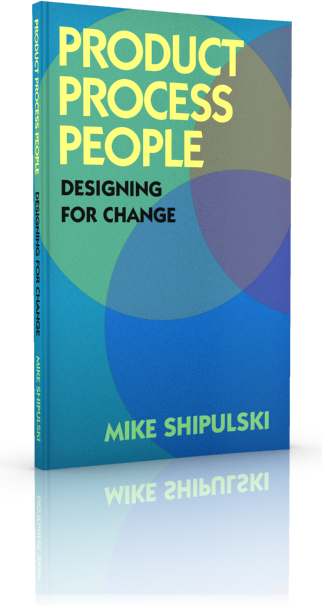
- Wrote a book — PRODUCT PROCESS PEOPLE – Designing for Change (Which my subscribers can download for free.)
Top 5 Posts
- What They Didn’t Teach Me In Engineering School — a reflection on my learning after my learning.
- Guided Divergence — balancing act of letting go and shaping the future.
- Innovation in 26 words — literally.
- Lasting Behavioral Change — easy to say, tough to do.
- Prototype The Unfamiliar — test early and often.
I look forward to a great year 5.
Define To Solve
August 21st, 2013
 Countries want their companies to create wealth and jobs, and to do it they want them to design products, make those products within their borders, and sell the products for more than the cost to make them. It’s a simple and sustainable recipe which makes for a highly competitive landscape, and it’s this competition that fuels innovation.
When companies do innovation they convert ideas into products which they make (jobs) and sell (wealth). But for innovation, not any old idea will do; innovation is about ideas that create novel and useful functionality. And standing squarely between ideas and commercialization are tough problems that must be solved. Solve them and products do new things (or do them better), become smaller, lighter, or faster, and people buy them (wealth).
But here’s the part to remember – problems are the precursor to innovation.
Before there can be an innovation you must have a problem. Before you develop new materials, you must have problems with your existing ones; before your new products do things better, you must have a problem with today’s; before your products are miniaturized, your existing ones must be too big. But problems aren’t acknowledged for their high station.
There are problems with problems – there’s an atmosphere of negativity around them, and you don’t like to admit you have them. And there’s power in problems – implicit in them are the need for change and consequence for inaction. But problems can be more powerful if you link them tightly and explicitly to innovation. If you do, problem solving becomes a far more popular sport, which, in turn, improves your problem solving ability.
But the best thing you can do to improve your problem solving is to spend more time doing problem definition. But for innovation not any old problem definition will. Innovation requires level 5 problem definition where you take the time to define problems narrowly and deeply, to define them between just two things, to define when and where problems occur, to define them with sketches and cartoons to eliminate words, and to dig for physical mechanisms.
With the deep dive of level 5 you avoid digging in the wrong dirt and solving the wrong problem because it pinpoints the problem in space and time and explicitly calls out its mechanism. Level 5 problem definition doesn’t define the problem, it defines the solution.
It’s not glamorous, it’s not popular, and it’s difficult, but this deep, mechanism-based problem definition, where the problem is confined tightly in space and time, is the most important thing you can do to improve innovation.
With level 5 problem definition you can transform your company’s profitability and your country’s economy. It does not get any more relevant than that.
Posted in Fear, Fundementals, Innovation, Problems, Product Development, Robust Economy, Seeing Things As They Are |
Tags: Problem Definition, Understanding Physics |
2 Comments »
Forgotten Pillars of Personal Growth
December 26th, 2012
 There are a lot of complex self-help programs out there to help us reach our potential. These programs are designed to take us to the next level by building on what we have. And they do help. But implicitly the programs assume we’ve got a foundation in place and it’s solid enough to stand on. But I think our foundation is rickety.
To be what we must be is our responsibility, and if we’re going to get any value from our self-help programs it’s our responsibility to establish the conditions for growth.
Here are three forgotten pillars that must be in place if we’re to grow:
Good sleep habits – most of us our sleep deprived, yet the data is clear that a rested brain thinks better. If we’re to grow, we’ve got to think better, and to think better we need more rest.
Good eating habits – most of us eat poorly. We eat too much which hurts our bodies and we eat too infrequently which hurts our brains. We all know our muscles need calories or they don’t work well, but what we forget is our brain also needs calories. (It’s 2% of our weight but consumes about 20% of our total calories.) And when we eat infrequently our blood sugar drops and so does our brains’ ability to think. If we’re to grow, we need to eat better.
Good fitness habits – most of us don’t exercise daily. Our brain is connected to our body, and they interact. When the muscles are exercised they cause the brain to make chemicals that sooth and calm. When we exercise we have a better attitude, have more stamina, and think better. If we’re to grow, we need more exercise.
The big three are far more powerful than the best self-help scheme, but they’re also far scarier. They’re so scary because they’re easy to measure and completely within our control.
After a one month trial you’ll know if you’ve slept more, worked out more, and ate better. And if you haven’t, you’ll also know who is responsible.
Circle of Life
November 28th, 2012

Engineers solve technical problems so
Other engineers can create products so
Companies can manufacture them so
They can sell them for a profit and
Use the wealth to pay workers so
Workers can support their families and pay taxes so
Their countries have wealth for good schools to
Grow the next generation of engineers to
Solve the next generation of technical problems so…
Posted in Design Engineers, DFMA, Fundementals, Innovation, Robust Economy, Technology, The Future, TRIZ |
Tags: Manufacturing Competitveness |
4 Comments »
 Mike Shipulski