Posts Tagged ‘Part Count’
I can name that tune in three notes.
 April 13th, 2011
 More with more doesn’t cut it anymore, just not good enough.
The behavior we’re looking for can be nicely described by the old TV game show Name That Tune, where two contestants competed to guess the name of a song with the fewest notes. They were read a clue that described a song, and ratcheted down the notes needed to guess it. Here’s the nugget: they challenged themselves to do more with less, they were excited to do more with less, they were rewarded when they did more with less. The smartest, most knowledgeable contestants needed fewer notes. Let me say that again – the best contestants used the fewest notes.
In product design, the number of notes is analogous to part count, but the similarities end there. Those that use the fewest are not considered our best or our most knowledgeable, they’re not rewarded for their work, and our organizations don’t create excitement or a sense of challenge around using the fewest.
For other work, the number of notes is analogous to complexity. Acknowledge those that use the fewest, because their impact ripples through your company, and makes all your work easier.
 Posted in Culture, Design Engineers, DFA, DFMA, Fundementals, Manufacturing Competitiveness, Product Development |
  Tags: Engineering Mindset, Part Count, Product Design |
  4 Comments »
Pareto’s Three Lenses for Product Design
March 24th, 2010
 Axiom 1 – Time is short, so make sure you’re working on the most important stuff.
Axiom 2 – You can’t design out what you can’t see.
In product development, these two axioms can keep you out of trouble. They’re two sides of the same coin, but I’ll describe them one at a time and hope it comes together in the end.
With Axiom 1, how do you make sure you’re working on the most important stuff? We all know it’s function first – no learning there. But, sorry design engineers, it doesn’t end with function. You must also design for lean, for cost, and factory floor space. Great. More things to design for. Didn’t you say time was short? How the hell am I going to design for all that?
Now onto the seeing business of Axiom 2. If we agree that lean, cost, and factory floor space are the right stuff, we must “see it” if we are to design it out. See lean? See cost? See factory floor space? You’re nuts. How do you expect us to do that?
Pareto to the rescue – use Pareto charts to identify the most important stuff, to prioritize the work. With Pareto, it’s simple: work on the biggest bars at the expense of the smaller ones. But, Paretos of what?
There is no such thing as a clean sheet design – all new product designs have a lineage. A new design is based on an existing design, a baseline design, with improvements made in several areas to realize more features or better function defined by the product specification. The Pareto charts are created from the baseline design to allow you to see the things to design out (Axiom 2). But what lenses to use to see lean, cost, and factory floor space?
Here are Pareto’s three lenses so see what must be seen:
To lean out lean out your factory, design out the parts. Parts create waste and part count is the surrogate for lean.

To design out cost, measure cost. Cost is the surrogate for cost.

To design out factory floor space, measure assembly time. Since factory floor space scales with assembly time, assembly time is the surrogate for factory floor space.

Now that your design engineers have created the right Pareto charts and can see with the right glasses, they’re ready to focus their efforts on the most important stuff. No boiling the ocean here. For lean, focus on part count of subassembly 1; for cost, focus on the cost of subassemblies 2 and 4; for floor space, focus on assembly time of subassembly 5. Leave the others alone.
Focus is important and difficult, but Pareto can help you see the light.
Fasteners Can Consume 20-50% of Assembly Labor
February 3rd, 2010
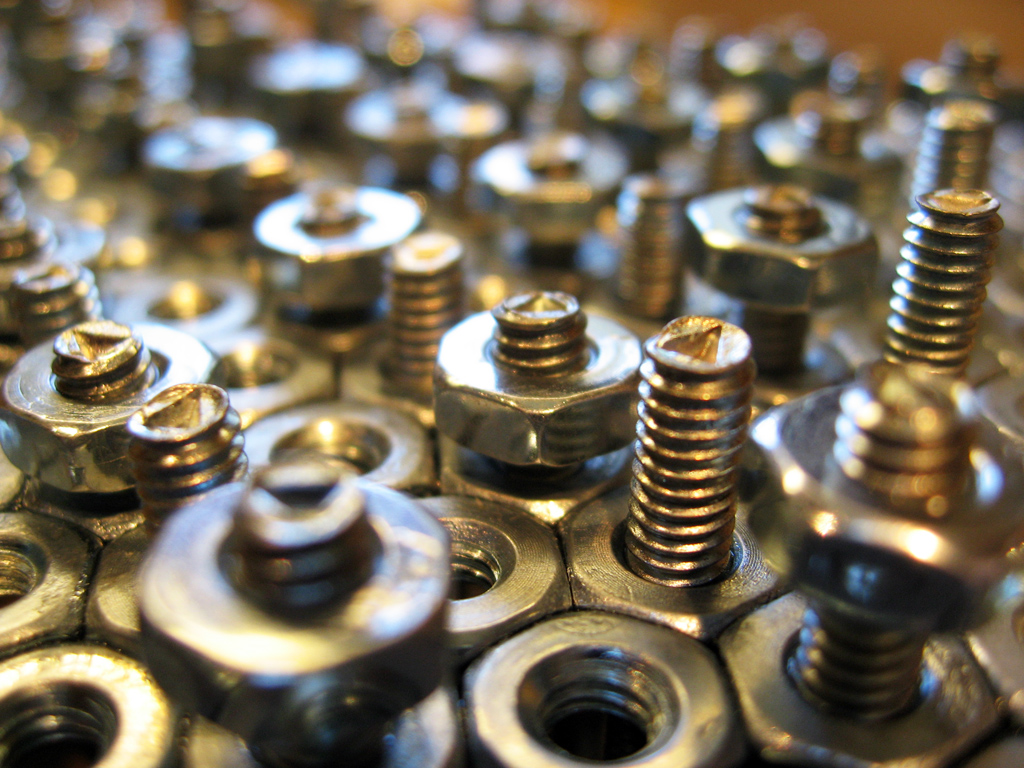 The data-driven people in our lives tell us that you can’t improve what you can’t measure. I believe that. And it’s no different with product cost. Before improving product cost, before designing it out, you have to know where it is. However, it can be difficult to know what really creates cost. Not all parts and features are created equal; some create more cost than others, and it’s often unclear which are the heavy hitters. Sometimes the heavy hitters don’t look heavy, and often are buried deeply within the hidden factory.
Measure, measure, measure. That’s what the black belts say. However, it’s difficult to do well with product cost since our costing methods are hosed up and our measurement systems are limited. What do I mean? Consider fasteners (e.g., nuts, bolts, screws, and washers), the product’s most basic life form. Because fasteners are not on the BOM, they’re not part of product cost. Here’s the party line: it’s overhead to be shared evenly across all the products in a socialist way. That’s not a big deal, right? Wrong. Although fasteners don’t cost much in ones and twos, they do add up. 300-500 pieces per unit times the number of units per year makes for a lot of unallocated and untracked cost. However, a more significant issue with those little buggers is they take a lot of time attach to the product. For example, using standard time data from DFMA software, assembly of a 1/4″ nut with a bolt, locktite, a lockwasher, and cleanup takes 50 seconds. That’s a lot of time. You should be asking yourself what that translates to in your product. To figure it out, multiply the number nut/bolt/washer groupings by 50 seconds and multiply the result by the number of units per year. Actually, never mind. You can’t do the calculation because you don’t know the number of nut/bolt/washer combinations that are in your product. You could try to query your BOMs, but the information is likely not there. Remember, fasteners are overhead and not allocated to product. Have you ever tried to do a cost reduction project on overhead? It’s impossible. Because overhead inflicts pain evenly to all, no one is responsible to reduce it.
With fasteners, it’s like death by a thousand cuts.
The time to attach them can be as much as 20-50% of labor. That’s right, up to 50%. That’s like paying 20-50% of your folks to attach fasteners all day. That should make you sick. But it’s actually worse than that. From Line Design 101, the number of assembly stations is proportional to demand times labor time. Since fasteners inflate labor time, they also inflate the number of assembly stations, which, in turn, inflates the factory floor space needed to meet demand. Would you rather design out fasteners or add 15% to your floor space? I know you can get good deals on factory floor space due to the recession, but I’d still rather design out fasteners.
Even with the amount of assembly labor consumed by fasteners, our thinking and computer systems are blind to them and the associated follow-on costs. And because of our vision problems, the design community cannot be held accountable to design out those costs. We’ve given them the opportunity to play dumb and say things like, “Those fastener things are free. I’m not going to spend time worrying about that. It’s not part of the product cost.” Clearly not an enlightened statement, but it’s difficult to overcome without cost allocation data for the fasteners.
The work-around for our ailing thinking and computer-based cost tracking systems is simple: get the design engineers out to the production floor to build the product. Have them experience first hand how much waste is in the product. They’ll come back with a deep-in-the-gut understanding of how things really are. Then, have them use DFMA software to score the existing design, part-by-part, feature-by-feature. I guarantee everyone will know where the cost is after that. And once they know where the cost is, it will be easy for them to design it out.
I have data to support my assertion that fasteners can make up 20-50% of labor time, but don’t take my word for it. Go out to the factory floor, shut your eyes and listen. You’ll likely hear the never ending song of the nut runners. With each chirp, another nut is fastened to its bolt and washer, and another small bit of labor and factory floor space is consumed by the lowly fastener.
Posted in Allocating Cost, Assembly Time Reduction, DFA, DFMA, Floor Space, Part Count Reduction, Product Development |
Tags: Design for Assembly, Floor Space, Part Count |
4 Comments »
“Hyper” for Lean
September 12th, 2008
“Hyper” for Lean — Lean Directions, SME
Hypertherm’s lean journey began in 1997 as a natural and enthusiastic extension of its long history of continuous improvement. Founded in 1968, the company’s “lean vision” includes training, application of 5S components, visual factory audits, single and mixed-model flow lines and the engagement of its product design functions.
A recent Hypertherm success is found in the company’s HyPerformance series of plasma arc, metalcutting systems. The company’s product design community designed a product line with Read the rest of this entry »
Free Up Floor Space with Design for Assembly and Part Count Reduction
November 4th, 2006
Free Up Floor Space with Design for Assembly and Part Count Reduction
By Mike Shipulski, Director of Engineering, Hypertherm, Inc
Design for Assembly (DFA) methods have been around for over 25 years, but the number of companies using the methods is surprisingly low given that they are straight-forward, fast, and produce significant savings in traditional Value Added (VA) metrics: labor content and material cost. Now that LEAN has raised the world’s awareness of the importance of reducing Non-Value Added (NVA) activities, the true value of DFA methods can be appreciated.
As a first principle, Design for Assembly (DFA) methods focus on part count reduction. Part count reduction results in labor content reduction (fewer parts to assemble) and material cost reduction Read the rest of this entry »
 Mike Shipulski