Improve Product Robustness at the Expense of Predicting It
 December 16th, 2009
In a previous post I defined the term brand-damaging threshold and said I’d talk about how to improve product robustness. So, here goes.
Every company is at a different stage in their formalized product robustness efforts, so it’s challenging to talk meaningfully to everyone. But there are two especially meaningful principles that have served me well through the years.
I had the privilege of working with Don Clausing – Total Quality Design, The House of Quality, Enhanced QFD, and Robust Quality. I vividly remember the conversation where Don shared one of his secrets. As we watched a robustness test run, Don, in his terse way, barked out a guiding principle of improving product robustness. He said:
“Improve robustness at the expense of predicting it.”
I asked Don what the hell he meant (he liked to make his students work for it), and after some prodding, he went on to explain why it’s so important. He said people spend far too much time running tests to predict robustness and then spend even more time calculating mean time between failures (MTBF). If that’s not enough, then they spend time arguing about MTBFs and the confidence intervals. He said companies should dedicate all their time and energy improving robustness. “That’s what matters to the customer,” he said. And then he continued with something like: “Predicting robustness is worse than a simple waste of time.” (He wasn’t that polite.) But I still didn’t get it. What’s the big deal about predicting robustness? Read the rest of this entry »
 Posted in Culture, How To, New Thinking, Product Robustness |
  Tags: Engage Design, Engineering Mindset, Failure Modes, Product Design |
  No Comments »
Lack of product robustness can damage your brand
December 9th, 2009
 There are many definitions of product robustness and just as many formally trained specialists willing to argue about them. I get confused by all that complexity, I don’t like to argue, and I am not a specialist, I am a generalist. I like simplicity so I use operational definitions every chance I get. Here’s one for product robustness:
A customer walks up to your product, turns it on, and it works without breaking or getting in its own way.
Bad product robustness is bad for your brand. Very bad. Customers do not like when they pay money for a product and it doesn’t work, especially when they rely on those products to make money for themselves. And they remember the experience in a visceral way.
You can’t fix bad product robustness with great marketing; you can’t fix it with spin selling; you can’t tell customers you fixed it when you didn’t (since they use your product, they know the truth); and you can’t hide it because customers talk (so do competitors). There is no quick fix – it takes tools, time, training, and new thinking to improve product robustness. And when you do manage to fix it, customers won’t believe you until the see it for themselves. They don’t want to get burned again.
No product is infinitely robust, nor should it be. It doesn’t make financial sense. The product would be infinitely expensive and would take an infinite amount time to develop. But how much robustness is enough? An easier, and possibly more important, question to answer is – how much is too little? Or, stated another way, what is the minimum level of product robustness?
The specialists won’t agree with my assertion that there is a minimum threshold for product robustness, but I don’t care. I think there is one. I call this minimum value the brand-damaging threshold. Here’s an operational definition of product robustness that’s below the brand-damaging threshold:
Customers don’t buy your product because they know it breaks or gets in its own way and they go out of their way to tell others about it.
It is difficult to know when customers don’t buy, never mind know why they don’t. But there are some tell-tale signs that product robustness is below the brand-damaging threshold. Here are a few.
The CEO takes enough direct calls about products that don’t work to feel obligated to send you a thoughtfully-crafted, four word email saying something like “Fix that @#&% thing!” Customers have to be really pissed off to call the CEO directly, so the situation is bad. It’s also bad for a reason that’s closer to home – the CEO sent the email to you.
You get a little sick to your stomach when sales increase. You know you should be happy, but you’re not. Deep down you know you’ll see many of those products again because they’ll be sent back by angry customers, in pieces.
The volume of returns is so significant you create a refurbishment department. Or you create a new group to scavenge the reusable stuff off the piles of returned product. Not good signs.
Your product’s lack of robustness is the headline message in your customers’ marketing literature.
Now that the brand-damaging threshold is defined, the next logical topic is how to improve product robustness so it’s above the threshold. But that’s for another post.
Posted in CEO, Problems, Product Robustness |
Tags: Brand-Damanging Product Robustness Threshold |
1 Comment »
Product Design – the most powerful (and missing) element of lean
December 1st, 2009
Lean has been beneficial for many companies, helping improve competitiveness and profitability. But, lean has not been nearly as effective as it can be because there is a missing ingredient – product design. Where lean can reduce the waste of making and moving parts, product design can eliminate the parts altogether; where lean can reduce setup times for big machines, product design can change the parts so they no longer need the big machines; where lean can reduce inventory, product design can eliminate it by designing out parts; where lean can make the supply chain more efficient, product design can radically shorten it by designing out the long lead time elements.
The power of product design is even more evident when considering the breakdown of product cost. Here is some data from Nick Dewhurst taken from multiple-hundred DFMA analyses showing the typical cost breakdown of products.

Of the three buckets of cost, material cost is by far the largest 74%, and this is where product development shines. Product design can eliminate 40 to 50% of material cost resulting in radical cost savings. Lean cannot. I will go a bit further and say that material cost reductions are largely off limits to the lean folks since it requires fundamental product changes.
Side note – Probably most surprising about cost breakdown data is labor cost is only 4%. Why we move our manufacturing to “low cost countires” to chase 50% labor reductions to net a whopping 2% cost reduction is beyond me, but that’s for a different post.
Let’s face it – material cost reduction is where it’s at, and lean does not have the toolbox to reduce material cost. There’s no mystery here. What is mysterious, however, is that companies looking to survive at all costs are not pulling the biggest lever at their disposal – product design. Here is a bit of old data from Ford showing that Product Design has the biggest lever on cost. We’ve know this for a long time, but we still don’t do it.

Clearly, the best approach of is to combine the power of product design with lean. It goes like this: the engineers design a low cost, low waste product that is introduced to the production line, and the lean folks improve efficiency and reduce cost from there. We’ve got the lean part down, but not the product design part.
There are two things in the way of designing low cost, low waste products in a way that helps take lean to the next level. First, product development teams don’t know how to do the work. To overcome this, train them in DFMA. Second, and most important, company leaders don’t give the product development teams the tools, time, and training to do the work. Company leaders won’t take the time to do the work because they think it will delay product launches. Also, they don’t want to invest in the tools and training because the cost is too high, even though a little math shows the investment is more than paid back with the first product launch. To fix that, educate them on the methods, the resource needs, and the savings.
Good luck.
Posted in Cost Savings, Design Engineers, DFA, DFMA, Lean, Manufacturing Competitiveness, Part Count Reduction |
Tags: Product Design |
3 Comments »
Want More New Products? Reduce Capacity Utilization
November 17th, 2009
Congratulations. You’ve managed to keep your product development engine running. Good work. But now the hard part. Marketing and sales know new products are a key to profitability, and so does the CEO. So they’ve all asked for more new products, and now you have more active product development projects in the pipeline. The product development folks will do whatever they can to crank out the products. But can they get it done?
When does the product pipeline become too much for your product development engine to handle? We all know you can’t keep adding more new product development projects without adding capacity or improving productivity. Sure you can ask your product development engine to do more (and more), and it will try; but at some point it will run out of gas. So, ask yourself: Has your product development engine run out of gas? How can you tell? If it hasn’t, do you know how many miles are left in the tank?
If you don’t measure it you can’t improve it, that’s what the black belts say. But what to measure? What are the right metrics to tell you if your product development engine is out of gas? One of the best books on the subject is Managing the Design Factory, by Don Reinertsen. The rest of the post is strongly shaped by Don’s book, if not taken directly from it. Remember, genius steals.
The best metrics are simple, relevant to the objective, and are leading indicators. Simple so they’re easy to interpret; relevant so they move you toward the objective, in this case launching more new products; and are leading indicators, in that they are predictors of outcomes, so you can take action before catastrophic outcomes occur. Here are three good ones. Read the rest of this entry »
Posted in Design Engineers, Product Development, Top Line Growth |
Tags: Capacity Utilization |
1 Comment »
Make it worse and do the opposite
November 10th, 2009
It’s time to write, but, again, no topic. This writing-once-a-week thing is tough. I drop my son off at the hockey rink and walk back to the parking lot to write in my car (I’m telling you, this is a good place to write). Before I get to my car, my cell phone rings. It’s a teacher friend of mine. He’s the guy at the high school who helps kids work out issues with substance use/abuse and related topics. He’s a real pro – every high school should have a person of his caliber. Without introducing himself, he says, “You want to go for a hike tomorrow?” “I have to work,” I say. “It’s Veteran’s Day,” he says. “Yeah, I know, and I have to work,” I reply. “Oh ya, I forgot about that,” he says with a chuckle.
My mind clicks and I remember a discussion we had the previous week while on a walk. I ask, “Do you remember talking about that trick to break intellectual inertia?” “Ya, we talked about how I used it to help a kid work himself out of some destructive behavior. Make it worse and do the opposite,” he says. “I love it; it works great,” he says. I now have my topic. We talk for a while and he helps my thinking converge. This one is a joint effort.
Here’s the problem: problems are stressful. We have a physiological reaction to problems; adrenaline rushes through our veins; our blood pressure increases; our heart rate increases; we get flushed. This is real. It’s run or attack, flight or fight. Our mental processing is all about survival. And there is real reason for concern; there are real consequences to not solving a problem – your reputation, your authority, your job. Read the rest of this entry »
Our New Normal, it’s all-you-can-eat
November 3rd, 2009
 Our New Normal is crazy. Competitors are chewing voraciously on each other, so are suppliers and their customers; there is immense pressure to launch more products; and radical cost cutting is required just to stay in business. It’s official, the engine is running at its rev limit. The wick is turned up. We’re running wide-open.
Your people are tired and stressed, but they won’t admit it openly. They are too concerned about losing their jobs. They know anyone looking for a job is hosed. The consequences? One word – FORECLOSURE. They will do whatever it takes to keep their jobs.
We are not infinite capacity beings, so there are limits to “whatever it takes”. Your people will not work 25 hours a day 8 days a week. They may sit at their desk more than before, but I assure you they’re not getting more done. They’re just sitting there more. That’s all. In fact, they’re spending most of their emotional energy trying to keep their heads down and trying to stay off the critical path. There is likely more activity, but less progress. Certainly there is more stress. This is not healthy or productive.
Most troubling is that our New Normal makes it impossible to say “no”. New Normal is really code for “can’t say no to anything”. Say no and you may lose your job. So guess what? No one says no. Read the rest of this entry »
Tools, training, time, and a great piano teacher
October 28th, 2009
 It was Monday night after dinner. My thirteen year old son and I got in the car and started on the drive to hockey practice. I drove and he texted. I was in the middle a struggle to come up with a topic for this post. My son finished a text, snapped his phone shut, and blurted out “Mozart wrote a note to his dad. He told him that he thought silence was the most important part of music.” I responded, “Really.” “He was a rule breaker,” he said. He paused then continued, “The music of the time was smooth with a regular pattern. But he did things that weren’t pleasing to the ear like using 7th notes and Bs right next to B flats. Do you know what else he did?” “No,” I said. “He put a fermata right in the middle of one of his pieces. That’s a rest that’s as long as you want it to be. When you use a fermata you can stop, go out and get a cup of coffee, and come back later and start playing and that’s okay.” “Really,” I said.
I dropped him off at the rink and pulled into a parking spot so I could write in the car (don’t knock it until you try it). I jotted down some scattered thoughts, and it hit me. Jackie! It was Jackie. His piano teacher was behind all this. That morning she taught him about Mozart. I now had my topic.
Jackie is a great piano teacher – really great. Sure, she’s got the pedigree, but more importantly she has the ability to reach my son. She can help him grow his thinking, help him think differently, help him build new thinking for himself. And this new thinking isn’t the kind that stops at his head, but makes it all the way into his chest. He feels this new thinking in his chest. We can learn a lot from Jackie. I want to look at her system for teaching new thinking, which she does under the cover of teaching piano, and compare it to how we improve our engineering thinking under cover of developing new products. Sounds like a stretch, I know, but I’ll take a shot at it.
The framework for Jackie’s system can be described by the three Ts – tools, training, and time. Let’s start with tools. Read the rest of this entry »
Problems are good
October 20th, 2009
Everyone laughs at the person who says “We don’t have problems, we have opportunities.” Why do we say that? We know that’s crap. We have problems; problems are real; and it’s okay to call them by name. In fact, it’s healthy. Problems are good. Problems focus our thinking. There is a serious and important nature to the word problem, and it sets the right tone. Everyone knows if the situation has risen to the level of a problem it’s important and action must be taken. People feel good about organizing themselves around a problem – problems help rally the troops.
In a previous post on innovation, I talked about the tight linkage between problems and innovation. In the pre-innovation state there is a problem; in the post-innovation state there is no problem. The work in the middle is a good description of the thing we call innovation. It could also be called problem solving.
Behind every successful product launch is a collection of solved problems. The engineering team defines the problems, understands the physics, changed the design, and makes problems go away. Behind every unsuccessful product launch is at least one unsolved problem. These unsolved problems disrupt product launches – limiting product function, delaying launches, and cancelling others altogether. All this can be caused by a single unsolved problem. Read the rest of this entry »
It’s a tough time to be a CEO
October 13th, 2009
2009 is a tough year, especially for CEOs.
CEOs have a strong desire to do what it takes to deliver shareholder value, but that’s coupled with a deep concern that tough decisions may dismantle the company in the process.
Here is the state-of-affairs:
Sales are down and money is tight. There is severe pressure to cut costs including those that are linked to sales – marketing budgets, sales budgets, travel – and things that directly impact customers – technical service, product manuals, translations, and warranty.
Pricing pressure is staggering. Customers are exerting their buying power – since so few are buying they want to name their price (and can). Suppliers, especially the big ones, are using their muscle to raise prices.
Capacity utilization is ultra-low, so the bounce-back of new equipment sales is a long way off.
Everyone wants to expand into new markets to increase sales, but this is a particularly daunting task with competitors hunkering down to retain market share, cuts in sales and marketing budgets, and hobbled product development engines.
There is a desire to improve factory efficiency to cut costs (rather than to increase throughput like in 2008), but no one wants to spend money to make money – payback must be measured in milliseconds.
So what’s a CEO to do? Read the rest of this entry »
Posted in A/B Data, CEO, Recession, Top Line Growth, VOC |
Tags: Engineering Capability, Engineering Mindset, Product Development Engine, Sales Tools |
No Comments »
Innovation, problems, and stomach aches
October 6th, 2009
In the last post on innovation I said I’d provide data on number of hits for a post with innovation in the title. Well, apparently the word recession is more relevant than the word innovation as there were 50% more hits with recession. Next time I should use both recession and innovation in the title and see what happens.
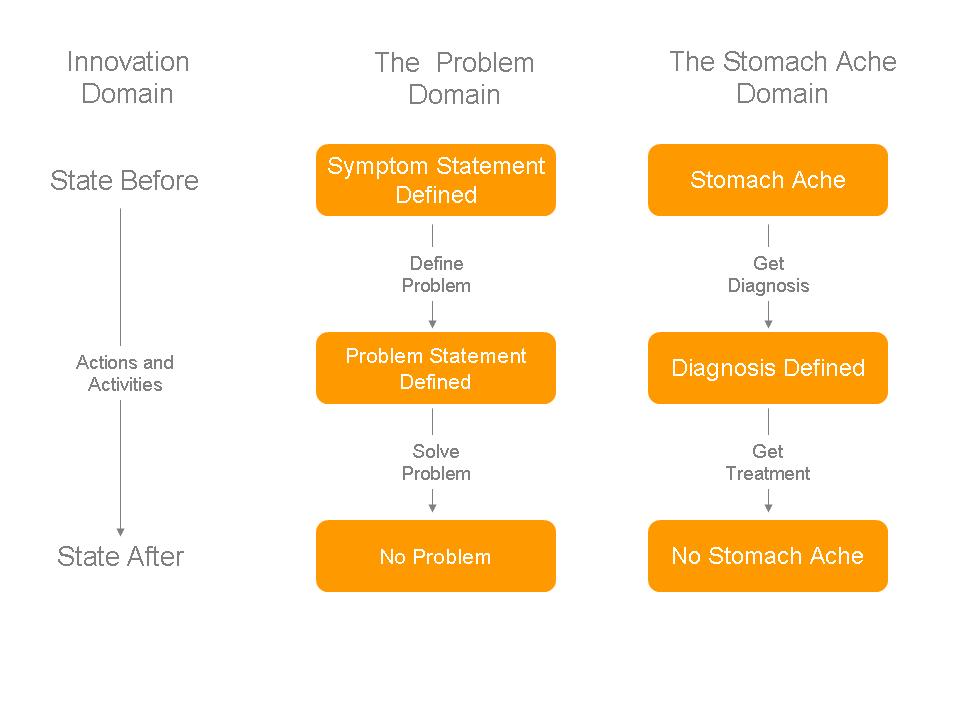
In the last post on innovation I left off with the notion of an operational definition as a way to assign meaning to the word innovation. I ended with a question — can you put your hand over your mouth and point to innovation? In other words, what can we observe to bring innovation into the range of our experience? Starting with the state of things before innovation – what does it look like? And what about the state of things after innovation – what does that look like? And what does it look like to transition between the states?
Starting simply, the state before innovation is defined by a symptom statement, an ill-defined, un-actionable statement of something undesirable. It has not yet risen to the level of an actionable problem statement, but clearly there is a realization of an undesirable situation. Here are several examples of symptom statements. Read the rest of this entry »
Innovation – words and actions
September 28th, 2009
I sat down to write my weekly post with the hope of coming up with something meaningful on innovation. Nothing came. I asked the all-powerful oracle named Google for some guidance, and my thinking diverged. I realized that there are too many definitions for the word innovation, too many contexts, too many facets. There is too much written about the word and too little written about the actions. I, too, am guilty of using the word for its multiple meanings and sex appeal. I put it in the title of this post to get some attention (I’ll let you know if Google Analytics reports more hits). Heck, I even use the word in the description of the blog.
When I started writing my dissertation, Chris Brown, my advisor, handed me a book and said something like, “You should learn how to write, so read this”. The book was Language In Thought and Action, by S.I. Hayakawa. I read it, finished my dissertation, and, most importantly, learned about words. Since my struggle with innovation was all about the word, I dusted off Hayakawa and asked him to help. Here is what the senator had to say.
To map meaning to a word it is best to point to the physical world (extensional meaning). Putting your hand over your mouth and pointing to a chair is a good way to assign meaning to the word chair. Closing your eyes and talking about a chair (intensional meaning) is not as good. So, to understand innovation it would be best to point your finger at it. But how?
Using an operational definition is a good way to point to the physical world. He quotes physicist P.W. Bridgeman who coined the term.
To find the length of an object, we have to perform certain physical operations. The concept of length is therefore fixed when the operations by which length is measured is fixed….. In general, we mean by any concept nothing more than a set of operations; the concept is synonymous with the corresponding set of operations.”
Hayakawa would ask, “Can you put your hand over your mouth and point to innovation?” Bridgeman would ask, “Can you define the set of operations for innovation? ”
This week my answer is “Not yet”.
 Mike Shipulski