Archive for the ‘The Future’ Category
WHY, WHAT, HOW to Improve Engineering
 September 7th, 2011
 When asked how to improve manufacturing, the recipe is clear: lean. When asked how to improve engineering, the recipe: there isn’t one. Each engineering improvement effort is unique; though there are common themes and building blocks, each has its own fingerprint.
Each company has its own strengths, weaknesses, opportunities and threats; each company has unique products and markets; each its own goals; each its own culture; each its own future state. Informed by uniqueness, the recipe is unique. To create your unique improvement recipe, I suggest WHY, WHAT, HOW.
WHY
Before your engineering improvement recipe can be formed, the fundamental shaping question must be answered. Take a breath, fire up your laptop, put on your headphones, and queue up your best music. Type this question:
WHY does our business demand we improve engineering?
Now, type the answer. (Literally.) Use nouns and verbs to explain why engineering must improve. If you can’t, stop. Without a clear, concise, jargon-free answer nothing can be done to advance the cause. (Though there can be plenty of activity, there can be no progress.) Without the WHY, you cannot pass GO. You must create a clear, concise WHY.
Seek out help from trustworthy people to create the WHY. Don’t move forward until you understand it well enough to explain it to the engineering organization. Now, with WHY in place, it’s time for WHAT.
WHAT
Informed by WHY, it’s time for WHAT. Secure a quiet spot, scare up a big piece of paper, and grab your favorite pen. On the top of the page, write this question:
WHAT does engineering improvement look like?
Now, draw the picture. (Literally.) Use sketches, scribbles, arrows, blocks, and people’s names to describe what improved engineering looks like. Sit in the future and describe it in present tense. Once drawn, review it with folks you trust, revise it, and repeat. If you cannot draw the future, keep trying. Once you have something, review it with folks you trust, revise it, and repeat. Don’t move forward until you draw it clearly enough to explain it to the engineering organization. And with WHAT in place, it’s time for HOW.
HOW
The first step of HOW is similar to WHAT. Pick up your favorite pen, come back to the now, and draw a picture of today’s engineering capabilities, engineering’s current state. Again, use scribbles, blocks, arrows, and names.
The second step is to define the difference between future and current states. With future and current state pictures side-by-side, perform a mathematical subtraction: future state – current state. The difference is HOW. A block in future state that’s not part of the current state is a new thing that must be created; a new arrow in the future state is an activity, interaction, or relationship that must be created; a new person, named or unnamed, represents new thinking. Things that appear in both states are strengths to build on.
The third step, prioritization. Start here:
What engineering strengths will we build on?
It’s important start with strengths. It sends the right message to the engineering organization: we must build on build on what works, build on what got us here. Engineers need to know that, fundamentally, their work is good, and major building blocks are in place, the foundation is solid.
What development areas will we improve?
Take care with this one. To avoid a demoralized engineering team, there should be fewer development areas than strengths. Though there may be many development areas, call out only the most important.
What’s the right first bite?
The most important improvements are those that strongly support the WHY; there’s a natural sequence of things (socks before shoes) that must be respected; and there’s a finite amount of work that can be done. Use these three lenses as the start of a prioritization framework.
Building blocks for engineering improvement are the same for all companies: people, tools, and processes, but there are many types of people, countless engineering tools, and all processes can be improved. WHY, WHAT, HOW can help define your unique improvement fingerprint: the right people, the right tools, the right processes, shaped by your unique company goals, and improved in right sequence.
Want to be green? Look to your product.
August 17th, 2011
 We’re starting to come to terms with the green revolution; we’re staring to realize that green is good for our planet and even better for our business. But how do we put greenwashing behind us and truly make a difference?
To improve recyling, find the non-recyclable stuff in your product and design it out. Make a Pareto chart of non-recyclable stuff (by weight) by major subassembly, and focus the design effort on the biggest brown bars of the Pareto. (Consider packaging a major subassembly and give it its own bar.)
To improve carbon footprint of logistics, find the weight and volume of your product and design out the biggest and heaviest. Make a Pareto chart of weight by major subassembly, and focus the design effort on the heaviest brown bars. Make a Pareto chart of volume by major subassembly, (Make cube around the subassembly and calculate volume in mm3.) and focus the design effort on the biggest bars. (Don’t forget the packaging.)
To improve energy efficiency of your factory, find electricity consumption and design it out. Make a Pareto chart of electricity consumption by major process step then map it to the product – to the element of the product that creates the need for electricity, and focus the design effort on the biggest bars.
Going forward, here are some thoughts to help grow your business with green (and save the planet):
- It’s easier to design out brown than to design in green.
- To design out brown, you’ve got to know where it is.
- The product creates brown – look to the product to eliminate it.
 Posted in Downstream Savings, Green, Manufacturing Competitiveness, New Normal, The Future |
  3 Comments »
The Voice of Technology
July 20th, 2011
 We’ve all done Voice of the Customer (VOC) work, where we jump on a plane, visit our largest customers, and ask leading questions. Under the guise of learning it’s mostly a mechanism to justify what we already want to do, to justify the products we know want to launch. (VOC should stand for Validate Our Choices.)
It’s a waste of time to ask customers for the next big thing or get their thoughts on a radical technology. First off, it’s not their job to know the next big thing, it’s ours. The next big thing is bigger than their imagination, never mind what they do today. (That’s why it’s called the next big thing.) And if we wait for customers tell us the next big thing, we’re hosed. (Their time horizon is too short and ours is shorter.) In this case it’s best to declare failure; our competitors figured it out a long time ago (they didn’t wait for the customer) and are weeks from commercialization. We should get busy on the next, next big thing because we’ve already missed this next generation. Next time we’ll silence the voice of the customer (VOC) and listen to the voice of the technology (VOT).
As far as radical technology, if we wait for customers to understand the technology, it’s not radical. Radical means radical, it means game-changing, a change so radical it obsoletes business models and creates unrecognizable, ultra-profitable, new ones. That’s radical. If we don’t start technical work until our customers understand the new technology, it’s no longer radical, and our competitors have already cornered the market. Again, we’ve missed an entire generation. Next time we’ll silence the voice of the customer (VOC) and listen to the voice of the technology (VOT).
Technology has a life force; it has a direction; it knows what it wants to be when it grows up. It has a voice. Independent of customer, it knows where it wants to go and how it will get there. At the highest level it has character traits and preferred paths, a kind of evolutionary inevitability; this is the voice of technology (VOT).
Technology will evolve to complete itself; it will move toward natural periodicity among its elements; it will harmonize itself; it will become more controllable; it will shorten its neural flow paths; it will do yoga to improve its flexibility; its feet will grow too fast and create adolescent imbalance; it will replicate into multiples selves; it will shrink itself; it will improve its own DNA. This is VOT.
Technology cannot tell us its lower-level embodiments (we control that), but it does sing hymns of its high-level wants and desires, and we must listen. No need to wait for VOC, it’s time to listen to VOT.
Like a dog whistle, technologists can hear VOT while others cannot. We understand the genetics of technology and we understand its desires (because we understand its physics.) We can look back to its ancestors, see its trajectory of natural evolution, and predict attributes of its offspring. Before everyone else, we see what will be.
Next time, instead of VOC, ask your technologists what the voice of technology is saying, and listen.
Posted in Imagination, Innovation, Technology, The Future, Top Line Growth |  Tags: Understanding Physics |
10 Comments »
Tags: Understanding Physics |
10 Comments »
Work that creates wealth
March 9th, 2011
 Today’s biggest problems are difficult to solve and our approach to solving them isn’t helping. Whether it’s healthcare, education, infrastructure, defense, or the economy we never get past the wrong question: “Who’s going to pay for it?
With healthcare we argue about costs and taxes – who pays and how much. But we’ve got to move past that argument. The real deal is we create insufficient wealth. (Our inability to pay for healthcare is a symptom.) So the real solution must focus on work that creates wealth, real wealth. I’m not talking about merger and acquisition wealth. I’m talking about real wealth generated by inventing, designing, and making products. I’m talking about manufacturing – creating products out of dirt, rocks, and sticks and selling them for more than the cost to make them. With more manufacturing we can fix healthcare. (I also think we should look deeply at the work of providing healthcare and improve the work.)
With education we argue about costs and taxes – who pays and how much. But we’ve got to move past that argument. The real deal is we create insufficient wealth. (Our inability to pay for education is a symptom.) So the real solution must focus on work that creates wealth, real wealth. I’m not talking about merger and acquisition wealth. I’m talking about real wealth generated by inventing, designing, and making products. I’m talking about manufacturing — creating products. With more manufacturing we can fix education. (I also think we should look deeply at the work of providing education and improve the work.)
With infrastructure we argue about costs and taxes – who pays and how much. But we’ve got to move past that argument. The real deal is we create insufficient wealth. (Our inability to pay for infrastructure is a symptom.) So the real solution must focus on work that creates wealth, real wealth. I’m talking about real wealth generated by inventing, designing, and making products. I’m talking about manufacturing — creating products. With more manufacturing we can fix our infrastructure. (I also think we should look deeply at the work of creating and maintaining infrastructure and improve it.)
With defense we argue about costs and taxes – who pays and how much. But we’ve got to move past that argument. The real deal is we create insufficient wealth. (Our inability to pay for defense is a symptom.) So the real solution must focus on work that creates wealth, real wealth. I’m talking about manufacturing — creating products. With more manufacturing we can fix defense. (I also think we should improve the work of providing defense.)
Pulling it all together, with the economy we argue about taxes – who pays and how much. But we’ve got to move past that argument. The real deal is we create insufficient wealth. (Our economy’s health is a symptom.) So the real solution must focus on work that creates real wealth. I’m talking about manufacturing. With more manufacturing the economy will fix itself.
Thankfully we all have different views on healthcare, education, infrastructure, and defense, and I want to preserve them. (That’s what makes our country great.) However, I think we can all agree that creating more wealth will improve our chances of fixing our big problems.
Let’s do more manufacturing.
I don’t know the question, but the answer is jobs.
December 22nd, 2010
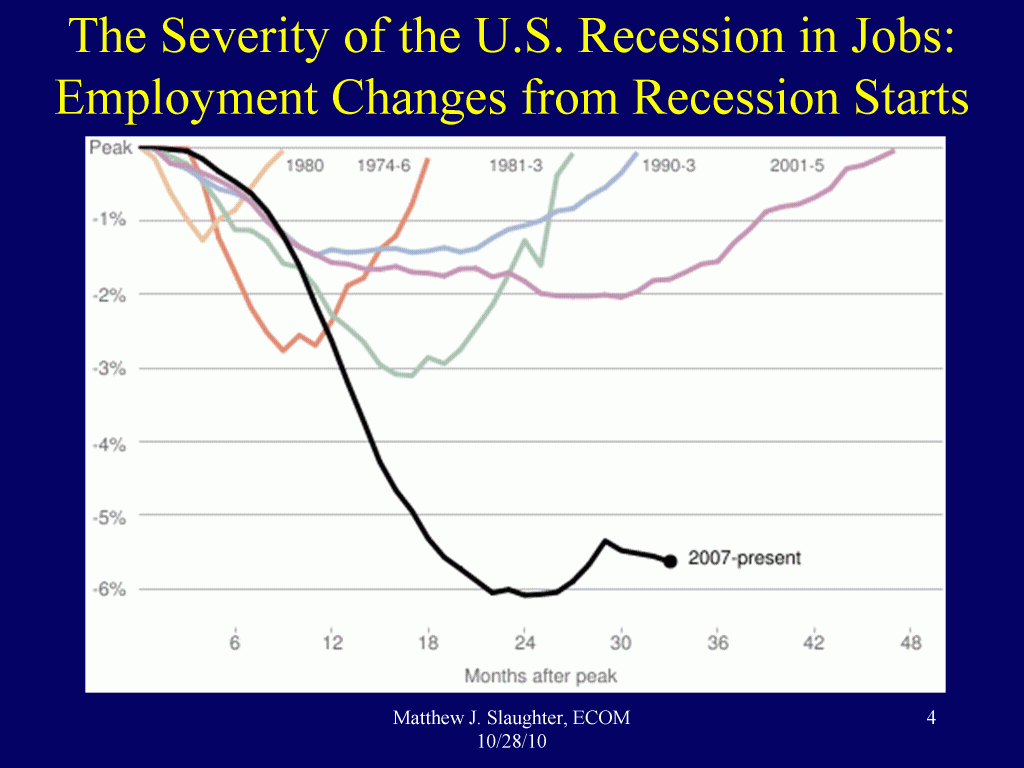 Some sobering facts: (figure and facts from Matt Slaughter)
- During the Great Recession, US job loss (peak to trough) was 8.4 million payroll jobs were lost (6.1%) and 8.5 million private-sector jobs (7.3%).
- In Sept. 2010 there were 108 million U.S. private-sector payroll jobs, about the same as in March 1999.
- It took 48 months to regain the lost 2.0% of jobs in the 2001 recession. At that rate, the U.S. would again reach 12/07 total payroll jobs around January 2020.
The US has a big problem. And I sure as hell hope we are willing do the hard work and make the hard sacrifices to turn things around.
To me it’s all about jobs. To create jobs, real jobs, the US has got to become a more affordable place to invent, design, and manufacture products. Certainly modified tax policies will help and so will trade agreements to make it easier for smaller companies to export products. But those will take too long. We need something now.
To start, we need affordability through productivity. But not the traditional making stuff productivity, we need inventing and designing productivity.
Here’s the recipe: Invent technology in-country, design and develop desirable products in-country (products that offer real value, products that do something different, products that folks want to buy), make the products in-country, and sell them outside the country. It’s that straightforward.
To me invention/innovation is all about solving technical problems. Solving them more productively creates much needed invention/innovation productivity. The result: more affordable invention/innovation.
To me design productivity is all about reducing product complexity through part count reduction. For the same engineering hours, there are few things to design, fewer things to analyze, fewer to transition to manufacturing. The result: more affordable design.
Though important, we can’t wait for new legislation and trade agreements. To make ourselves more affordable we need to increase productivity of our invention/innovation and design engines while we work on the longer term stuff.
If you’re an engineering leader who wants more about invention/innovation and or design productivity, send me an email at
and use the subject line to let me know which you’re interested in. (Your contact information will remain confidential and won’t be shared with anyone. Ever.)
Together we can turn around the country’s economy.
Define the future, walk the path.
December 8th, 2010
 If you want to shape what will be, define the future.
a
If you want to know how to get there, define the path.
a
If you want to know what’s in the way, define your fears.
a
If you want to overcome your fears, walk the path.
a
If it doesn’t work, repeat.
 Mike Shipulski