Archive for the ‘Innovation’ Category
It Can’t Be Innovation If…
 December 4th, 2013

Companies strive for predictability, yet if it’s predictable, it cannot be innovation.
We seek comfort in our work, but if it’s comfortable it can’t be innovation.
Businesses like to grow by selling more to the customers we have, but if existing customers can recognize it, it can’t be innovation.
We want to meet year end numbers, but if the project will generate profit in the year it begins, it can’t be innovation.
We love our standardized processes, but if it’s standard, it cannot be innovation.
If there’s consensus, it’s not innovation.
If the project isn’t wreaking havoc with your organizational norms, it can’t be innovation.
If the market already exists, it can’t be innovation.
If you’ve done it before, it can’t be innovation.
If you are following a best practice, it can’t be innovation.
If there’s a high probability it will work, it can’t be innovation.
If people aren’t threatened, it can’t be innovation.
 Posted in Fear, Fundementals, Innovation, Intellectual Intertia, Positivity |
  Tags: Trust-based approach |
  1 Comment »
Crossword Puzzle – Product, Technology, Innovation
November 26th, 2013
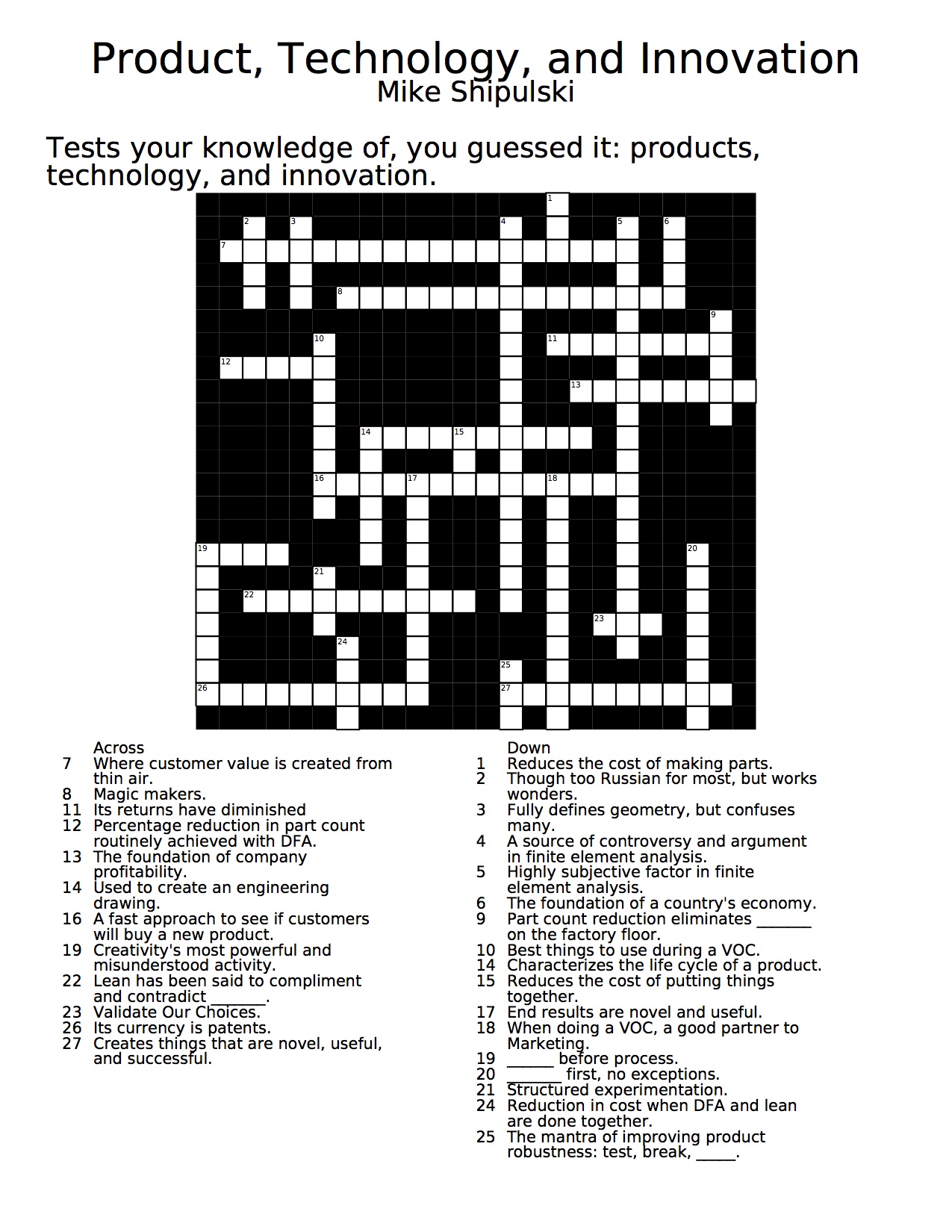
Here’s something a little different – a crossword puzzle to test your knowledge on products, technology, and innovation. Complete the puzzle using the image below, or download it (and answer key) using the green arrows below, and take your time with it over the Thanksgiving holiday.
[wpdm_file id=5]
[wpdm_file id=4]
Posted in Design Engineers, DFA, Innovation, Product Development, Product Robustness, Technology |
Tags: Crossword Puzzle |
No Comments »
Less Before More – Innovation’s Little Secret
November 20th, 2013
 The natural mindset of innovation is more-centric. More throughput; more performance; more features and functions; more services; more sales regions and markets; more applications; more of what worked last time. With innovation, we naturally gravitate toward more.
There are two flavors of more, one better than the other. The better brother is more that does something for the first time. For example, the addition of the first airbags to automobiles – clearly an addition (previous vehicles had none) and clearly a meaningful innovation. More people survived car crashes because of the new airbags. This something-from-nothing more is magic, innovative, and scarce.
Most more work is of a lesser class – the more-of-what-is class. Where the first airbags were amazing, moving from eight airbags to nine – not so much. When the first safety razors replaced straight razors, they virtually eliminated fatal and almost fatal injuries, which was a big deal; but when the third and fourth blades were added, it was more trivial than magical. It was more for more’s sake; it was more because we didn’t know what else to do.
While more is more natural, less is more powerful. The Innovator’s Dilemma clearly called out the power of less. When the long-in-the-tooth S-curve flattens, Christensen says to look down, to look down and create technologies that do less. Actually, he tells us someone will give ground on the very thing that built the venerable S-curve to make possible a done-for-the-first-time innovation. He goes on to say you might as well be the one to dismantle your S-curve before a somebody else beats you to it. Yes, a wonderful way to realize the juciest innovation is with a less-centric mindset.
The LED revolution was made possible with less-centric thinking. As the incandescent S-curve hit puberty, wattage climbed and more powerful lights became cost effective; and as it matured, output per unit cost increased. More on more. And looking down from the graying S-curve was the lowly LED, whose output was far, far less.
But what the LED gave up in output it gained in less power draw and smaller size. As it turned out, there was a need for light where there had been none – in highly mobile applications where less size and weight were prized. And in these new applications, there was just a wisp of available power, and incandesent’s power draw was too much. If only there was a technology with less power draw.
But at the start, volumes for LEDs were far less than incandesent’s; profit margin was less; and most importantly, their output was far less than any self-respecting lightbulb. From on high, LEDs weren’t real lights; they were toys that would never amount to anything.
You can break intellectual inertia around more, and good things will happen. New design space is created from thin air once you are forced from the familiar. But it takes force. Creative use of constraints can help.
Get a small team together and creatively construct constraints that outlaw the goodness that makes your product great. The incandescent group’s constraint could be: create a light source that must make far less light. The automotive group’s constraint: create a vehicle that must have less range – battery powered cars. The smartphone group: create a smartphone with the fewest functions – wrist phone without Blutooth to something in your pocket , longer battery life, phone in the ear, phone in your eyeglasses.
Less is unnatural, and less is scary. The fear is your customers will get less and they won’t like it. But don’t be afraid because you’re going to sell to altogether different customers in altogether markets and applications. And fear not, because to those new customers you’ll sell more, not less. You’ll sell them something that’s the first of its kind, something that does more of what hasn’t been done before. It may do only a little bit of that something, but that’s far more than not being able to do it all.
Don’t tell anyone, but the next level of more will come from less.
Posted in Assumptions, Culture, Fear, Imagination, Innovation, Magic, Manufacturing Competitiveness, Technology, The Future |
Tags: less-with-far-less |
3 Comments »
Choose Yourself
November 6th, 2013
 We’ve been conditioned to ask for direction; to ask for a plan; and ask for permission. But those ways no longer apply. Today that old behavior puts you at the front of the peloton in the great race to the bottom.
The old ways are gone.
Today’s new ways: propose a direction (better yet, test one out on a small scale); create and present a radical plan of your own (or better, on the smallest of scales test the novel aspects and present your learning); and demonstrate you deserve permission by initiating activity on something that will obsolete the very thing responsible for your success.
People that wait for someone to give them direction are now a commodity, and with commodities it always ends in the death spiral of low cost providers putting each other out of business. As businesses are waist deep in proposals to double-down on what hasn’t worked and are choking on their flattened S-curves, there’s a huge opportunity for people that have the courage to try new things on their own. Today, if you initiate you’ll differentiate.
[This is where you say to yourself – I’ve already got too much on my plate, and I don’t have the time or budget to do more (and unsanctioned) work. And this is where I tell you your old job is already gone, and you might as well try something innovative. It’s time to grab the defibrillator and jolt your company out of its flatline. ]
It’s time to respect your gut and run a low cost, micro-experiment to test your laughable idea. (And because you’ll keep the cost low, no one will know when it doesn’t go as you thought. [They never do.]) It’s time for an underground meeting with your trusted band of dissidents to plan and run your pico-experiment that could turn your industry upside down. It’s time to channel your inner kindergartener and micro-test the impossible.
It’s time to choose yourself.
Posted in Decisions, Fear, Imagination, Innovation, Level 5 Courage, Manufacturing Competitiveness, Risk, Seeing Things As They Are, The Future |
Tags: Creativity, Trust-based approach |
No Comments »
Moving From Kryptonite To Spinach
September 18th, 2013
 With websites, e-books, old fashioned books, Twitter, LinkedIn, Facebook, and blogs, there’s a seemingly limitless flood of information on every facet of business. There are heaps on innovation, new product development, lean, sales and marketing, manufacturing, and strategy; and within each there are elements and sub elements that fan out with multiple approaches.
With today’s search engines and bots to automatically scan the horizon, it’s pretty easy to find what you’re looking for especially as you go narrow and deep. If you want to find best practices for reducing time-to-market for products designed in the US and manufactured in China, ask Google and she’ll tell you instantly. If you’re looking to improve marketing of healthcare products for the 20 to 40 year old demographic of the developing world, just ask Siri.
It’s now easy to separate the good stuff from the chaff and focus narrowly on your agenda. It’s like you have the capability dig into a box of a thousand puzzle pieces and pull out the very one you’re looking for. Finding the right puzzle piece is no longer the problem, the problem now is figuring out how they all fit together.
What holds the pieces together? What’s the common thread that winds through innovation, sales, marketing, and manufacturing? What is the backplane behind all this business stuff?
The backplane, and first fundamental, is product.
Every group has their unique work, and it’s all important – and product cuts across all of it. You innovate on product; sell product; manufacture product; service product. The shared context is the product. And I think there’s opportunity to use the shared context, this product lens, to open up design space of all our disciplines. For example how can the product change to make possible new and better marketing? How can the product change to radically simplify manufacturing? How can the product change so sales can tell the story they always wanted to tell? What innovation work must be done to create the product we all want?
In-discipline improvements have been good, but it’s time to take a step back and figure out how to create disruptive in-discipline innovations; to eliminate big discontinuities that cut across disciplines; and to establish multidisciplinary linkages and alignment to power the next evolution of our businesses. New design space is needed, and the product backplane can help.
Use the product lens to look along the backplane and see how changes in the product can bridge discontinuities across sales, marketing, and engineering. Use the common context of product to link revolutionary factory simplification to changes in the product. Use new sensors in the product to enable a new business model based on predictive maintenance. Let your imagination guide you.
It’s time to see the product for more than what it does and what it looks like. It’s time to see it as Superman’s kryptonite that constrains and limits all we do that can become Popeye’s spinach that can strengthen us to overpower all obstacles.
Moving at the Speed of People
September 4th, 2013
 More-with-less is our mantra for innovation. But these three simple words are dangerous because they push us almost exclusively toward efficiency. On the surface, efficiency innovations sound good, and they can be, but more often than not efficiency innovations are about less and fewer. When you create a new technology that does more and costs less the cost reduction comes from fewer hours by fewer people. And if the cash created by the efficiency finances more efficiency, there are fewer jobs. When you create an innovative process that enables a move from machining to forming, hard tooling and molding machines reduce cost by reducing labor hours. And if the profits fund more efficiency, there are fewer jobs. When you create an innovative new material that does things better and costs less, the reduced costs come from fewer labor hours to process the material. And if more efficiency is funded, there are less people with jobs. (The cost reduction could also come from lower cost natural resources, but their costs are low partly because digging them up is done with fewer labor hours, or more efficiently.)
But more-with-less and the resulting efficiency improvements are helpful when their profits are used to fund disruptive innovation. With disruptive innovation the keywords are still less and fewer, but instead of less cost, the product’s output is less; and instead of fewer labor hours, the product does fewer things and satisfies fewer people.
It takes courage to run innovation projects that create products that do less, but that’s what has to happen. When disruptive technologies are young they don’t perform as well as established technologies, but they come with hidden benefits that ultimatley spawn new markets, and that’s what makes them special. But in order to see these translucent benefits you must have confidence in yourself, openness, and a deep personal desire to make a difference. But that’s not enough because disruptive innovations threaten the very thing that made you successful – the products you sell today and the people that made it happen. And that gets to the fundamental difference between efficiency innovations and disruptive innovations.
Efficiency innovations are about doing the familiar in a better way – same basic stuff, similar product functionality, and sold the same way to the same people. Disruptive innovations are about doing less than before, doing it with a less favorable cost signature, and doing it for different (and far fewer) people. Where efficiency innovation is familiar, disruptive innovation is contradictory. And this difference sets the the pace of the two innovations. Where efficiency innovation is governed by the speed of the technology, disruptive innovation is governed by the speed of people.
With efficiency innovations, when the technology is ready it jumps into the product and the product jumps into the market. With disruptive innovations, when the technology is ready it goes nowhere because people don’t think it’s ready – it doesn’t do enough. With efficiency innovations, the new technology serves existing customers so it launches; with disruptive, technology readiness is insufficient because people see no existing market and no existing customers so they make it languish in the corner. With efficiency, it launches when ready because margins are better than before; with disruptive, it’s blocked because people don’t see how the new technology will ultimately mature to overtake and replace the tired mainstream products (or maybe because they do.)
Done poorly efficiency innovation is a race to the bottom; done well it funds disruptive innovation and the race to the top. When coordinated the two play together nicely, but they are altogether different. One is about doing the familiar in a more efficient way, and the other is about disrupting and displacing the very thing (and people) that made you successful.
Most importantly, efficiency innovation moves at the speed of technology while disruptive innovation moves at the speed of people.
Posted in Fear, Innovation, Intellectual Intertia, New Thinking, Technology, Top Line Growth |
Tags: less-with-far-less, Manufacturing Competitveness |
1 Comment »
Define To Solve
August 21st, 2013
 Countries want their companies to create wealth and jobs, and to do it they want them to design products, make those products within their borders, and sell the products for more than the cost to make them. It’s a simple and sustainable recipe which makes for a highly competitive landscape, and it’s this competition that fuels innovation.
When companies do innovation they convert ideas into products which they make (jobs) and sell (wealth). But for innovation, not any old idea will do; innovation is about ideas that create novel and useful functionality. And standing squarely between ideas and commercialization are tough problems that must be solved. Solve them and products do new things (or do them better), become smaller, lighter, or faster, and people buy them (wealth).
But here’s the part to remember – problems are the precursor to innovation.
Before there can be an innovation you must have a problem. Before you develop new materials, you must have problems with your existing ones; before your new products do things better, you must have a problem with today’s; before your products are miniaturized, your existing ones must be too big. But problems aren’t acknowledged for their high station.
There are problems with problems – there’s an atmosphere of negativity around them, and you don’t like to admit you have them. And there’s power in problems – implicit in them are the need for change and consequence for inaction. But problems can be more powerful if you link them tightly and explicitly to innovation. If you do, problem solving becomes a far more popular sport, which, in turn, improves your problem solving ability.
But the best thing you can do to improve your problem solving is to spend more time doing problem definition. But for innovation not any old problem definition will. Innovation requires level 5 problem definition where you take the time to define problems narrowly and deeply, to define them between just two things, to define when and where problems occur, to define them with sketches and cartoons to eliminate words, and to dig for physical mechanisms.
With the deep dive of level 5 you avoid digging in the wrong dirt and solving the wrong problem because it pinpoints the problem in space and time and explicitly calls out its mechanism. Level 5 problem definition doesn’t define the problem, it defines the solution.
It’s not glamorous, it’s not popular, and it’s difficult, but this deep, mechanism-based problem definition, where the problem is confined tightly in space and time, is the most important thing you can do to improve innovation.
With level 5 problem definition you can transform your company’s profitability and your country’s economy. It does not get any more relevant than that.
Posted in Fear, Fundementals, Innovation, Problems, Product Development, Robust Economy, Seeing Things As They Are |
Tags: Problem Definition, Understanding Physics |
2 Comments »
Own Your Happiness
July 17th, 2013
 Own your ideas, not the drama.
Own your words, not the gossip.
Own your vision, not the dogma.
Own your effort, not the heckling.
Own your vacation, not the email.
Own your behavior, not the strife.
Own your talent, not the cynicism.
Own your deeds, not the rhetoric.
Own your caring, not the criticism.
Own your sincerity, not the hot air.
Own your actions, not the response.
Own your insights, not the rejection.
Own your originality, not the critique.
Own your passion, not the nay saying.
Own your loneliness, not the back story.
Own your health, not the irrational workload.
Own your thinking, not the misunderstanding.
Own your stress level, not the arbitrary due date.
Own your happiness.
Acceleration Is King
May 22nd, 2013
 Everything is about speed – speed through process reengineering, waste elimination, standardization, modularity, design reuse. All valid, but not all that powerful. Real speed comes from avoiding rapid progress in the wrong direction, from avoiding a blistering pace on the wrong stuff. Real speed comes from saying no to the work that creates drag in order to say yes to work that accelerates.
It’s healthy to have time limits and due dates, finite resources, and budgets. These constraints are helpful because they force a cutoff decision: what work will get done and what won’t. And thankfully, all businesses have them – take them away and eliminate all hope of profitability and sustainability. But from a speed perspective, sometime we look at them in a backward way.
Yes, that work would change the game, but we don’t have time. That argument is a little misleading. Truth is, there’s the same amount of time as last year – a week is still a week, and there are still 52 of them in a year. It’s not about time; it’s about the work done during that time. With a backwards view, the constraint calls attention to work won’t get done, but the constraint is really about work that will get done. If the work that doesn’t make the cut is less magical than the work that does, the constraint creates a speed problem – too slow on the game-changing work. The speed problem is realized when the new kid on the block makes magic and you don’t. If the constraint helps say yes to magic and no to lesser work, there’s no speed problem.
Yes, we could reinvent the industry, but we don’t have resources. No, we have resources. But the constraint isn’t really about resources, it’s about the work. And not any old work, the constraint is about the work that will get done. (Not the work that won’t.) If the constraint causes us to stuff our fingers in the holes in the dyke at the expense of eliminating it altogether, the constraint caused a speed problem. It’s a problem because while we’re plugging holes, an eager competitor will dismantle the need for the dyke. Speed problem.
Sure, we’d leapfrog the competition, but we don’t have the budget. No, we have a budget. But, like the other constraints, the budgetary one is also about the work that will get done. If the constraint prioritizes same-as-last-time over crazy, it creates a speed problem. New competitors who don’t have to protect the old guard products will work on crazy and bring it to market. And that’s a problem because you’ll have more of what you’ve always had and they’ll have crazy.
Yes, in all cases, choose the bigger bet. Choose crazy over sane, magical over mundane, and irregular over regular. And choose that way because it’s faster. And here’s why faster is king: The number of countries with a well educated work force is growing; there’s an ever increasing number of micro companies who can afford to bet on disruptive technologies; and the internet has shown the world how their lives could be and created several billion people who will use their parental fortitude to do whatever it takes to make life better for their kids. (And there’s no stronger force on earth.) And it all sums to an incredible amount of emotional energy relentlessly pushing the pace.
The world isn’t just getting faster, it’s accelerating – yes, next month will be faster than this month, but that’s not the real trick with acceleration. With acceleration the faster things get, the faster they get faster. Is there really any question how to use your constraints?
Posted in Innovation, Intellectual Intertia, Level 5 Courage, The Future |
Tags: Competitiveness, Creativity |
2 Comments »
The Flux Lines of Innovation
May 8th, 2013
 There are countless books, tools, processes, methodologies and frameworks for innovation.
And cutting across all theory and practice, the biggest fundamental of innovation is fear.
We define fear as bad because it limits new thinking and new actions, but there’s another way to look at it. We should look at fear as a leading indicator of innovation potential.
When inputs, outputs, or contexts are different than expectations, our bodies create physical symptoms we recognize as fear. It’s this chemical change in the body, manifested as cold sweats, tingling hands, difficulty in breathing, or knotted stomachs, that’s the tell-tale sign innovation is in the house.
If things are predictable, knowable, understandable, there is no fear. And if things are predictable, knowable, understandable there is no innovation. By the associative theorem: no fear, no innovation.
We should learn to use our bodies as innovation barometers. When pressure builds, especially when we don’t know why, we should recognize our fear, not as a blocker of innovation, but as a leading indicator of it.
Innovation, especially the type that reinvents, is not an in-the-head thing, it’s an in-the-chest thing. It’s indescribable, un-scriptable, and almost spiritual. Just as migratory birds sense weak magnetic fields to guide themselves home, we can use our bodies to sense fear and guide ourselves along the flux lines of innovation.
Fear is scary and can be uncomfortable. But for innovation, it’s scarier if there’s no fear.
What They Didn’t Teach Me in Engineering School
April 24th, 2013
 The technical stuff is the easy part. Technical systems respond predictably, but people don’t.
There’s nothing worse than solving the wrong problem, so before you start solving you’ve better done a whole lot of defining.
There is no exact answer; engineering is all about judgment.
Organizational structure is important. Whatever the structure, see its strengths and make them work for you. If you try to fight it, it will eat you.
Innovation isn’t about ideas, innovation is about commercializing ideas.
Engineering analysis can win minds, but not hearts. And hearts govern minds.
The engineer’s role is not to minimize risk; it’s to understand the commercial reward and take risk accordingly.
What people believe is far more powerful than what they think.
New technology threatens status quoers, and, in turn, they block it.
There is no problem unless someone important thinks there’s one.
All technical systems are really human systems masquerading as technical systems.
If you let it, fear dominates. Be afraid and do it anyway. But along the way, keep in mind that others are too afraid to try.
Engineering is not sane and rational; engineering is about people.
Posted in Culture, Design Engineers, Engineering Leaders, Fear, Innovation, New Thinking, Problems, Technology |
Tags: Engineering Mindset |
3 Comments »
 Mike Shipulski