Archive for the ‘Culture’ Category
A Unifying Theory for Manufacturing?
 January 5th, 2011
 The notion of a unifying theory is tantalizing – one idea that cuts across everything. Though there isn’t one in manufacturing, I think there’s something close: Design simplification through part count reduction. It cuts across everything – across-the-board simplification. It makes everything better. Take a look how even HR is simplified.
HR takes care of the people side of the business and fewer parts means fewer people – fewer manufacturing people to make the product, fewer people to maintain smaller factories, fewer people to maintain fewer machine tools, fewer resources to move fewer parts, fewer folks to develop and manage fewer suppliers, fewer quality professionals to check the fewer parts and create fewer quality plans, fewer people to create manufacturing documentation, fewer coordinators to process fewer engineering changes, fewer RMA technicians to handle fewer returned parts, fewer field service technicians to service more reliable products, fewer design engineers to design fewer parts, few reliability engineers to test fewer parts, fewer accountants to account for fewer line items, fewer managers to manage fewer people.
Before I catch hell for the fewer-people-across-the-board language, product simplification is not about reducing people. (Fewer, fewer, fewer was just a good way to make a point.) In fact, design simplification is a growth strategy – more output with the people you have, which creates a lower cost structure, more profits, and new hires.
A unifying theory? Really? Product simplification?
Your products fundamentally shape your organization. Don’t believe me? Take a look at your businesses – you’ll see your product families in your org structure. Take look at your teams – you’ll see your BOM structure in your org structure. Simplify your product to simplify your company across-the-board. Strange, but true. Give it a try. I dare you.
WHY, WHAT, HOW, and new thinking for the engineering community.
December 29th, 2010
 Sometimes we engineers know the answer before the question, sometimes we know the question’s wrong before it’s asked, and sometimes we’re just plain pig-headed. And if we band together, there’s no hope of changing how things are done. None. So, how to bring new thinking to the engineering community? In three words: WHAT, WHY, HOW.
WHY – Don’t start with WHAT. If you do, we’ll shut down. You don’t know the answer, we do. And you should let us tell you. Start with WHY. Give us the context, give us the problem, give us the business fundamentals, give us the WHY. Let us ask questions. Let us probe. Let us understand it from all our angles. Don’t bother moving on. You can’t. We need to kick the tires to make sure we understand WHY. (It does not matter if you understand WHY. We need understand it for ourselves, in our framework, so we can come up with a solution.)
WHAT – For God’s sake don’t ask HOW – it’s too soon. If you do, we’ll shut down. You don’t know the answer, we do. And, if you know what’s good for you, you should let us tell you. It’s WHAT time. Share your WHAT, give us your rationale, explain how your WHAT follows logically from your WHY, then let us ask questions. We’ll probe like hell and deconstruct your WHY-WHAT mapping and come up with our own, one that makes sense to us, one that fits our framework. (Don’t worry, off-line we’ll test the validity of our framework, though we won’t tell you we’re doing it.) We’ll tell you when our WHY-WHAT map holds water.
HOW – Don’t ask us WHEN! Why are you in such a hurry to do it wrong?! And for sanity’s sake, don’t share your HOW. You’re out of your element. You’ve got no right. Your HOW is not welcome here. HOW is our domain – exclusively. ASK US HOW. Listen. Ask us to explain our WHAT-HOW mapping. Let us come up with nothing (that’s best). Let us struggle. Probe on our map, push on it, come up with your own, one that fits your framework. Then, and only then, share how your HOW fits (or doesn’t) with ours. Let us compare our mapping with yours. Let us probe, let us question, let us contrast. (You’ve already succeeded because we no longer see ours versus yours, we simply see multiple HOWs for consideration.) We’ll come up with new HOWs, hybrid HOWs, all sorts of HOWs and give you the strengths and weaknesses of each. And if your HOW is best we’ll recommend it, though we won’t see it as yours because, thankfully, it has become ours. And we’ll move heaven and earth to make it happen. Engineering has new thinking.
Whether it’s my favorite new thinking (product simplification) or any other, the WHY, WHAT, HOW process works. It works because it’s respectful of our logic, of our nature. It fits us.
Though not as powerful a real Vulcan mind meld, WHY, WHAT, HOW is strong enough to carry the day.
 Posted in Authentic, Culture, Design Engineers, Engineering Leaders, Problems, Top Line Growth |
  2 Comments »
DoD’s Affordability Eyeball
November 24th, 2010
 The DoD wants to do the right thing. Secretary Gates wants to save $20B per year over the next five years and he’s tasked Dr. Ash Carter to get it done. In Carter’s September 14th memo titled: “Better Buying Power: Guidance for Obtaining Greater Efficiency and Productivity in Defense Spending” he writes strongly:
…we have a continuing responsibility to procure the critical goods and services our forces need in the years ahead, but we will not have ever-increasing budgets to pay for them.
And, we must
DO MORE WITHOUT MORE.
I like it.
Of the DoD’s $700B yearly spend, $200B is spent on weapons, electronics, fuel, facilities, etc. and $200B on services. Carter lays out themes to reduce both flavors. On services, he plainly states that the DoD must put in place systems and processes. They’re largely missing. On weapons, electronics, etc., he lays out some good themes: rationalization of the portfolio, economical product rates, shorter program timelines, adjusted progress payments, and promotion of competition. I like those. However, his Affordability Mandate misses the mark.
Though his Affordability Mandate is the right idea, it’s steeped in the wrong mindset, steeped in emotional constraints that will limit success. Take a look at his language. He will require an affordability target at program start (Milestone A)
to be treated like a Key Performance Parameter (KPP) such as speed or power – a design parameter not to be sacrificed or comprised without my specific authority.
Implicit in his language is an assumption that performance will decrease with decreasing cost. More than that, he expects to approve cost reductions that actually sacrifice performance. (Only he can approve those.) Sadly, he’s been conditioned to believe it’s impossible to increase performance while decreasing cost. And because he does not believe it, he won’t ask for it, nor get it. I’m sure he’d be pissed if he knew the real deal.
The reality: The stuff he buys is radically over-designed, radically over-complex, and radically cost-bloated. Even without fancy engineering, significant cost reductions are possible. Figure out where the cost is and design it out. And the lower cost, lower complexity designs will work better (fewer things to break and fewer things to hose up in manufacturing). Couple that with strong engineering and improved analytical tools and cost reductions of 50% are likely. (Oh yes, and a nice side benefit of improved performance). That’s right, 50% cost reduction.
Look again at his language. At Milestone B, when a system’s detailed design is begun,
I will require a presentation of a systems engineering tradeoff analysis showing how cost varies as the major design parameters and time to complete are varied. This analysis would allow decisions to be made about how the system could be made less expensive without the loss of important capability.
Even after Milestone A’s batch of sacrificed of capability, at Milestone B he still expects to trade off more capability (albeit the lesser important kind) for cost reduction. Wrong mindset. At Milestone B, when engineers better understand their designs, he should expect another step function increase in performance and another step function decrease of cost. But, since he’s been conditioned to believe otherwise, he won’t ask for it. He’ll be pissed when he realizes what he’s leaving on the table.
For generations, DoD has asked contractors to improve performance without the least consideration of cost. Guess what they got? Exactly what they asked for – ultra-high performance with ultra-ultra-high cost. It’s a target rich environment. And, sadly, DoD has conditioned itself to believe increased performance must come with increased cost.
Carter is a sharp guy. No doubt. Anyone smart enough to reduce nuclear weapons has my admiration. (Thanks, Ash, for that work.) And if he’s smart enough to figure out the missile thing, he’s smart enough to figure out his contractors can increase performance and radically reduces costs at the same time. Just a matter of time.
There are two ways it could go: He could tell contractors how to do it or they could show him how it’s done. I know which one will feel better, but which will be better for business?
Posted in Assumptions, Culture, Fundementals, Intellectual Intertia, Positivity, Product Development |  Tags: Engineering Mindset, Product Design |
4 Comments »
Tags: Engineering Mindset, Product Design |
4 Comments »
A Call To Arms for Engineers
November 17th, 2010
 Engineers make magic. We are the only ones who create things from nothing: cars, televisions, bridges, buildings, machine tools, molecules, software… (You get the idea.) Politicians can’t do it, lawyers can’t do it, MBAs can’t do it. Only engineers.
And the stuff we create is the foundation of sustainable economies. We create things, our companies sell them for a profit, and that profit creates wealth and fuels our economies – a tight causal chain. Said another way: no engineers, no products, no profits, no wealth, no economy. The end.
Engineers used to be valued for our magic. In medieval times we were given high status for our art, for making stuff that mattered: swords, trebuchets, armor, castles… (You get the idea.) And the best of us were given a special title (wizard) and special consideration (if not reverence) for our work. These folks were given a wide berth, and for good reason. Piss them off and they’d turn someone into a toad, or worse yet, stop making the stuff that mattered.
In the industrial revolution we were valued for our magic, for making stuff that mattered. This time it was the machines that made machines and weapons: water powered factories, gun drills, lathes, grinding machines, honing machines… (You get the idea.) Politicians used our magic to advance their causes and industrialists got rich on our magic, and our status was diminished.
Since then we’ve made more magic than ever: cars, televisions, bridges, buildings, machine tools, molecules, software… (You get the idea.) We still make magic yet have little influence over our how our companies do things. How did we let this happen? We forgot that we make magic.
We forgot our magic is valuable and powerful (and scary). We forgot that without our magic the wheels fall off. No magic, no profit, no economy.
Engineers – A call to arms! It’s time recognize our magic is still as powerful as Merlin’s and it’s time to behave that way again. Watch out politicians, lawyers, and MBAs or we’ll turn you into toads.
Don’t change the culture, change your behavior
October 13th, 2010
 Change the culture. Easy to say, tough to do. What does it mean, anyway?
Culture is a result of something – behavior. I’ll go further – culture is behavior, behavior themes, but behavior still. Behavior is a result of behavior.
Want to change someone’s behavior? Wrong question. You can’t. You can change yours, they can change theirs. Those are the rules.
Want someone to change their behavior? Change yours to help them change theirs. Want to seal the deal? Explain why. Why cuts deeper than behavior.
Don’t change the culture, change your behavior.
Inspiring Work
October 6th, 2010
 Inspiring work is art.
Inspiring work is rare.
Inspiring work is scary.
Inspiring work is thrilling.
Inspiring work is the reward.
Inspiring work is life changing.
Inspiring work is easy to recognize.
Inspiring work is difficult to recognize.
Inspiring work is an acknowledgment of self.
Inspiring work’s magnitude is proportional to the fear.
Fight Dilution
September 16th, 2010
 What’s worse than getting only one thing done today? Getting none done.
The problem? Our New Normal. Too many things. Dilution.
The answer? Stop starting and start finishing.
Top 10 signs your labor costs are too low
September 8th, 2010
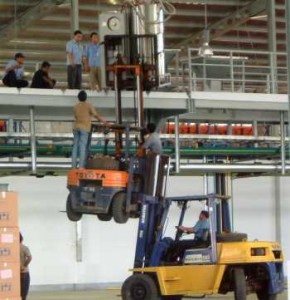 Your purchasing manager was just fired due to skyrocketing shipping costs now that you build product in a country with low cost labor.
You must hold a national press conference to explain how lead paint was put on your product by your supplier in a country with low cost labor.
You get up at 3:00 a.m. (for the fourth night in a row) to talk about a quality problem with a factory in a country with low cost labor.
You must cancel your lean projects because all your black belts are still solving quality problems in a country with low cost labor.
Though you have many half empty factories in your home country, you have a plan to build a new one in country with low cost labor.
Your best manufacturing leader just quit (via text message) because she wants to live with her family and not in a country with low cost labor.
Your purchasing manager’s brand new replacement was just fired because inventory carrying costs are through the roof now that you build product in a country with low cost labor.
You must find a landfill to bury three months of bad product now on a slow boat from a country with low cost labor.
Your new product launch is delayed because you have to tear down the machines and move them to a country with low cost labor.
The financial types that run your company are too far removed from the work so their only trick is to move it to a country with low cost labor.
Posted in Cost Savings, Culture, Manufacturing Competitiveness |
Tags: Fix Manufacturing |
8 Comments »
Be Purple
September 1st, 2010
 Focus, focus, focus. Measure, measure, measure. We draw organizational boxes, control volumes, and measure ins and outs. Cost, quality, delivery.
Control volumes? Open a Ziploc bag and pour water in it. The bag is the control volume and the water is the organizational ooze. Feel free to swim around in the bag, but don’t slip through it because you’ll cross an interface. You’ll get counted.
Organizational control volumes are important. They define our teams and how we optimize (within the control volumes). We optimize locally. But there’s more than one bag in our organizations.
The red team designs new products. They wear red shirts, red pants, and red hats. They do red things. We measure them on product function. The blue team makes products. They wear blue and do blue things. We measure them on product cost. Both are highly optimized within their bags, yet the system is suboptimal. Nothing crosses the interface – no information, no knowledge, no nothing. All we have is red and blue. What we need is purple.
We need people with enough courage to look up one level, put on a blue shirt and red pants, and optimize at the system level. We need people with enough credibility to swap their red hat for blue and pass information across the interface. We need trusted people to put on a purple jumpsuit and take responsibility for the interface.
Purple behavior cuts across the fabric of our metrics and control volumes, which makes it difficult and lonely. But, thankfully some are willing to be purple. And why do they do it? Because they know customers see only one color – purple.
What if manufacturing mattered?
August 18th, 2010
 What if it was cool to make stuff? What if we advertised manufacturing’s coolness like we advertise beer and cigarettes? Who would be the celebrity spokesman?
What if we took as much pride in university manufacturing programs as with their football programs? What if great manufacturing programs were as profitable as great football programs? What if fans jammed college stadiums every Saturday to cheer manufacturing competitions? What if they were televised like football games? Who would host the pre-game show?
What if manufacturing was valued like professional sports? The World Series of Manufacturing, The Super Bowl of Manufacturing, The World Cup of Manufacturing? Who would do color commentary?
What if manufacturing thought leaders were celebrated like sports legends? What would kids want to be when they grew up? Whose face would be on the cereal boxes?
What if government understood the importance of manufacturing? Who would lead the charge?
Flags Without Sting
August 11th, 2010
 We live in the country. Trees and wildlife all around. Can’t see our neighbors. A great place to be if you like the outdoors. We have two dogs – Abe and Lola.
The dilemma: How to let the dogs run around outside but prevent them from running off into the wilderness? The technological solution: an electric dog fence, an underground wire around the perimeter, a receiver hung on the dogs’ collars, and little white flags to designate the safe zone. The rules are straightforward and clear: 1. Stay within the perimeter and it’s happy happy: strut around, bark at smells and sounds, and guard the perimeter against the invading UPS truck. 2. Go outside the perimeter and all hell breaks loose: a nasty jolt from the collar, tail between the legs, and general disorientation. All is well.
But it’s not purely a technological system. There are dogs involved – thinking beings. They must understand the rules, they need training, and they must live within the system day-to-day. No matter what the situation, even if not covered in the training, they must stay within the perimeter or pay the price.
The people world has a similar dilemma: How to give the right amount of freedom and set the right limits. Boundaries are established, though not as formally or as simply as the flags; we live within the perimeter day-to-day or face consequences, though shock collars should not be used; and the thinking beings are more important than technology.
And, there is no right way to place the white flags – perimeters can be too big or too small; there is no right consequence level – the jolt can be too severe or too muted; and there is no perfect training – too much or too little. However, there must always be respect for the thinking beings.
One day I was in the yard with Abe and his new, high powered collar intended to stop his socializing, when a deer crossed the driveway about 50 meters outside the perimeter. Without hesitation, without consideration of consequence, he broke ranks and exploded though the perimeter – right through without a yelp, flinch, or twitch. He was in the moment, he did what he was made to do, he lived up to his genetics, he was all dog, he was himself. It was beautiful to watch him tear down the driveway.
As I watched the chase I thought about the power of his singular focus blasting him through without even a yelp. Then the realization – I never fixed the break in the wire – the fence was off. Flags without sting, though Abe did not know it.
The sting would not have prevented the chase, but would it have prevented the next one? I hope not. Perimeters can be too tight and consequences too severe, preventing us from being in the moment, doing what we’re made to do, living up to our genetics, and depriving us from experiencing our full selves.
Maybe I won’t fix the fence – flags without sting seems about right.
 Mike Shipulski